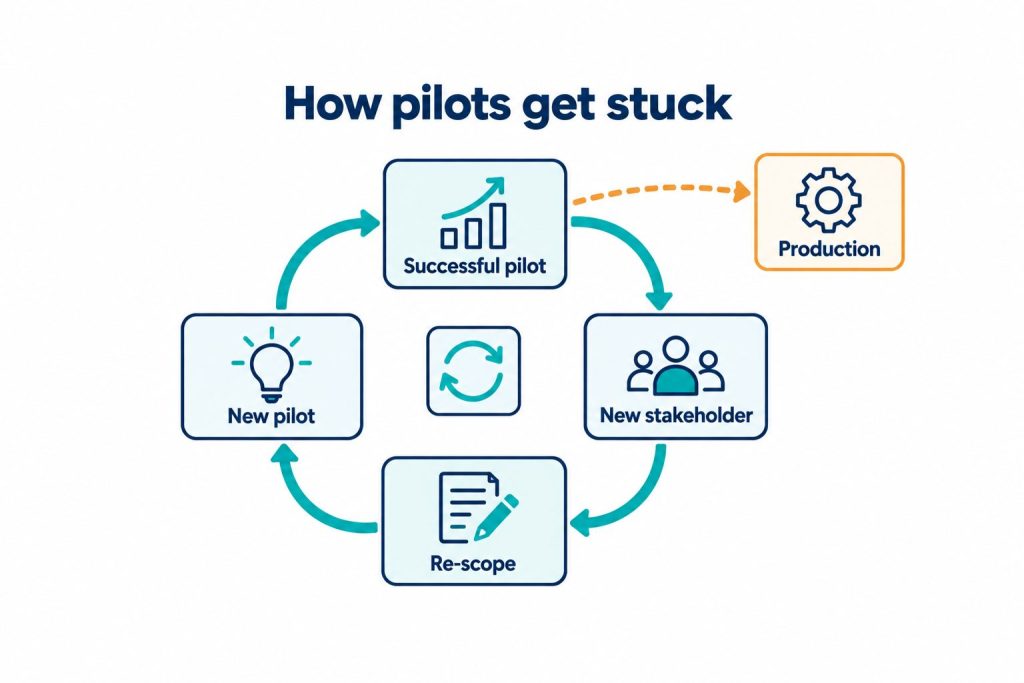
Pilot purgatory is the state where an enterprise AI project neither fails outright nor ships to production. It sits in a demo environment, gets shown in quarterly reviews, and never touches a real workflow. Industry reports put the number of AI pilots that fail to reach production somewhere between 52 percent and 95 percent, and the average project that does make it takes roughly 8 months to get there. The reasons are consistent across sectors: poor data quality, weak governance, cost overruns, unclear business value, and fragmented data architecture. None of these are exotic problems. They are deployment mistakes that show up the same way in a government agency, a manufacturer, or a 40-person retail chain, and they are fixable if you know where to look before you start.
TL;DR
- Between 52 percent and 95 percent of enterprise AI pilots never reach production, and the ones that do take an average of 8 months.
- The five recurring failure points are: bad data foundations, no governance built in from day one, underestimated total cost, no defined business metric, and architecture that cannot connect to existing systems.
- Enterprise AI integration fails less often on the model and more often on the plumbing around it: data pipelines, access controls, and system connections.
- AI implementation cost is usually miscalculated because teams price the model, not the surrounding data work, review process, and maintenance.
- Private, human-in-the-loop deployment models with source-cited outputs reduce two of the five failure points simultaneously: governance risk and unclear business trust.
About the Author: This article is written by Fooyo, a Singapore-headquartered company that builds and operates production AI systems, including AI knowledge bases and workflow automation, for government agencies, enterprises, and SMEs across Singapore, Indonesia, and Japan. Fooyo’s engagement model is built specifically around moving clients from prototype to live deployment, which puts it in direct, repeated contact with the mistakes described below.
What Is Pilot Purgatory, Exactly?
Pilot purgatory is not a failed project. It is a project that succeeded just enough to survive but never enough to graduate to full production use. The pilot answers questions correctly in a demo, the stakeholders nod, budget gets approved for “phase two,” and then nothing happens for months. This is distinct from an AI project that gets killed after a clear failure. A killed pilot at least frees up budget and attention. A pilot stuck in purgatory keeps consuming both indefinitely, which is why several analyses now describe it as a cost problem rather than a technical one [expertaiprompts.blog][thedataexperts.us]. Recognizing this distinction matters because the fix for a stalled pilot is different from the fix for a broken one: stalled pilots usually need a decision process, not more engineering.
Why Do Most Enterprise AI Pilots Fail to Reach Production?
Most pilots fail to reach production because the pilot was built to prove a concept, not to survive contact with real data volume, real users, and real compliance requirements. A pilot running on a curated dataset with a handful of test users tells you almost nothing about how the system behaves when it hits messy production data or a thousand concurrent queries. Gartner and McKinsey research attribute the bulk of failures to five factors: poor data quality, inadequate risk controls and governance, escalating costs, unclear business value, and fragmented data architecture. Each of these compounds the others. Bad data quality makes governance harder to prove. Unclear business value makes it harder to justify the cost of fixing the data. That compounding effect is why pilots don’t usually fail with a bang. They fail by quietly losing internal support until nobody defends the budget line anymore [aiassemblylines.com][imaginaryspace.ai].
Mistake One: Treating Data Quality as Someone Else’s Problem
Data quality is the single largest predictor of whether an AI system will work outside a demo. A retrieval or automation system is only as reliable as the documents, records, or logs it reads from, and most enterprises discover during the pilot that their internal knowledge is scattered across shared drives, outdated wikis, and inconsistent formats. Teams often assume this gets solved “later,” but later usually means never, because fixing data pipelines after a pilot is approved competes for budget against new, more visible initiatives. The practical fix is to audit data quality and structure before writing a line of pilot code, not after. For a retrieval-based system specifically, this means evaluating the embedding model, chunking strategy, and vector database indexing approach up front, and testing whether hybrid search (semantic plus keyword fallback) is needed to catch the queries pure vector search misses.
Mistake Two: Bolting Governance On After the Pilot Works
Governance added at the end of a project is governance that was never really tested. Risk controls, access permissions, and audit trails need to be part of the system architecture from the first prototype, not a checklist item before go-live. This matters more in regulated environments: private cloud AI deployments in Asia have to comply with data localization and cross-border transfer rules under Singapore’s PDPA, Japan’s APPI, and India’s DPDPA, and any system touching EU data or entities has to align with GDPR and the layered risk classifications in the EU AI Act. A pilot that never had to answer “where does this data live, and who can see it” during development almost always hits a wall when legal or compliance review starts, and that wall is exactly where many projects stall out for months [raisesummit.com][techtarget.com]. Building with human-in-the-loop review gates and source-cited outputs from day one keeps this compliance review straightforward, because the answers to the governance questions were designed in rather than retrofitted.
Mistake Three: Underestimating What Production Actually Costs
AI implementation cost is almost never just the cost of the model or the license. It includes data cleanup, integration engineering, ongoing monitoring, retraining or re-indexing, and the human review layer needed to keep outputs trustworthy. Teams that budget only for the pilot phase get a nasty surprise when they try to scale: some analyses put cost overruns in enterprise AI projects at several times the original estimate once production requirements are factored in [thedataexperts.us]. The way to avoid this is to price the full lifecycle before the pilot starts, not after it succeeds. That means asking, specifically:
- What does data cleanup and structuring cost, separate from the AI tooling itself?
- What does integration into existing CRM, POS, CMS, or messaging systems cost, versus building something standalone?
- What does ongoing operation and monitoring cost once the system is live and being used daily?
- What does a human review layer cost, and is it accounted for as a permanent operating expense rather than a temporary pilot safeguard?
Vendors that quote a pilot price without answering these four questions are quoting a demo, not a deployment.
Mistake Four: Never Defining What “Working” Means
An AI pilot without a measurable success metric will never get approved for production, because nobody can prove it should be. This sounds obvious, but a recurring pattern in stalled pilots is that the original goal was something vague like “improve efficiency” rather than a number tied to a business outcome, such as average handling time, response accuracy against a benchmark, or hours of manual work removed per week. Some researchers describe the healthiest AI programs as ones with a predetermined stop criterion: a clear line that says the pilot has either proven itself or should be killed, with no indefinite middle state allowed [institutepm.com]. Setting that line before the pilot begins, rather than debating it after the results come in, removes the ambiguity that keeps projects in limbo.
Mistake Five: Building AI That Doesn’t Talk to Anything Else
An AI system that cannot connect to the tools people already use will get used once and then ignored. This is the most underrated failure point because it is invisible during a demo, where the AI is usually shown in isolation, but becomes obvious the moment real staff try to use it inside their actual workflow. Enterprise AI integration means the system reads from and writes to the CRM, ticketing system, CMS, or messaging channel a team already lives in, rather than asking staff to open a separate tool. Emerging standards like the Model Context Protocol are starting to make this kind of integration more standardized rather than custom-built for every system, which should reduce integration cost over time. Until that standardization matures further, the safest approach is to evaluate integration compatibility with existing systems before committing to a platform, not after the pilot is built.
Frequently Asked Questions
What percentage of enterprise AI pilots actually reach production?
Industry reports put the failure rate between 52 percent and 95 percent, meaning a large majority of pilots never make it to a live, ongoing deployment.
How long does it typically take to move from AI pilot to production?
The average is around 8 months, though this varies heavily depending on data readiness, governance requirements, and integration complexity.
Is pilot purgatory a technical problem or a business problem?
Both, but more often business. The five failure points, data quality, governance, cost, unclear value, and fragmented architecture, are as much about planning and accountability as they are about engineering.
Does enterprise AI integration cost more than the AI model itself?
In most real deployments, yes. Data cleanup, system integration, monitoring, and human review typically account for more of the total AI implementation cost than the underlying model or license.
Can smaller companies avoid pilot purgatory, or is it only an enterprise problem?
It applies at any size. Smaller organizations often have less fragmented data architecture, which can work in their favor, but they usually have less budget slack to absorb an underestimated implementation cost.
What’s the fastest way to tell if a pilot is heading toward purgatory?
If there is no defined success metric and no scheduled decision point for go/no-go, the pilot has no mechanism to force a conclusion, which is the clearest early warning sign.
Does private cloud deployment help avoid these failure points?
It directly addresses governance and compliance risk, since data residency and access control are handled by design rather than retrofitted, but it does not on its own fix data quality or unclear business value.
About Fooyo
Fooyo builds AI knowledge bases, marketing automation, commerce platforms, and tourism tools with human-in-the-loop review and source-cited answers, and every deployment runs inside the client’s own private cloud rather than a shared public model. The company works with government agencies, enterprises, and SMEs across Singapore, Indonesia, and Japan, with business partnerships based in Tokyo. Its products are built to integrate directly into existing CRM, POS, CMS, and messaging systems rather than requiring clients to replace what they already use.
If your organization is trying to figure out why a pilot has stalled, or wants to design one that avoids purgatory from the start, get in touch with Fooyo for a scoped conversation about what production-ready would actually take.
References
- Why Do AI Pilots Fail to Scale? The 5 Mistakes Mid-Market Companies Make (aiassemblylines.com)
- The End of the Pilot Purgatory: Scaling AI from Experiment to Enterprise Standard. (raisesummit.com)
- Why AI pilots fail and how to move them into production | TechTarget (techtarget.com)
- Escaping Pilot Purgatory: Why 70% of Enterprise AI Pilots … (expertaiprompts.blog)
- Why Enterprise AI Adoption Fails in 2026 (And What the 8.6% Who Made It to Production Did Differently) | ImaginarySpace Blog (imaginaryspace.ai)
- Why 88% of Enterprise AI Pilots Never Reach Production – and How to Be in the 12% (institutepm.com)
- 95% of Enterprise AI Projects Fail. The 5% Do This. (thedataexperts.us)