Knowledge base gap analysis is the systematic process of testing a retrieval-augmented generation (RAG) system against real or simulated questions to find out where its underlying knowledge base is missing, outdated, or contradictory, before those gaps surface as wrong answers in front of a customer or regulator. The core method combines query log analysis, retrieval metrics such as context recall and context precision, and human review of low-confidence or unanswered queries. Done well, it turns “we think our AI knows the policy manual” into a documented, testable claim. Done poorly, or not at all, it leaves a company finding out what its system doesn’t know the same way Air Canada did: in a tribunal, after the system had already given a customer the wrong answer.
TL;DR
- A RAG system is only as complete as the knowledge base behind it. Gaps in that knowledge base show up as confident-sounding wrong answers, not visible errors.
- General industry research has found that a majority of enterprise AI responses can contain fabricated information when RAG systems retrieve from ungoverned data sources.
- Gap analysis uses specific, measurable signals: context recall, context precision, faithfulness scores, unanswered-query logs, and source-citation audits.
- Regulatory frameworks including the EU AI Act and GDPR increasingly expect companies to log and trace how an AI system arrived at an answer, and voluntary standards like ISO 42001 provide a management framework for the same kind of governance, which only works if the knowledge base is governed in the first place.
- Fixing a knowledge base gap is a data and process problem before it’s a model problem: the retrieval layer and the content feeding it both need ongoing maintenance, not a one-time setup.
About the Author: This article is written by Fooyo, a Singapore-headquartered company that builds AI Knowledge Base systems for government agencies, enterprises, and SMEs, deploying grounded, source-cited RAG products into clients’ private cloud or on-premises infrastructure rather than shipping prototypes and walking away.
What Is a Knowledge Base Gap in a RAG System?
A knowledge base gap is any point where a RAG system’s underlying data doesn’t contain the information needed to answer a question correctly, and the system either fabricates an answer, retrieves irrelevant context, or stays silent when it should respond. This matters because RAG was built specifically to solve the hallucination problem of plain language models by grounding answers in retrieved documents [ninetwothree.co]. The logic is simple: instead of asking a model to recall facts from training data, you give it the relevant document at the moment of the question. But that logic only holds if the document exists, is current, and is retrievable. If the policy was updated last month and the knowledge base still has the old PDF, the system isn’t malfunctioning. It’s doing exactly what it was built to do, with the wrong input.
This is the mechanism behind one of the most cited cautionary examples in the field: the Air Canada chatbot incident, where the airline’s system gave a customer incorrect bereavement fare policy because the knowledge base it drew from was outdated or incomplete. The airline was held liable for negligent misrepresentation. The chatbot didn’t “lie” in any meaningful sense. It retrieved from a gap and generated a fluent, confident, wrong answer, because fluency and accuracy are two separate properties of a RAG system and only one of them is guaranteed by default.
How Common Is the Knowledge Base Gap Problem?
It’s common enough to be a defining risk of enterprise RAG deployment rather than an edge case. Industry research has found that a majority of enterprise AI responses contain fabricated information specifically when RAG systems retrieve from ungoverned data sources, meaning knowledge bases without clear ownership, update cycles, or quality controls. The distinction matters: the failure isn’t inherent to RAG as an architecture, it’s inherent to RAG running on ungoverned content. A knowledge base with clear versioning, regular review cycles, and defined ownership behaves very differently from one that’s an accumulated pile of old wikis, PDFs, and Slack exports.
Think of it like a library with no librarian. The building might be full of accurate books, but if nobody is tracking which editions are current, which sections are empty, and which shelves haven’t been touched in three years, a visitor pulling a book at random has no way of knowing if they’re holding this year’s truth or five-year-old fiction. The RAG system is the visitor. Gap analysis is the audit that tells you which shelves are missing books entirely.
What Technical Metrics Are Used to Detect Knowledge Base Gaps?
Gap detection relies on a specific set of measurable signals rather than a general sense that “the bot seems off.” The most widely used metrics, popularized by evaluation frameworks like RAGAS and used across LangChain-based pipelines, are:
- Context Recall: measures whether all the information actually needed to answer a question was successfully retrieved from the knowledge base. Low recall means the right document exists somewhere but the retrieval step is missing it, or the document doesn’t exist at all.
- Context Precision: measures how relevant the retrieved chunks are to the actual question. Low precision means the system is pulling in noise alongside, or instead of, the right information.
- Faithfulness: measures whether the generated answer is strictly grounded in the retrieved context, rather than the model filling gaps with its own prior training knowledge.
These three metrics triangulate the problem. A low recall score points to a genuine content gap in the knowledge base. A low precision score points to a chunking or indexing problem. A low faithfulness score, even when recall and precision look fine, points to a model generating beyond what it was given, the exact failure mode that makes “grounded, source-cited” answers a meaningful design requirement rather than a nice-to-have feature.
The U.S. National Institute of Standards and Technology sponsors the TREC Retrieval Augmented Generation Track, which applies a multi-layered evaluation approach covering relevance assessment, response completeness, attribution verification, and agreement analysis. That level of formal evaluation is largely academic and benchmark-focused, but the categories translate directly to what an enterprise should be checking in production: is the retrieved content relevant, is the answer complete, can every claim be traced to a source, and do independent checks agree on the result.
How Does an Enterprise Actually Run a Gap Analysis, Step by Step?
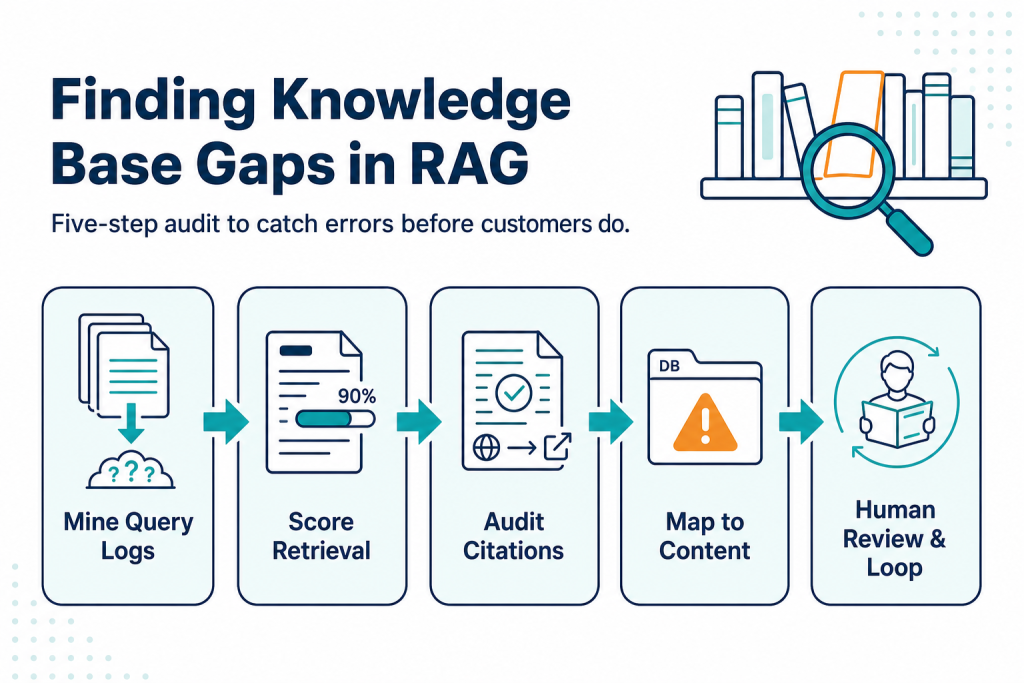
Building on the metrics above, the practical question for most teams isn’t which metric matters, it’s how to run the process without turning it into a research project. A workable gap analysis cycle looks like this:
- Mine the query logs. Pull every question the system received over a defined period and flag the ones it answered with low confidence, no answer, or a fallback response.
- Score retrieval on a representative sample. Run context recall and context precision checks against a curated set of real and edge-case questions, not just the easy ones.
- Audit source citations. Since grounded answers should cite the document they came from, spot-check whether the cited source actually supports the claim made. A mismatch here is a faithfulness failure even if the answer sounds right.
- Map gaps back to content, not just to the model. Most gaps trace to missing documents, stale versions, or content that exists but was never indexed. Fixing the model’s temperature setting doesn’t fix a missing document.
- Close the loop with a human reviewer. A person with subject-matter authority should sign off on what gets added or corrected, which is the human-in-the-loop gate that keeps the fix itself from introducing a new error.
- Re-run the evaluation. Gap analysis isn’t a one-time audit; it’s a cycle that should repeat on a schedule tied to how often the underlying business information changes.
What Do Regulations Require When It Comes to Knowledge Gaps and AI Traceability?
A separate but increasingly unavoidable concern is that regulators are starting to require proof of this kind of diligence, not just good intentions. The EU AI Act mandates automated event logging for high-risk AI systems specifically to ensure output-to-input traceability, meaning a company needs to be able to show which source produced which answer. GDPR requires records of data flows, which applies directly to any knowledge base containing personal data. ISO 42001, while a voluntary international standard rather than a binding regulation, provides a management framework with specific controls for data management and traceability across the AI system’s lifecycle, and companies increasingly adopt it to demonstrate governance ahead of regulatory scrutiny. None of these frameworks ask “is your AI accurate.” They ask “can you prove where this answer came from and show you’re managing the data behind it.” A knowledge base without gap analysis and citation tracking can’t answer that question, regardless of how good the model is.
What Does This Mean for How a Knowledge Base Should Be Built and Maintained?
Stepping back from the technical detail, the deeper implication is that a RAG system is a living data product, not a one-time integration. This is the premise behind how Fooyo builds its AI Knowledge Base product: grounded, source-cited responses with human-in-the-loop review gates built into the workflow, deployed into a client’s private cloud or fully on-premises infrastructure depending on data-residency requirements. Private-cloud hosting means the data stays within infrastructure Fooyo and the client control together, though it may still reach a model API during processing; fully on-premises deployment means the data never leaves the client’s own infrastructure at all. The distinction matters for the same reason gap analysis matters: both are about being able to state precisely what happens to information, rather than relying on an assumption.
Fooyo’s home base is Singapore, with operations in Chengdu and Tokyo, and it works with government agencies, enterprises, and SMEs across those markets, with delivery timelines scoped to each engagement’s integration complexity, data readiness, and approval process rather than a fixed multi-month build. That scoping matters directly for gap analysis: a knowledge base that’s still being assembled from scratch needs a different review cadence than one that’s being connected to systems that already exist, such as a CRM, CMS, or document repository.
Frequently Asked Questions
Is a knowledge base gap the same as a hallucination?
Not exactly. A hallucination is the symptom, a confident but false answer. A knowledge base gap is often the cause, missing or outdated source content that forces the model to fill in with its own prior knowledge instead of retrieved fact.
How often should gap analysis be run?
It depends on how fast the underlying information changes. A policy knowledge base tied to regulatory updates needs more frequent review than a static product catalog. The right cadence is tied to the business process, not a calendar default.
Can gap analysis be automated entirely?
Metrics like context recall, precision, and faithfulness can be automated and run continuously. Closing the gap, meaning deciding what content to add or correct, generally needs a human reviewer with subject-matter authority, which is why human-in-the-loop review is a design requirement, not an optional extra.
Does private or on-premises deployment make gap analysis unnecessary?
No. Hosting location affects data residency and who can access the data, not whether the content feeding the system is complete or current. A fully on-premises knowledge base can still have stale documents.
What’s the first sign a company usually notices that its knowledge base has gaps?
Usually it’s a pattern in the unanswered-query or low-confidence logs: the same category of question keeps triggering fallback responses, which points to a specific document or topic area that was never properly indexed.
Is this only a concern for large enterprises?
No. Government agencies, large enterprises, and SMEs all run on knowledge bases that can go stale, and the Air Canada case involved a single policy page, not a company-wide system failure. Scale changes the volume of queries, not the underlying risk.
About Fooyo
Fooyo is a Singapore-headquartered company that builds data platforms and AI agents for enterprises, with its AI Knowledge Base product designed specifically around grounded, source-cited answers and automated actions triggered from those answers. The company deploys into a client’s private cloud or fully on-premises infrastructure depending on data-residency needs, and operates as a hands-on partner that builds and runs the product with clients rather than handing over a report or prototype. With offices in Singapore, Chengdu, and Tokyo, Fooyo works with government agencies, enterprises, and SMEs in those markets. Its integration approach connects into existing CRM, POS, CMS, and messaging systems rather than requiring a rip-and-replace rebuild.
If your team is trying to figure out what your current knowledge base doesn’t know yet, or is building one from scratch and wants gap analysis designed in from day one, get in touch with Fooyo to talk through a scoped pilot.