Crowd surges at festivals and large events are largely preventable because the warning signs show up well before a crush happens. Dangerous crowd density is typically visible up to 30 minutes before a crush occurs, and researchers have identified specific early indicators, density gradients, falling walking speeds, and queues building at bottlenecks, that precede most incidents. AI forecasting tools now let organizers model entry-point load, gate throughput, and arrival patterns before opening day, rather than reacting to a crowd that has already formed. That shift, from reading a crowd in the moment to predicting it days or weeks in advance, is the core value AI brings to event safety planning.
TL;DR
- Crowd crushes have a measurable warning window; the 2021 Astroworld Festival surge, which caused 10 fatalities, led directly to stricter occupancy-load permitting recommendations in Texas.
- AI forecasting models arrival curves, gate capacity, and bottleneck risk using historical and ticketing data before the event opens, not just during it.
- Sensor-fusion systems combining RGB, thermal, WiFi, acoustic, and RFID data have reached 92.6% crowd-density accuracy in mega-event simulations.
- Only 28% of surveyed professional venues currently use AI for crowd management or access screening, meaning most events still plan entry points on instinct and past experience alone.
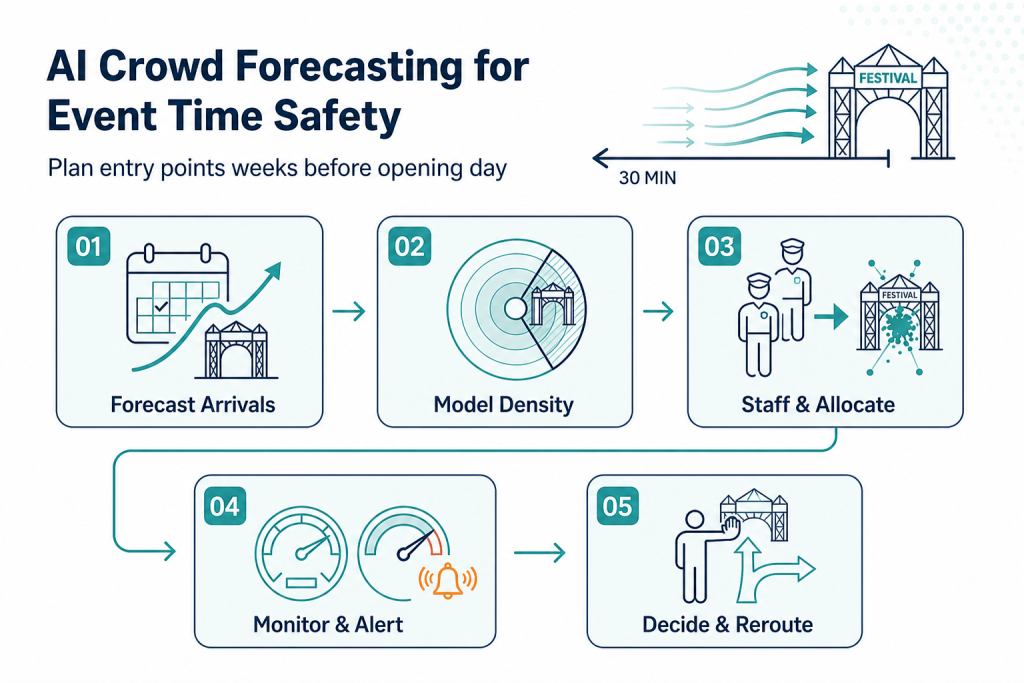
- Crowd management software works best as part of a workflow: forecast, simulate, staff, monitor, and adjust, with humans making the final call on gate changes.
About the Author: This article is produced by Fooyo, a Singapore-based company that builds AI knowledge bases and workflow automation products for government agencies, enterprises, and SMEs. Fooyo has direct presence in Singapore, China as a Tencent and WeChat partner, and Japan, bringing practitioner-level experience to event and venue operations across the region.
Why Do Crowd Surges Still Happen at Well-Planned Events?
Crowd surges happen when arrival volume, physical layout, and real-time decision-making fall out of sync, not because organizers are careless. The Astroworld Festival crowd surge in 2021 resulted in 10 fatalities, and the 2022 Texas Task Force on Concert Safety report that followed pointed to a specific, fixable gap: the absence of a universal permitting template that enforces strict occupancy loads at every venue. That finding matters because it reframes the problem. A surge is rarely one failure; it is a stack of smaller miscalculations, underestimated arrival rates, a single chokepoint gate, a stage schedule that pulls everyone toward one area at once, that compound once the crowd is already dense.
The 30-minute warning window that researchers have documented is the part most traditional planning misses. Security staff watching a video feed can often tell something is wrong, but by the time density is visually obvious, the crowd’s own momentum makes rerouting difficult. A crowd moving toward a bottleneck behaves a bit like water approaching a narrowing pipe: pressure builds invisibly first, and by the time you see the surge at the narrow point, the volume behind it is already committed. Forecasting is valuable precisely because it addresses the invisible buildup stage, not just the visible one.
What Does AI Forecasting Actually Predict Before an Event Opens?
AI forecasting for events uses historical and real-time data to model how many people will arrive, when, and through which entry points, before a single ticket holder shows up on site. This is distinct from on-the-day monitoring; it’s a planning exercise that happens in the weeks before opening day. Typical inputs include:
- Ticket sales and registration data, segmented by entry time slot, ticket type, and price tier
- Historical attendance patterns from comparable past events, including how early crowds typically arrive relative to doors opening
- Transport and geographic data, such as public transit schedules and parking capacity near each gate
- Weather forecasts, which shift arrival timing and clustering behavior
- Venue layout constraints, including gate width, queuing area size, and distance to the nearest emergency exit
From these inputs, forecasting models produce an expected arrival curve per entry point, not just a total headcount for the day. That distinction is what makes the output actionable: knowing 40,000 people are expected is far less useful than knowing 6,000 of them are likely to arrive at Gate 2 in the 20 minutes before doors open. Organizers can use that forecast to add staff, widen a queue lane, or open a gate earlier, all before the crowd physically forms. Event teams increasingly use AI this way to automate workflows, flag operational risk, and surface patterns hidden in ticketing and historical data [gomomentus.com][eventtia.com].
How Accurate Is AI Crowd Density Forecasting, Really?
Accuracy depends heavily on how many data sources the system fuses together, and the gap between single-source and multi-source systems is significant. A 2026 study published in MDPI tested the SmartCrowd-IoT framework, which combines RGB camera footage, thermal imaging, WiFi signal density, acoustic sensors, and RFID tracking through edge computing, and reported 92.6% crowd-density accuracy in real-time mega-event simulations. That figure is notable because it reflects sensor fusion rather than any single input; a camera alone struggles in low light or dense crowds, WiFi detection alone misses anyone who’s disabled discovery mode, but combining signals compensates for each method’s individual blind spots.
It’s worth being direct about what this accuracy figure does and doesn’t mean. A 92.6% accurate density read during a simulation tells you the sensor-fusion approach is sound; it doesn’t guarantee the same number in every live deployment, since venue acoustics, crowd composition, and lighting conditions vary. Organizers evaluating crowd management software should ask vendors what sensor combination their accuracy figures are based on, and whether those figures come from live events or simulations, before treating any single percentage as a guarantee.
What Should Go Into an AI-Assisted Entry Point Plan?
Building on the forecasting and accuracy points above, the practical question for organizers is how to turn a density model into an actual gate plan. A usable entry-point plan generally includes:
- Staggered or timed entry informed by the predicted arrival curve, so ticket types are nudged toward different arrival windows
- Dynamic staffing allocation that shifts security and ticketing staff toward gates predicted to see the heaviest load [eventstaff.com]
- Pre-set threshold alerts that flag when real-time density approaches a defined percentage of the forecast, giving staff a buffer to act rather than a reactive scramble
- A fallback routing plan for each gate, pre-approved before the event, so a decision to redirect crowds doesn’t need to be invented on the spot
- A clear decision owner, a named person with authority to close or reroute a gate without needing sign-off from someone off-site
The common thread across all five is that none of them require AI to execute, but AI materially improves the quality of the inputs each one depends on. A staffing plan built on a guess is still a staffing plan; one built on a modeled arrival curve per gate is a better one. This is also where real-time monitoring and pre-event forecasting need to work together rather than in isolation: predictive models set the plan, and live monitoring confirms whether reality is tracking the forecast, with the system flagging deviations before they become dangerous [festivalpro.com].
How Does Crowd Management Software Fit Into the Rest of Event Planning?
A related but distinct question from forecasting itself is where crowd management software sits in the broader event technology stack. It shouldn’t be a standalone tool bolted on separately from ticketing, staffing, and vendor systems; it works best when it pulls data from those systems directly. Organizers already use AI for budget forecasting, vendor cost analysis, and attendee personalization [eventtia.com][remo.co], and crowd forecasting is a natural extension of the same data pipeline rather than a separate discipline.
This is also the area where adoption still lags expectation. Only 28% of surveyed professional venues currently use AI for crowd management or access screening functions, which means the majority of festivals and large events are still planning entry points based on prior-year headcounts and staff judgment alone. That gap is less about the technology being unproven and more about integration effort: most venues’ ticketing, security, and transport data live in separate systems that were never built to talk to each other. Closing that gap is an integration problem as much as an AI one, which is why systems that connect into existing CRM, ticketing, and operational tools tend to get adopted faster than ones that require replacing what’s already in place.
Frequently Asked Questions
Does AI forecasting replace the need for human security staff at events?
No. Forecasting tells staff where and when crowd pressure is likely to build; trained staff still make the call on gate closures, rerouting, or emergency response. Human-in-the-loop oversight remains standard practice for any safety-critical decision.
How far in advance can organizers use AI to plan entry points?
Forecasting typically starts as soon as meaningful ticket sales data exists, often weeks before the event, and gets refined as sales data accumulates closer to opening day.
What data does an event need before AI forecasting is useful?
At minimum, historical attendance by time slot, current ticket sales by segment, and venue layout details including gate capacity. More granular data (transit schedules, weather, past incident logs) improves accuracy further.
Can smaller festivals or community events use this, or is it only for major venues?
Crowd forecasting scales down. A smaller event has less historical data to work with, but the same arrival-curve modeling applies, just with a lighter data footprint and simpler gate plan.
What’s the warning window before a crowd surge becomes dangerous?
Research indicates dangerous density is often visible up to 30 minutes before a crush, through indicators like density gradients and slowing walking speed, which is the window forecasting and real-time monitoring are both designed to catch.
Is private or on-premises deployment necessary for crowd data?
It depends on the sensitivity of the data involved and local regulatory requirements. Ticketing and location data can be sensitive, so organizers should confirm whether a vendor’s platform runs in a private cloud, where data may still reach a model API, or fully on-premises, where data never leaves the venue’s own infrastructure.
About Fooyo
Fooyo is a Singapore-headquartered company building AI knowledge bases and workflow automation products for government agencies, enterprises, and SMEs. The company is headquartered in Singapore with direct presence in China as a Tencent and WeChat partner, and in Japan. Fooyo’s Smart Tourism platform works with live crowd data and predictive tools for destinations and venues, giving the team direct, practitioner-level exposure to the operational side of crowd planning. Fooyo deploys into a client’s private cloud or fully on-premises infrastructure depending on data-residency needs, and builds and operates products alongside clients rather than handing off a report and walking away. Engagements typically start with a short demo and move to a scoped pilot, with timelines set by integration complexity and data readiness rather than a fixed delivery date.
If your organization is evaluating crowd management software or wants to understand what AI forecasting could look like for your venue or event, get in touch with Fooyo at https://fooyo.sg/.
References
- AI for Events: The 2026 Guide to Smarter Venues (gomomentus.com)
- Predictive Artificial Intelligence for Music Festival Site Crowd Control Planning. (festivalpro.com)
- 18 ways event planners use AI to save time and stress (eventtia.com)
- AI for Event Planning Tools & Strategies 2026 | Remo (remo.co)
- Festival Staffing Guide: Proven Plan for Large Events (eventstaff.com)