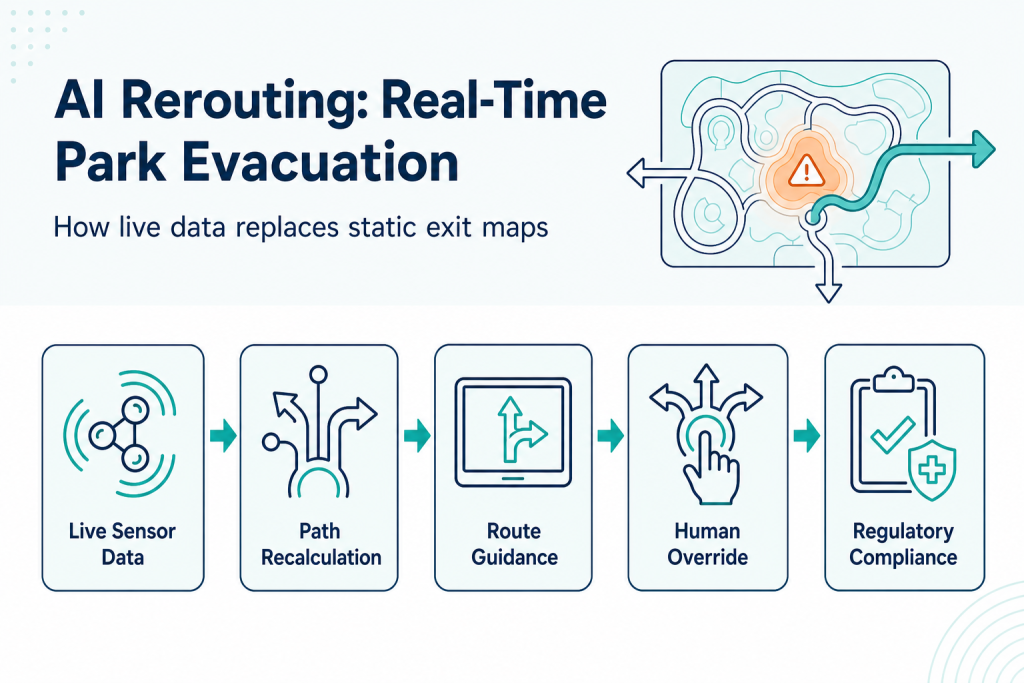
When an incident occurs inside a theme park, the single most important variable is not how fast people can move, it’s how fast the route guidance can change. A fixed evacuation map printed on a wall assumes the nearest exit is always the right exit. AI crowd models exist precisely because that assumption breaks down the moment one path gets blocked, overcrowded, or made unsafe by the hazard itself. These systems ingest live crowd density, sensor data, and hazard location, then recompute the safest path for each zone of the park in near real time, something static signage and manual radio dispatch cannot do.
TL;DR
- Static evacuation maps assume the nearest exit is always safe; AI crowd models recalculate routes as conditions change, which is the core gap they close.
- Modern crowd simulation engines can execute path recalculations with response times measured in milliseconds, making updated guidance available before bottlenecks fully form.
- Two modeling approaches dominate the field: the continuous, physics-based Social Force Model and the grid-based Cellular Automata model, each with different tradeoffs for speed and realism.
- Regulatory frameworks like NFPA 101, ISO 22320, and ISO 45001 set the baseline for egress design and incident response that any AI system has to operate within, not replace.
- Fooyo’s experience with live crowd data and AI-powered guidance in tourism settings gives it a grounded view of how real-time crowd systems need to be built for production use, not just simulated in a lab.
About the Author: This article is written by Fooyo, a Singapore-based company that builds production AI systems including a Smart Tourism platform using live crowd data and AI-powered guidance for destinations across Southeast Asia. That work on real-time crowd data pipelines informs this piece on how evacuation routing systems are actually built and operated, as distinct from how they’re described in vendor brochures.
What Makes Theme Park Evacuation Different From Standard Building Egress?
Theme parks are not buildings with hallways and fire exits, they’re open, irregular spaces with rides, queues, water features, and seasonal crowd surges that a standard office egress plan was never designed to handle. A corporate office evacuation plan assumes a known headcount, fixed corridors, and people who know the building. A theme park has transient visitors who don’t know the layout, crowd densities that swing from near-empty to capacity within hours, and physical obstacles like ride vehicles, queue switchbacks, and water bodies that don’t exist in a typical commercial building. Safety authorities do not prescribe a single universal evacuation time limit for theme parks. Instead, they rely on a combination of equipment and building standards: ASTM F2291 requires ride manufacturers to document specific evacuation procedures and estimated times based on hazard analyses, while NFPA 101 regulates egress capacities and travel distances, including a maximum travel distance of 250 feet, about 76 meters, for assembly occupancies in sprinkler-equipped buildings. This patchwork of standards is exactly why dynamic routing matters: a plan built around fixed distances and capacities needs a live layer on top that accounts for where people actually are right now.
How Do AI Crowd Models Actually Recalculate Safe Paths?
An AI crowd model recalculates a safe path by continuously comparing live crowd and hazard data against a map of the venue, then re-running a pathfinding algorithm whenever conditions change enough to matter. The mechanism is similar to how a GPS navigation app reroutes you around a traffic jam: it doesn’t wait for you to reach the blocked road, it detects the slowdown upstream and recalculates before you get there. In a theme park, the inputs are different, crowd density sensors, CCTV-derived headcounts, smoke or heat detectors, staff reports, instead of traffic sensors, but the loop is the same: sense, compare against a threshold, recompute, and push the new route to whoever needs it, whether that’s a digital sign, a staff member’s handset, or a guest’s phone. Modern crowd simulation systems can execute real-time path recalculations with response times measured in milliseconds, making updated guidance available before bottlenecks fully form rather than after.
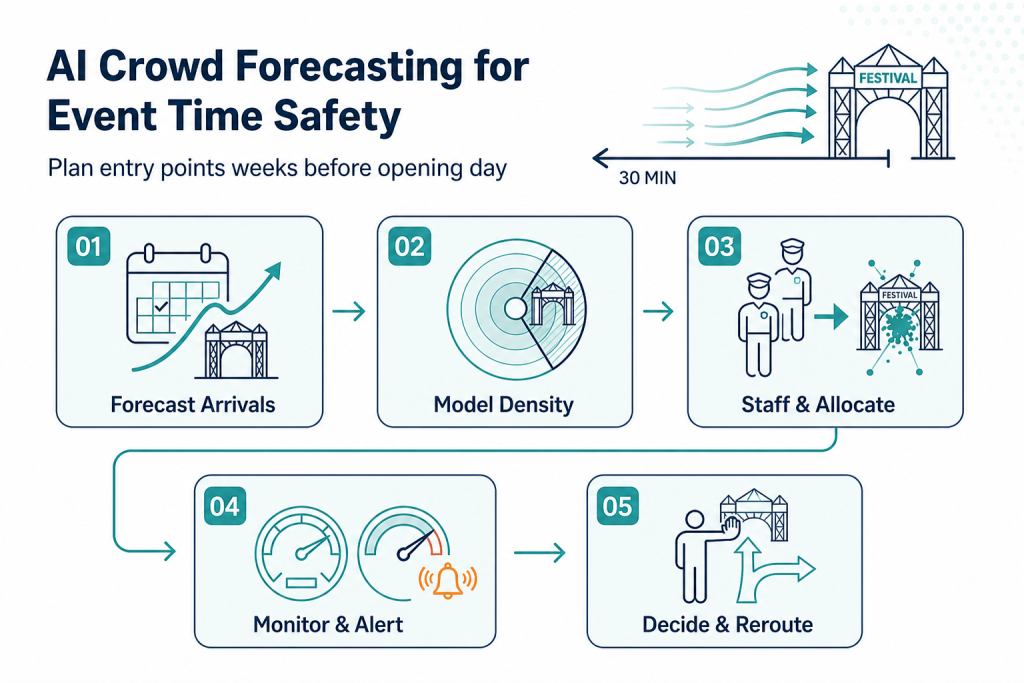
This is a meaningfully different capability from crowd forecasting tools that predict wait times or busy periods hours in advance. Forecasting tells a park operator which day will be busy. Evacuation routing has to work on a time horizon of seconds, because the hazard itself, fire, structural failure, a medical mass-casualty event, is actively changing the environment as the system responds to it.
What Technical Models Power These Systems?
Two modeling families dominate crowd simulation research, and understanding the difference matters because it determines what a given system can and can’t do under pressure. The Social Force Model is a continuous, physics-based approach that treats each pedestrian as a particle subject to attractive forces (toward an exit) and repulsive forces (away from walls, obstacles, and other people). Cellular Automata, by contrast, is a discrete model that divides the environment into a grid of cells, with each cell’s occupancy governed by local transition rules about who can move where next. The Social Force Model tends to produce more realistic crowd behavior, including the kind of crowding and funneling that happens at narrow exits, but it’s more computationally expensive. Cellular Automata is cheaper to compute at scale, which matters when a park covers tens of hectares and needs to update routes for multiple zones simultaneously.
Researchers evaluate both approaches against the same core performance metrics: total evacuation time, flow rate through exits, maximum crowd density at bottleneck points, and computational efficiency. A separate line of research applies maximum-flow algorithms, borrowed from network theory, to generate evacuation routes for a whole precinct rather than a single building, treating the venue as a network of nodes and capacity-constrained edges [pmc.ncbi.nlm.nih.gov]. Agent-based simulation has also been used specifically for theme park contexts, comparing evacuation time when only the main gate is used versus when all available gates are opened, which is a question with real operational consequences for park design and staffing [wmpllc.org].
How Does This Connect to Broader Crowd Management Software?
Building on the modeling detail above, it’s worth stepping back to see where evacuation routing sits inside the wider category of crowd management software. Crowd management software spans a spectrum: at one end, tools that track wait times and guide guests toward less congested attractions during normal operations, at the other end, systems that take over route guidance entirely during an emergency. The two aren’t separate systems bolted together, they share the same underlying sensor and density data, just applied to different decisions. A platform that already tracks live crowd density to tell a family “the queue at this ride is short right now” has most of the raw data infrastructure needed to also say “this exit path is currently overcrowded, use this one instead.” The difference is the decision logic layered on top and the latency requirement, routine guidance can tolerate a delay of minutes, emergency routing cannot.
Live crowd data infrastructure enables parks to optimize guest flow during normal operations and support faster decision-making during emergencies. The underlying principle illustrates the same point made above: once a park has live, granular crowd data flowing continuously, that data becomes useful for far more than the original use case it was built for. That said, capacity at large parks is ultimately constrained by physical footprint, and meaningful attendance growth often requires physical expansion rather than operational tools alone.
Where Does AI for Public Safety Fit Into Emergency Decision-Making?
AI for public safety in a theme park context is not about replacing human incident commanders, it’s about giving them a faster, more current picture than radios and visual spot-checks can provide. A related but distinct question from the modeling detail above is who actually acts on the AI’s output during an incident. NIST researchers developed a model called Safe Step specifically to direct building occupants to the safest evacuation route during a fire, accounting for conditions that change as the fire spreads [nist.gov]. The principle generalizes: the AI’s job is to narrow down options and flag the safest one given current conditions, while trained staff retain authority to override the recommendation based on information the sensors can’t capture, a blocked service corridor, an injured guest, a judgment call about crowd panic.
Digital twin technology is increasingly used to support this decision layer, creating a live virtual replica of the physical venue that emergency teams can use to test routing decisions and visualize accessibility constraints, including for guests with mobility limitations, before committing to a live instruction [anvil.so]. Regulatory frameworks that govern how this decision-making has to be structured include NFPA 101 for life safety and egress design, ISO 22320 for incident response and emergency management, and ISO 45001 for occupational health and safety preparedness. None of these standards mandate a specific AI system, they mandate outcomes and documented procedures, which means any AI routing tool has to be built to produce auditable decisions, not a black box that can’t explain why it recommended one path over another.
What Should Park Operators Look for When Evaluating These Systems?
The practical evaluation question for an operator is less about whether a vendor uses impressive-sounding algorithms and more about whether the system integrates with what’s already running on site. A crowd model that can’t ingest data from existing CCTV, turnstile counters, or ride operations systems is a research prototype, not an operational tool. Key questions worth asking a vendor:
- What’s the actual recalculation latency under load, not in a demo, but during the busiest hour of the busiest day of the year?
- Does the system integrate with existing sensor and operations infrastructure, or does it require a rip-and-replace of hardware already installed?
- Where does the data live? Does any of it leave the venue’s infrastructure to reach a third-party model API, or is all processing kept on-premises or within a private cloud under your control? This distinction matters for parks with government or regulatory data-handling obligations.
- Can staff see and understand why a route was recommended, or is the reasoning opaque?
- Is there a human override built into the workflow, not as an afterthought, but as a designed checkpoint?
This last point reflects a broader principle that applies well beyond theme parks: any automated decision system touching safety needs a built-in review gate rather than full autonomy, because the cost of a wrong automated call is far higher than the cost of a few seconds’ delay for human confirmation.
Frequently Asked Questions
Do theme parks have a legally mandated maximum evacuation time?
No single universal time limit exists. Instead, ASTM F2291 requires ride manufacturers to document hazard-specific evacuation procedures and estimated times, while NFPA 101 governs egress capacities and travel distances more broadly.
How fast can AI crowd models actually recalculate a route?
Modern crowd simulation systems can execute real-time path recalculations with response times measured in milliseconds, making updated guidance available before bottlenecks fully form.
What’s the difference between the Social Force Model and Cellular Automata?
The Social Force Model treats pedestrians as particles moving under continuous attractive and repulsive forces. Cellular Automata divides the space into a grid of cells with discrete local transition rules. The first tends to be more realistic, the second is cheaper to compute at scale.
Does AI crowd management actually increase park capacity, or is it only about safety?
It depends on the park. Live crowd data infrastructure can support both routine guest-flow optimization and emergency routing, but at parks already near full capacity, meaningful attendance growth typically requires physical expansion rather than operational tools alone.
Can AI fully automate evacuation decisions without human staff involvement?
No credible deployment does this. Systems like NIST’s Safe Step are designed to recommend the safest route given current conditions, with trained staff retaining override authority based on context the sensors can’t capture.
What regulatory standards govern emergency decision-making in these venues?
NFPA 101 for life safety and egress design, ISO 22320 for incident response and emergency management, and ISO 45001 for occupational health and safety preparedness are the key frameworks.
Does using cloud-based AI mean guest data leaves the park’s own systems?
It depends on the deployment model. Private-cloud hosting can still mean data reaches an external model API, whereas fully on-premises deployment means data never leaves the venue’s own infrastructure. Operators handling sensitive data should confirm which model a vendor actually uses.
About Fooyo
Fooyo is a Singapore-headquartered company that builds data platforms and AI agents for enterprises, with additional offices in Chengdu and Tokyo supporting delivery across Southeast Asia, China, and Japan. Its Smart Tourism platform applies live crowd data, AI-powered guides, and engagement tools to destinations, giving it direct, applied experience with the same real-time crowd data challenges discussed in this article, not as an abstract research exercise. Fooyo deploys production systems into a client’s private cloud or fully on-premises infrastructure depending on data-residency needs, with human-in-the-loop review gates built into automated workflows rather than full autonomy. The company is trusted by government agencies, enterprises, and SMEs across Asia, and works as a hands-on partner that builds and operates AI products with clients rather than only delivering reports.
If your organization is exploring crowd management software or AI for public safety applications, whether for a venue, a tourism destination, or a public space, get in touch with Fooyo to discuss how live crowd data and AI-powered systems can be scoped for your specific environment.
References
- New AI Model Shows How to Evacuate for Fires One Safe … (nist.gov)
- Intelligent Evacuation Route Planning Algorithm Based on Maximum Flow – PMC (pmc.ncbi.nlm.nih.gov)
- Digital Twins for Accessible Evacuation Routes | Anvil Labs (anvil.so)
- Agent-based modeling for theme park evacuation | Journal of Emergency Management (wmpllc.org)