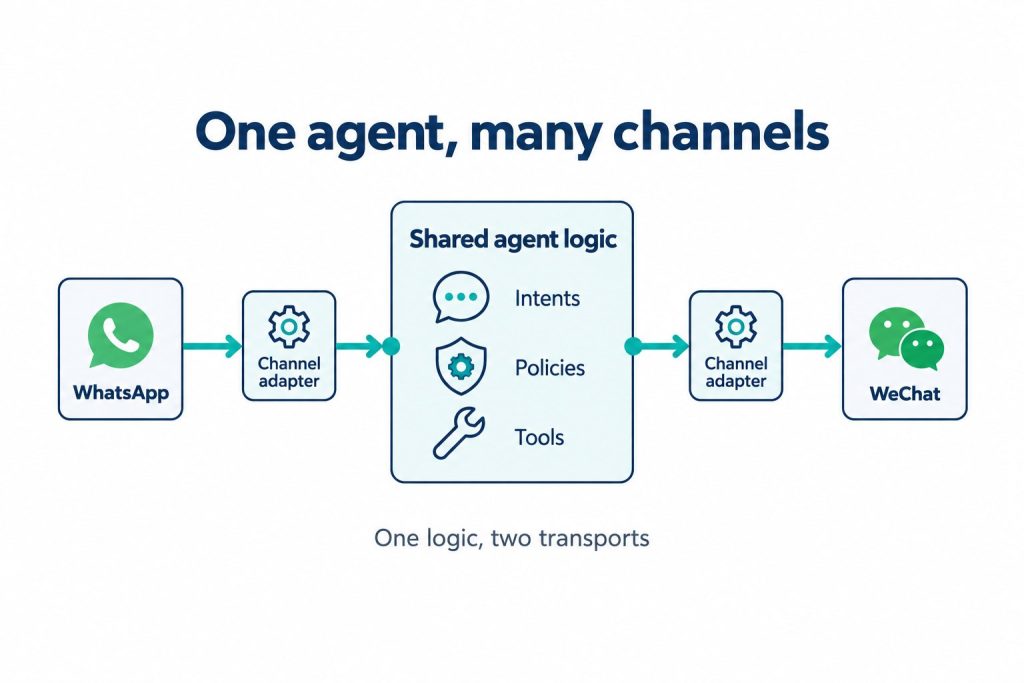
To run one AI agent across WhatsApp and WeChat without maintaining two separate codebases, you need to separate the agent’s reasoning layer from each platform’s messaging quirks. The two platforms differ enough at the protocol level, in encryption model, response timing, and message structure, that a naive integration ends up as two agents wearing one name. The fix is architectural: normalize inbound messages through a middleware layer, keep a single orchestration core, and push platform-specific handling (timeouts, templates, encryption compliance) into thin adapters at the edge. Get that separation right and you get one knowledge base, one set of business rules, and one place to fix a bug, instead of two.
TL;DR
- WhatsApp and WeChat differ in encryption, rate limits, and response timeouts, which is why most companies end up building two agents instead of one.
- WeChat’s 5-second synchronous response timeout is the single biggest technical constraint, since it can cut off an LLM mid-generation.
- A middleware layer that normalizes messages before they hit your orchestration core is what prevents logic forking, an approach increasingly standardized through protocols like MCP and ACP.
- Rich media templates, compliance rules, and data localization requirements should live in platform-specific adapters, never in the core agent logic.
- Fooyo builds this kind of unified, private-cloud AI agent architecture for clients operating across Southeast Asia and China, integrating into existing CRM, POS, and messaging stacks rather than replacing them.
About the Author: Fooyo builds AI knowledge base and agent systems deployed into clients’ private cloud environments. The company is headquartered in Singapore with a development office in Chengdu and business partnerships in Tokyo, spanning Southeast Asia and China market operations including WeChat Mini Programs. This footprint means the WhatsApp/WeChat integration problem described here is one the team designs around directly, not theoretically.
Why Is Building One AI Agent for WhatsApp and WeChat Harder Than It Looks?
It looks like a simple integration problem, connect two chat APIs to one language model, but the platforms were built for different regulatory and technical environments and that shows up in the plumbing. WhatsApp Business API serves over 8.3 million businesses globally, with particularly high enterprise penetration in India and Southeast Asia. WeChat Official Accounts, meanwhile, dominate China and the Chinese diaspora with more than 25 million active enterprise accounts. Both are messaging platforms, but that’s roughly where the similarity ends.
The documented friction points are specific and technical, not just “different APIs”:
- Response timing: WeChat enforces a strict 5-second synchronous response timeout on its service account API, which frequently interrupts a large language model mid-generation if the agent tries to reason and respond in real time.
- Message debouncing: Without proper debouncing, rapid-fire forwarded messages on either platform can cause repeated agent invocations, wasting tokens on redundant processing.
- Template incompatibility: Rich media message structures, WhatsApp’s interactive buttons and list templates versus WeChat’s template messages and Mini Program cards, are not interchangeable at the data-structure level.
Each of these is solvable individually. The problem is that most teams solve them inside the agent’s core logic, which is exactly what causes the fork.
What Does “Forking Your Logic” Actually Mean in AI Agent System Design?
Forking happens when platform-specific handling leaks into the part of the system that’s supposed to be platform-agnostic, meaning your business rules, your knowledge base retrieval, and your decision logic. Once that happens, a fix for WeChat’s timeout behavior gets written directly into the same function that decides how to answer a refund question, and now every change to one requires re-testing the other. Over time, teams maintain two “agents” in name only, each with duplicated prompts, duplicated retrieval logic, and duplicated edge-case handling, because nobody separated the concerns early.
Good AI agent architecture treats the core reasoning engine, the part that retrieves facts, applies business logic, and generates a response, as a single service that has no idea whether it’s talking to WhatsApp or WeChat. Everything platform-specific sits in an adapter layer around it. Think of it like a call center with one trained agent answering calls routed through different phone lines: the agent doesn’t need to know which line rang, only what the caller is asking. The phone system, not the agent, handles the line-specific quirks like call waiting or voicemail formats.
How Should the Middleware Layer Normalize Messages Across Channels?
Middleware’s job is to translate every inbound message, regardless of source, into one consistent internal format before it reaches the reasoning core. This is the layer that absorbs the differences documented between platforms, so the orchestration logic behind it never has to. Enterprises increasingly do this using unified middleware gateways alongside emerging standards like the Model Context Protocol (MCP) and Agent Communication Protocol (ACP), which normalize inbound messages across channels and route them into a single orchestration layer without duplicating agent logic.
A practical normalization layer typically handles:
- Message shape: converting WhatsApp’s JSON payloads and WeChat’s XML or JSON service messages into one internal schema.
- Timing: queuing and acknowledging WeChat messages within its 5-second window (often via an immediate placeholder response) while allowing WhatsApp’s more forgiving service message latency, generally under 2.5 seconds by default, to run synchronously.
- Debouncing: holding rapid successive messages from the same user for a short window before triggering a single agent call, to avoid the token waste caused by forwarded message bursts.
- Identity mapping: linking a WhatsApp phone number and a WeChat OpenID to the same underlying customer record, so context isn’t lost when a user switches channels.
Once messages are normalized, the orchestration layer, the part doing retrieval-augmented generation against your knowledge base and deciding what action to trigger, runs identically regardless of origin. This is the architectural pattern behind what’s sold as an enterprise chatbot platform: not a bigger model, but a cleaner separation of concerns.
What About the 5-Second WeChat Timeout Specifically?
This constraint deserves its own answer because it’s the most common reason teams give up and fork. WeChat’s timeout isn’t a soft guideline, it’s an enforced synchronous window, and if your LLM is still generating a response when it expires, the message fails silently from the user’s perspective. The workaround most production systems use is a two-step response: acknowledge immediately with a lightweight placeholder or typing indicator, then push the full generated answer through WeChat’s asynchronous customer service message API once reasoning completes. WhatsApp doesn’t require this pattern given its longer default latency tolerance, but building the two-step pattern as a configurable adapter behavior, rather than a special case bolted onto the core agent, is what keeps the logic unforked.
How Do Compliance and Data Handling Requirements Differ Between the Two Platforms?
Compliance is not a detail to bolt on later, it changes where and how data can even flow. WhatsApp provides default end-to-end encryption and does not store delivered messages on its own servers. WeChat, in contrast, only applies transport-layer encryption, enforces strict Chinese data localization laws, and actively monitors and moderates content to comply with government regulations. That means a single, globally shared data pipeline for both channels is not just an architecture choice, it can be a legal problem.
The practical implication for AI agent architecture is that your data residency and logging layer needs to be channel-aware even when your reasoning layer isn’t. Messages routed through WeChat may need to stay within a China-based deployment, while WhatsApp traffic can run through a Singapore or regional cloud, all while both routes call the same underlying knowledge base logic. This is one of the reasons private, per-client cloud deployment matters more in this context than shared multi-tenant infrastructure: compliance boundaries are easier to enforce when the deployment itself is isolated.
What Should an Enterprise Actually Look For in an AI Agent for This Use Case?
Building on the architecture and compliance points above, the practical question for a buyer is what to check for before commissioning a system like this. A few things separate a workable ai knowledge base chatbot setup from one that quietly forks within six months:
| Requirement | Why it matters |
|---|---|
| Single source-cited knowledge base behind all channels | Prevents WhatsApp and WeChat from giving different answers to the same question |
| Adapter-based channel handling | Keeps timeout, template, and encoding differences out of core logic |
| Private cloud or region-aware deployment | Satisfies WeChat’s data localization requirements without restructuring WhatsApp flows |
| Human-in-the-loop review gates | Catches edge cases where automated responses shouldn’t go out unsupervised, on either channel |
| Existing CRM/POS integration | Avoids a rip-and-replace project just to add a second channel |
This is also where ai chatbot pricing conversations tend to go wrong. Vendors quoting per-channel licensing implicitly assume forked logic, since they’re pricing two builds. A unified architecture should price closer to one core system plus lighter-weight channel adapters, which is a meaningfully different cost curve over a multi-year deployment.
Frequently Asked Questions
Can one AI agent really handle both WhatsApp Business API and WeChat without duplicate code?
Yes, provided the platform-specific handling (timeouts, templates, encryption compliance) sits in adapters outside the core reasoning logic, rather than inside it.
What’s the biggest technical blocker to a unified WhatsApp AI chatbot and WeChat setup?
WeChat’s 5-second synchronous response timeout, which can cut off LLM generation mid-response if not handled with an acknowledge-then-deliver pattern.
Is WhatsApp automation tool integration easier than WeChat?
Generally yes, since WhatsApp’s default message latency (under 2.5 seconds) and end-to-end encryption model are more forgiving for real-time LLM responses than WeChat’s stricter timeout and transport-layer encryption.
Do I need separate data storage for WhatsApp and WeChat conversations?
Often yes for the WeChat side, due to Chinese data localization laws, even if the reasoning layer querying that data is shared across both channels.
What’s a realistic AI agent system design pattern for adding a third channel later (e.g., Instagram or Telegram)?
The same middleware-and-adapter pattern extends cleanly, since new channels just need a new adapter translating into the existing normalized message schema, not a new agent.
How should I evaluate ai chatbot reviews or vendor claims for this kind of project?
Ask specifically whether their reference deployments run one shared knowledge base and orchestration layer across channels, or whether “multi-channel support” means separately configured bots per channel.
About Fooyo
Fooyo builds AI knowledge base and agent systems for government agencies, enterprises, and SMEs across Asia, deploying into each client’s private cloud rather than a shared public model. The company is headquartered in Singapore with a development office in Chengdu and business partnerships in Tokyo, meaning Southeast Asia and China-market integrations, including WeChat Mini Programs, are part of the core delivery model. Fooyo’s engagement starts with a 30-minute demo and moves through a scoped pilot to private-cloud deployment, typically reaching production in weeks rather than the standard six-month enterprise build cycle. Integration work plugs into existing CRM, POS, and messaging stacks already in place, so a unified WhatsApp-and-WeChat agent can sit on top of systems a client already runs.
If your team is weighing whether to build this kind of unified, multi-channel AI agent in-house or with a partner who has already solved the WeChat timeout and compliance questions, get in touch with Fooyo at https://fooyo.sg/.