Going live is the midpoint of an AI project, not the finish line. The work that determines whether an AI knowledge base or automation system actually delivers value happens in the months after launch: monitoring accuracy, adjusting workflows as business processes shift, patching integrations when a client’s CRM or POS system updates, and keeping the model grounded as new data flows in. Fooyo structures its post-go-live contracts around this reality, building ongoing operation and support directly into the engagement model rather than treating it as a separate add-on negotiated after the fact. This matters because AI systems, unlike static software, degrade quietly if nobody is watching, and the contract structure a company signs determines whether that degradation gets caught in week two or discovered by an angry end user in month six.
TL;DR
- Post-go-live support is not optional maintenance; it is where AI systems either compound in value or quietly decay.
- Fooyo’s engagement model builds ongoing operation into the contract from day one: demo, pilot, private-cloud deployment, then continuous support.
- Enterprise AI contracts are increasingly structured as ongoing “as a service” commitments rather than one-time deliverables, to accommodate continuous updates and monitoring.
- Private, secure deployment in a client’s own cloud changes what “support” needs to cover: security patching, access control, and data residency compliance sit alongside model performance.
- Human-in-the-loop review gates are part of the operating model, not a bolt-on, because grounded AI systems need ongoing checks against model drift.
About the Author: Fooyo builds and operates production AI systems for government agencies, enterprises, and SMEs across Singapore, Indonesia, and Japan, with a delivery structure that runs pilots through to long-term private-cloud operation rather than handing off a prototype and walking away.
Why Does Post Go-Live Support Matter More for AI Than for Traditional Software?
Traditional enterprise software, once configured, behaves predictably until someone changes the code. AI systems don’t work that way. A retrieval-augmented knowledge base is only as good as the data it’s grounded in, and that data changes constantly as documents get updated, policies shift, and new products launch. Left unmonitored, a knowledge base can start surfacing outdated answers within weeks, not because anything broke, but because the underlying content moved and the retrieval layer wasn’t refreshed. Industry guidance backs this up directly: best practice calls for continuous monitoring, data lineage tracking, and testing across functional, performance, reliability, and safety categories specifically to prevent model degradation over time. This is a structurally different risk profile from a CRM or accounting system, and it’s why post go-live support for AI needs a different contract shape, not just a renamed maintenance line item.
What Does the First 90 Days After Go-Live Typically Look Like?
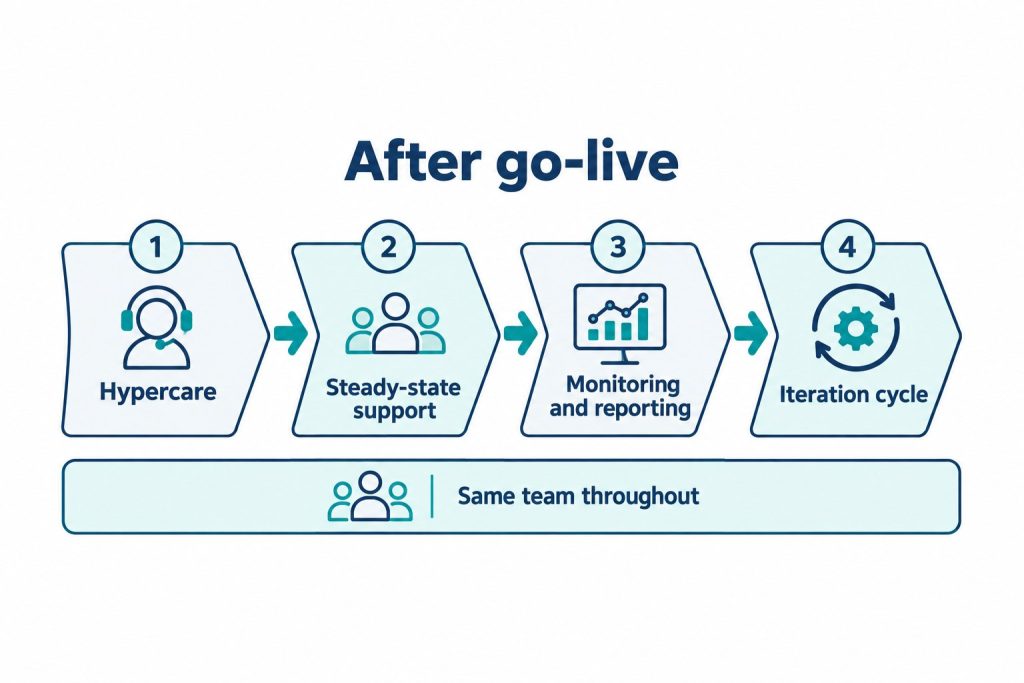
The period immediately following launch is where most operational issues surface, and getting through it well sets the tone for the rest of the relationship. Industry practice generally treats the first 30 to 90 days after go-live as a stabilization window, often called hypercare, where the priority is rapid-response troubleshooting rather than new feature work [rockcrest.com]. During this window, the objectives are narrower than people expect:
- Stability first. The primary goal in month one is establishing that the system behaves consistently under real usage, not adding capability [bizowie.com].
- Adoption tracking. Usage data reveals whether end users are actually relying on the system or working around it, which is a leading indicator of long-term value [vfp-consulting.com].
- Rapid-response troubleshooting. Issues that would be minor in a mature system can undermine confidence entirely if they happen in week one, so response time matters disproportionately during this phase [rockcrest.com].
- Training reinforcement. Support during this period isn’t just technical; personalized assistance and follow-up training measurably improve adoption and user confidence [hrchitect.com].
Fooyo builds this stabilization period into the pilot-to-production path explicitly. Because deployments run in the client’s private cloud, the stabilization phase also includes confirming that access controls, encryption, and audit logging are behaving as configured, not just that the AI is answering questions correctly.
How Should an AI Implementation Partner Structure an Ongoing Support Contract?
Post-go-live support is not a one-time event; it needs to function as an ongoing operating relationship with a partner who stays engaged after launch [blog.mastek.com]. This is where the choice of AI implementation partner has the biggest downstream effect, because a partner that treats delivery as complete at go-live has structurally different incentives from one that treats go-live as the start of an operating relationship.
Documented best practice for enterprise AI contracts backs this up: agreements should be structured as ongoing “as a service” commitments rather than fixed-price one-time products, precisely because AI capabilities update continuously and the contract needs to accommodate that without renegotiation every quarter. Fooyo’s engagement model follows this shape directly:
- 30-minute demo to establish fit and scope.
- Scoped pilot to validate the use case against real data and workflows.
- Private-cloud deployment, so the client’s data and the trained system live inside their own environment rather than a shared public model.
- Ongoing operation and support, structured as a continuing relationship rather than a handoff.
This is a meaningfully different structure from firms that operate as a delivery-then-exit consultancy. A report or prototype has no ongoing operating requirement. A production AI system that’s answering customer questions, triggering workflow actions, or managing a storefront does, and the contract needs to reflect that from the outset rather than being renegotiated as an emergency once something breaks.
What Does “AI Managed Services” Actually Include Day to Day?
AI managed services is the ongoing operational layer that keeps a production AI system accurate, secure, and aligned with a business’s changing needs after initial deployment. It is distinct from a support ticket queue. In practice, it covers several categories that map to the technical shape of the system itself. A RAG-based knowledge base, for example, depends on four core components: an external knowledge base, a retriever, an integration layer, and a generator model, and each of those needs different ongoing attention.
| Component | What Ongoing Support Covers |
|---|---|
| Knowledge base / data layer | Re-extraction, re-chunking, and re-embedding as source documents change, so answers stay grounded in current information |
| Retriever | Tuning search relevance as the volume and variety of content grows |
| Integration layer | Keeping connections to CRM, POS, CMS, or messaging channels working as those client systems get updated independently |
| Generator (LLM) and workflows | Monitoring output quality, source citation accuracy, and human review gates on any automated action the AI triggers |
Because Fooyo’s products connect into a client’s existing stack rather than replacing it, a meaningful share of ongoing support work is integration maintenance: catching and adapting to changes on the client’s side of the connection before they cause a visible failure on the AI side.
How Does Private-Cloud Deployment Change What Support Needs to Cover?
Building on the technical maintenance above, a separate but connected question is what changes when the deployment itself is private rather than shared. Running in a client’s own private cloud, as opposed to a shared public AI model, adds security and compliance obligations to the support scope that a public-model deployment doesn’t carry in the same way. For clients operating in Singapore, this means private cloud deployments must comply with the Personal Data Protection Act (PDPA), which governs how personal data is collected, used, and protected. Singapore does not mandate strict data localization and permits cross-border data flows, but organizations remain responsible for ensuring that any data transferred overseas receives a comparable standard of protection.
On top of regulatory compliance, ongoing operations need to maintain baseline security practices: encryption at rest and in transit, least-privilege access controls, and comprehensive audit logging. These aren’t one-time setup tasks. Access permissions change as staff turn over, encryption certificates expire, and audit logs need regular review to be useful at all. A support contract that only covers “is the AI answering correctly” and skips this layer is missing half of what private deployment actually requires.
Why Does Human-in-the-Loop Review Stay Relevant After Launch?
A related but distinct question from security is oversight of the AI’s actual outputs. It’s tempting to treat human review as a pre-launch safety net that becomes unnecessary once the system is proven. That’s backwards. Grounded, source-cited responses reduce the risk of confidently wrong answers, but they don’t eliminate the need for review gates on automated actions, particularly as usage scales and the system encounters edge cases it wasn’t tested against during the pilot. Fooyo keeps human-in-the-loop checkpoints built into every automated workflow specifically because this risk doesn’t disappear after go-live; it shows up in different forms as the system handles more volume and more varied inputs over time.
Frequently Asked Questions
What is the difference between post go-live support and AI managed services?
Post go-live support usually refers to the stabilization window immediately after launch, typically 30 to 90 days, focused on troubleshooting and adoption [rockcrest.com]. AI managed services is the longer-term operational layer that continues indefinitely, covering data refresh, integration maintenance, security, and monitoring.
How long should hypercare last after an AI system goes live?
Hypercare, the intensive rapid-response period right after launch, typically spans 30 to 90 days depending on system complexity [rockcrest.com]. Simpler pilots stabilize faster; systems integrated across multiple client platforms take longer.
Why do AI systems need ongoing support when traditional software doesn’t need as much?
Because AI systems are grounded in data that changes continuously, and because best practice calls for continuous monitoring and testing to catch model drift before it affects users, rather than reacting after complaints arrive.
Does private-cloud deployment cost more to support than a shared AI model?
It requires a different scope of support, primarily around encryption, access control, and audit logging, rather than inherently more effort. The tradeoff is that client data stays within the client’s own environment rather than training a shared public model.
What should a company look for in an AI implementation partner’s support contract?
Look for an ongoing “as a service” structure rather than a fixed-price handoff, explicit stabilization periods, and clear coverage of both technical monitoring and compliance obligations like data residency.
Can an AI knowledge base fall out of date even after a successful launch?
Yes. If the underlying documents change and the retrieval layer isn’t refreshed, the system will keep answering confidently with outdated information, which is why re-indexing and monitoring are ongoing tasks, not one-time setup steps.
About Fooyo
Fooyo is a Singapore-headquartered company that builds AI knowledge bases, marketing AI tools, commerce platforms, and smart tourism systems for government agencies, enterprises, and SMEs across Asia, with additional offices in Chengdu and Tokyo. Every product deploys into the client’s own private cloud, integrates with existing systems like CRM, POS, and CMS rather than requiring replacement, and moves from pilot to production in weeks rather than the typical enterprise timeline of many months. Fooyo’s engagement model, from a 30-minute demo through pilot, deployment, and ongoing operation, is built specifically so that go-live is the start of the partnership rather than its conclusion.
If your organization is evaluating what ongoing AI operation and support should actually look like, get in touch with Fooyo to talk through what a pilot and long-term support structure would look like for your systems.
References
- What Happens After ERP Go-Live: The First 180 Days That Decide Success or Failure – Bizowie (bizowie.com)
- Ensuring Post-Go-Live Success: Transitioning from … (rockcrest.com)
- Understanding the Importance of Post Go-Live Support (blog.mastek.com)
- Why Maintain A Strong Support Team After Go-Live (hrchitect.com)
- After Go-Live: Adoption and Continuous Improvement – VFP Consulting (vfp-consulting.com)