Integrating WeChat Pay into a Singapore business isn’t a matter of dropping in a QR code widget. It requires a licensed local acquirer to satisfy Payment Services Act rules, API v3 authentication using a Merchant ID, App ID, API v3 Key, and RSA-SHA256 signatures, PCI DSS-compliant infrastructure, and a settlement pipeline that converts Chinese Yuan into Singapore Dollars on a T+1 basis. Most of the complexity sits behind the checkout button, in the parts customers never see: signature verification, webhook handling, encryption, and reconciliation. Get the backend wrong and the payment fails silently, or worse, settles incorrectly.
TL;DR
- WeChat Pay integration in Singapore runs through a MAS-licensed local acquirer, not a direct link to Tencent’s China infrastructure.
- The technical core is API v3: Merchant ID, App ID, API v3 Key, RSA-SHA256 signatures, and endpoints like
/v3/pay/transactions/nativefor QR payments. - Transaction fees typically run 0.5% to 0.6%, with settlement on a T+1 cycle and automatic CNY-to-SGD conversion.
- Security compliance includes PCI DSS, AES-256-GCM encryption for payloads, and RSA signature verification on webhook notifications.
- WeChat Pay has grown from roughly 600 Singapore merchants in 2018 to over 100,000 local retail outlets by 2026, making the integration decision less about “if” and more about “how well.”
About the Author: This article draws on Fooyo’s experience building AI-powered storefront and commerce systems for clients across Singapore, Indonesia, and Japan, including payment-layer integrations for the China market through Fooyo Commerce® and WeChat Mini Program readiness work documented on Fooyo’s Medium blog.
Why Does WeChat Pay Matter for Singapore Merchants?
WeChat Pay matters because the user base behind it has grown fast and isn’t going away. Adoption expanded from about 600 merchants in Singapore in 2018 to more than 100,000 local retail outlets by 2026, driven by Chinese tourists, expatriates, and residents who prefer paying in a currency and app they already trust. For a retail, F&B, or hospitality business, that’s a payment method a meaningful slice of customers expect to see at checkout, not a niche add-on. The strategic question isn’t whether to support it, but whether the backend is built to handle it reliably at scale.
What Are the Core Technical Requirements for WeChat Pay Integration?
The technical foundation is WeChat Pay’s API v3, and getting this right is the single biggest determinant of whether an integration runs smoothly or breaks under load. Every request needs four credentials working together: a Merchant ID, an App ID, an API v3 Key, and an RSA-SHA256 signature attached to each call. Think of the signature the way a notarized document works: it doesn’t hide the content, but it proves the request came from who it claims to and hasn’t been tampered with in transit.
- Native QR payments route through
/v3/pay/transactions/native, generating a code for in-store or desktop checkout. - Mobile web payments use
/v3/global/transactions/mweb, redirecting users from a browser into the WeChat app. - Webhook notifications confirm payment status asynchronously, and each one must be verified before your system marks an order as paid.
A common mistake is treating the webhook as a formality. If a merchant’s backend updates order status the moment a payment request is sent, rather than waiting for a verified webhook confirmation, refunds and double-fulfillment issues follow.
What Regulatory and Compliance Rules Apply in Singapore?
Building on the technical layer above, compliance is where a Singapore-specific integration diverges from a generic international one. Under MAS guidelines, WeChat Pay transactions processed in Singapore must go through a licensed local acquirer to comply with the Payment Services Act, rather than connecting merchants directly to Tencent’s China-side settlement rails. On top of that, any merchant handling customer payment data must follow Singapore’s Personal Data Protection Act for how that data is stored, accessed, and retained. Cross-border settlement adds a third layer: because funds move between Chinese Yuan and Singapore Dollars, transactions are subject to both MAS oversight and Chinese foreign exchange rules simultaneously. This is one reason working with a MAS-licensed payment services provider matters more here than in a market without cross-border currency conversion built into every transaction.
What Do Transaction Fees and Settlement Actually Look Like?
Cost and cash flow timing are usually the first questions a finance team asks, and the answer is fairly consistent across providers. WeChat Pay typically charges Singapore merchants a transaction fee of around 0.5% to 0.6%, though the exact rate depends on industry category and which payment service provider handles the acquiring relationship. Settlement generally lands on a T+1 basis, meaning a transaction processed today is typically available the next business day. Because the customer pays in Chinese Yuan, the conversion into Singapore Dollars happens automatically as part of that settlement cycle, so the merchant never has to manage the FX leg manually.
WeChat Pay vs Alipay: How Do They Compare for Backend Integration?
Merchants weighing wechat pay vs alipay often assume the two are interchangeable, but the backend requirements aren’t identical. Both rely on QR-based flows and require a licensed local acquirer for Singapore-based settlement, and both convert from CNY at the point of settlement. The practical difference tends to show up in ecosystem behavior rather than raw fee structure: WeChat Pay integration is often paired with WeChat Mini Program storefronts and in-chat commerce flows, since payment and messaging sit inside the same app, while Alipay integrations more commonly stand alone as a checkout option. For a business already building a WeChat presence for marketing or customer service, integrating WeChat Pay through the same technical stack tends to be more efficient than treating payments as a separate project [worldfirst.com][airwallex.com].
What Security Standards Does the Backend Need to Meet?
Security isn’t a checkbox exercise here, it’s built into the API mechanics themselves. Integrated merchants are required to meet Payment Card Industry Data Security Standard requirements, the same baseline used across most card and digital wallet processing globally. On top of PCI DSS, WeChat Pay’s API v3 specifically requires AES-256-GCM encryption for decrypting sensitive payload data and RSA signature verification for every webhook notification received. The logic mirrors a sealed envelope with a wax seal: encryption keeps the contents private in transit, and the signature proves the seal hasn’t been broken or forged along the way. Skipping signature verification on webhooks is a common shortcut in rushed integrations, and it’s precisely the gap that opens the door to fraudulent payment confirmations.
How Should a Singapore Business Approach the Integration Process?
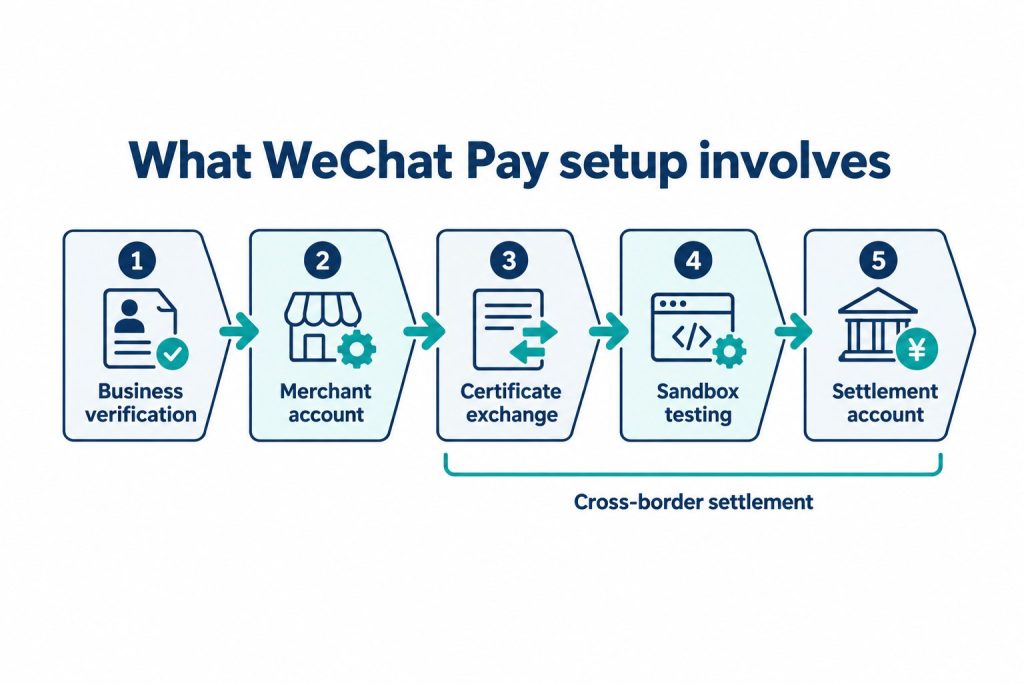
Pulling the pieces above together, a sound integration sequence looks like this:
- Select a MAS-licensed acquirer or payment gateway provider that already handles WeChat Pay settlement for Singapore merchants.
- Register and provision API v3 credentials, including Merchant ID, App ID, and API v3 Key, with signature generation built into the checkout flow.
- Build webhook handling with verification as a non-negotiable step before updating order or inventory status.
- Confirm PDPA-compliant data storage for any customer or transaction data retained on your servers.
- Test settlement reconciliation against the T+1 timeline before going live, so finance teams aren’t surprised by currency conversion entries.
This is also where the integration approach matters as much as the payment method itself. Bolting a payment gateway onto a storefront that wasn’t built with that flexibility in mind often means rebuilding checkout logic from scratch. Fooyo Commerce® was built to plug payment, product listings, and AI merchandising into one storefront stack without requiring a wholesale rebuild, which is the same integration-first philosophy Fooyo applies across its AI Knowledge Base and workflow automation products: connect to what already exists rather than replacing it.
Frequently Asked Questions
Does WeChat Pay work directly with a business’s existing POS system?
It depends on the POS vendor. Most licensed payment gateway providers offer plugins or APIs that connect WeChat Pay to common POS and e-commerce platforms, but custom-built systems typically need direct API v3 integration.
What are typical wechat pay transaction fees for a small Singapore retailer?
Rates generally fall between 0.5% and 0.6%, though the exact figure depends on industry category and which provider handles the acquiring relationship.
How long does settlement take after a WeChat Pay transaction?
Settlement is generally T+1, meaning funds are typically available the next business day, with CNY automatically converted to SGD.
Is a Singapore business allowed to settle WeChat Pay transactions directly with Tencent in China?
No. Under MAS rules, transactions must be processed through a licensed local acquirer to comply with the Payment Services Act.
What’s the difference between WeChat Pay and Alipay for a merchant’s backend?
Both require a licensed local acquirer and follow similar QR-based checkout flows, but WeChat Pay integrations are more often tied into broader WeChat Mini Program and messaging features, while Alipay tends to function as a standalone payment option [worldfirst.com][airwallex.com].
Does a small business need PCI DSS compliance to accept WeChat Pay?
Yes. PCI DSS compliance is required of integrated merchants regardless of business size, since it governs how payment data is handled and secured.
Can WeChat Pay be integrated without a developer?
Some payment gateway providers offer plug-and-play modules for common e-commerce platforms, but custom storefronts or POS systems generally require developer involvement to handle API v3 authentication and webhook verification correctly.
About Fooyo
Fooyo is a Singapore-headquartered company that builds AI knowledge bases, workflow automation, and applied AI products with production deployments running in clients’ own private cloud environments rather than shared public models. Its product lineup, including Fooyo Commerce® for storefront and payment integration, an AI Knowledge Base for grounded internal search, and workflow automation tools, serves businesses operating across Singapore, China, and Japan. Fooyo works with government agencies, enterprises, and SMEs across Asia, and its integration-first approach means new capabilities like payment gateways plug into existing CRM, POS, and CMS systems rather than requiring a rebuild. With offices in Singapore, Chengdu, and Tokyo, Fooyo is positioned to support both the technical and market-specific requirements that come with cross-border commerce.
If your business is weighing a WeChat Pay integration, or building a broader storefront that needs to work across Singapore and China from day one, get in touch with Fooyo to see how a production-ready setup comes together in weeks rather than months.
References
- A Guide to WeChat Pay for Businesses (stripe.com)
- How to Use Alipay & WeChat Pay in Singapore (worldfirst.com)
- WeChat Pay Singapore: The Ultimate Merchant Guide | nashi (trynashi.com)
- Alipay and WeChat Pay in Singapore: The Complete Guide (2026) | Airwallex SG (airwallex.com)