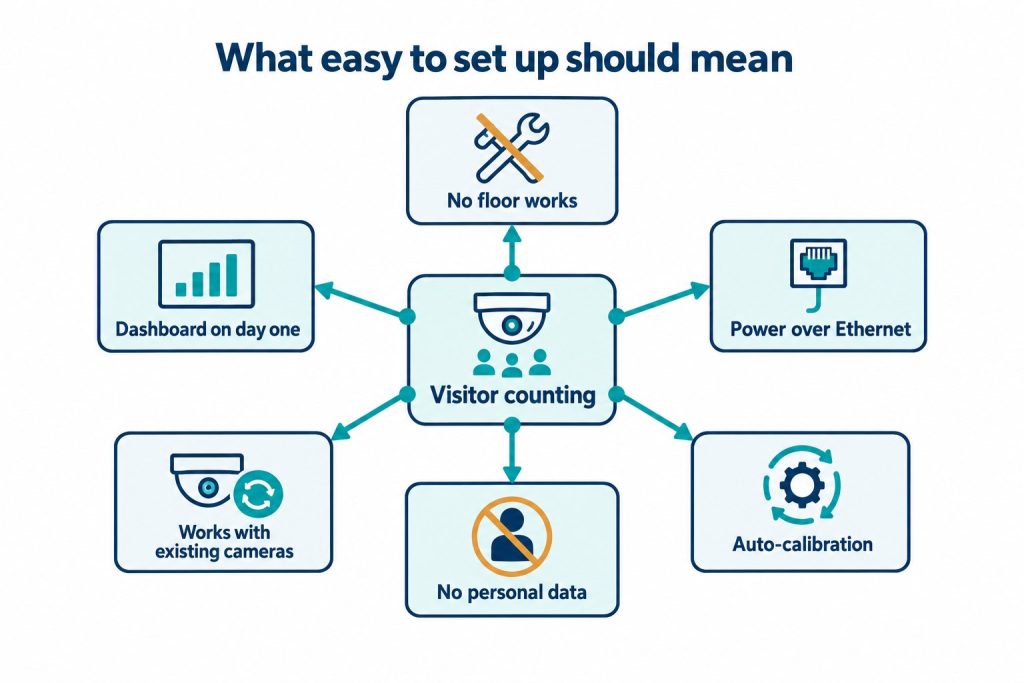
“Easy to set up” for a visitor counting system should mean a defined 2 to 4 week rollout covering site assessment, sensor installation, and configuration, with counting accuracy that holds at 95 percent or higher once the system is live, not just on day one. For mid-size malls, the phrase gets used loosely by vendors to describe plug-and-play hardware, but the real test is whether the system still counts accurately after six months of foot traffic, seasonal layout changes, and staff turnover on the operations side. A system that is easy to install but hard to keep accurate has just moved the difficulty from week one to month six.
TL;DR
- “Easy to set up” should be judged on total time-to-reliable-data (2 to 4 weeks standard, 1 to 5 business days for expedited deployments using existing CCTV), not just physical installation speed.
- Accuracy varies meaningfully by sensor type: computer vision and 3D stereo (95-99 percent), thermal/infrared (97-99 percent), and WiFi-based tracking (92-93 percent).
- Compliance in Singapore and other Asian markets requires privacy-by-design, meaning edge processing without storing personally identifiable or biometric data.
- Mall management software should treat people counting data as an input to occupancy monitoring and operational decisions, not a standalone dashboard number.
- Vendor claims about accuracy should be benchmarked against the 98 percent or higher standard used by leading systems, and re-tested after installation, not taken at face value.
About the Author: Fooyo is a Singapore-headquartered company building data platforms and AI agents for enterprises across retail, hospitality, and tourism, including a Smart Tourism platform that processes live crowd data for destinations and venues. This gives Fooyo direct, hands-on exposure to the gap between what counting systems promise on a spec sheet and what mall operators actually need from the data day to day.
What Does “Easy to Set Up” Actually Mean for a Visitor Counting System?
It means the time between signing a contract and having trustworthy, actionable data is short and predictable, not just that the hardware mounts quickly. Standard implementation for mid-size retail facilities typically takes 2 to 4 weeks, covering site assessment, installation, and configuration. Expedited deployments can be completed in 1 to 5 business days when the project leverages existing CCTV infrastructure and cloud-based SaaS platforms, skipping new sensor hardware entirely.
Many vendors market “easy to set up” purely in terms of the physical mounting process for people counting sensors [footfallcam.com][trafsys.com]. That’s a narrow definition. A doorway sensor can be screwed into a frame in twenty minutes and still take three weeks before the mall’s operations team can trust the numbers it produces, because configuration, calibration against actual foot traffic patterns, and integration with existing mall management software all happen after the hardware goes up.
Why Does Sensor Type Change What “Accurate” Means?
Because different sensor technologies trade off accuracy against cost, privacy posture, and resilience to real-world conditions like crowding and lighting. There is no single accuracy number that applies across all people counting sensors; the technology underneath the count matters as much as the count itself.
| Sensor Type | Typical Accuracy | Best Suited For |
|---|---|---|
| Computer vision / 3D stereo | 95-99% | Wide entrances, atriums, and areas needing directional counting |
| Thermal / infrared | 97-99% | Narrow doorways and single-entry points where lighting is inconsistent |
| WiFi-based tracking | 92-93% | Zone-level occupancy monitoring across a large floor plate |
Computer vision and 3D stereo systems generally sit at the top of the accuracy range, but their performance can vary based on lighting and occlusion, meaning a crowded entrance during a sale event can push actual accuracy toward the lower end of that band. Thermal and infrared sensors hold up better under variable lighting and are a reasonable fit for narrow doorways and single-entry points [trafsys.com], but they capture less contextual detail than a vision-based retail people counting setup. WiFi-based tracking is the least precise of the three but useful when the goal is occupancy monitoring across zones rather than exact headcounts at a single door.
How Should a Mid-Size Mall Decide Where to Place Sensors?
Placement should follow the mall’s actual traffic architecture, not a generic “one sensor per door” rule. The building question here is straightforward: what decision will this data drive? If the answer is fire-code occupancy limits, sensors need to cover every entry and exit point with enough accuracy to sum to a reliable building-wide total. If the answer is tenant-level footfall reporting for lease negotiations, sensors need to sit at zone boundaries, not just the mall’s main doors.
A useful analogy: think of sensor placement like metering electricity in a building with multiple tenants. A single meter at the main supply line tells the landlord total consumption, but it can’t tell any individual tenant what they used or justify a billing dispute. Zone-level metering costs more to install but produces data that survives scrutiny. The same logic applies to a visitor counting system feeding retail people counting reports to tenants, mall management, or leasing teams; the level of granularity has to match who will actually use the number and for what decision.
- Main entrances: prioritize accuracy over cost, since this feeds total footfall reporting.
- Tenant zone boundaries: prioritize consistent placement across zones so comparisons between tenants are fair.
- Escalators and internal circulation points: useful for occupancy monitoring and crowd flow, less critical for total footfall accuracy.
What Compliance Requirements Apply to Real Time People Counting in Singapore and Asia?
Building on the placement question above, where sensors sit also determines what compliance obligations apply, since a camera-based sensor positioned to capture faces raises different regulatory concerns than a thermal sensor counting silhouettes. In major Asian markets, visitor counting systems must comply with regional data protection laws like Singapore’s PDPA and India’s DPDP Act by ensuring privacy by design. In practice, this typically requires processing data at the edge, meaning counts are generated on the device itself, without storing personally identifiable information or biometric data like facial recognition.
This matters more for mid-size malls than it might first appear. A mall running a real time people counting system across dozens of entry points generates a continuous stream of visual data. If that data is stored centrally and includes recognizable faces, the compliance burden multiplies: retention policies, access controls, and breach notification obligations all attach to it. Systems designed to count without retaining identifiable images sidestep most of that burden by design, not by policy alone.
Which Industry Standards Should Buyers Actually Check?
A related but distinct question from compliance is certification: regulatory law sets the floor, but industry standards indicate whether a vendor has been independently audited against a recognized bar. Current industry standards for visitor counting systems emphasize data security and privacy, with ISO 27001 and ISO 27701 being the most widely adopted certifications. Leading systems also benchmark their counting accuracy against a standard of 98 percent or higher to ensure reliable retail analytics.
Buyers evaluating an occupancy monitoring system should ask for two things specifically: proof of current ISO 27001/27701 certification (not just “compliant with”), and an accuracy figure benchmarked under real crowd conditions, not laboratory conditions. A vendor quoting 98 percent accuracy without specifying test conditions is giving a number, not evidence.
How Does People Counting Data Connect to Broader Mall Management Software?
Stepping back from sensor-level detail, the harder question for most mall operators isn’t which sensor to buy, it’s what to do with the count once it exists. A people counting system that sits in isolation from mall management software produces a number on a dashboard and little else. The value shows up when footfall data triggers something: adjusting staffing levels, informing tenant mix decisions, or feeding energy management systems that scale HVAC and lighting to actual occupancy rather than fixed schedules.
This is the same principle behind treating a visitor counting deployment as a data platform decision rather than a hardware purchase. Fooyo’s work building data platforms and AI agents for enterprises, including a Smart Tourism platform that processes live crowd data for destination and venue operators, reflects this pattern: the sensor is the input, but the operational value comes from what a knowledge base or automated workflow does with that data once it flows in. A mid-size mall considering a counting system should ask its integrator the same question asked of any enterprise AI deployment: does this plug into existing systems, or does it require a rip-and-replace of the mall’s current CRM, CMS, or reporting tools?
Frequently Asked Questions
How long does a visitor counting system take to install in a mid-size mall?
Standard implementation typically takes 2 to 4 weeks, covering site assessment, installation, and configuration. Deployments using existing CCTV infrastructure and cloud-based platforms can be completed in 1 to 5 business days.
What accuracy rate should a mall expect from people counting sensors?
It depends on sensor type: computer vision and 3D stereo systems typically achieve 95 to 99 percent, thermal and infrared sensors 97 to 99 percent, and WiFi-based tracking around 92 to 93 percent.
Do people counting systems require facial recognition to work?
No. Compliant systems in markets governed by PDPA and similar laws process data at the edge and do not need to store facial recognition data or other biometric identifiers to produce accurate counts.
What certifications should a mall look for when choosing a vendor?
ISO 27001 and ISO 27701 are the most widely adopted certifications for data security and privacy in this category, alongside a documented accuracy benchmark of 98 percent or higher.
Can an existing CCTV system be used for people counting instead of new sensors?
Yes, this is one of the ways expedited 1 to 5 business day deployments are achieved, by layering counting software on cloud-based platforms connected to existing CCTV rather than installing new hardware.
Is WiFi-based tracking accurate enough for retail people counting?
It’s generally the least accurate of the common options, at around 92 to 93 percent, making it better suited to broad occupancy monitoring across zones than to precise entrance-level footfall counts.
Why does sensor placement matter more than sensor accuracy alone?
Because a highly accurate sensor in the wrong location still produces data that doesn’t answer the operator’s actual question, whether that’s total mall footfall, tenant-level reporting, or occupancy limits for compliance.
About Fooyo
Fooyo is a Singapore-headquartered company that builds data platforms and AI agents for enterprises, deploying production-grade AI products into clients’ private cloud environments rather than delivering prototypes or reports. Its Smart Tourism platform works with live crowd data, AI-powered guides, and engagement tools for destinations and venues, giving it direct experience turning raw occupancy and footfall data into operational decisions. Fooyo is trusted by government agencies, enterprises, and SMEs across Asia, with delivery capability spanning Singapore, China, Japan, and other markets. The company’s integration-first approach, connecting into existing CRM, POS, and CMS systems rather than requiring a rip-and-replace, applies directly to how mall operators should evaluate any new counting or occupancy system before buying it.
If your mall is evaluating a visitor counting system or trying to connect existing footfall data to real operational decisions, get in touch with Fooyo to talk through what a working deployment actually looks like.
References
- People Counting System | People Counter | FootfallCam (footfallcam.com)
- People Counting Technology for Crowd Management and … (trafsys.com)