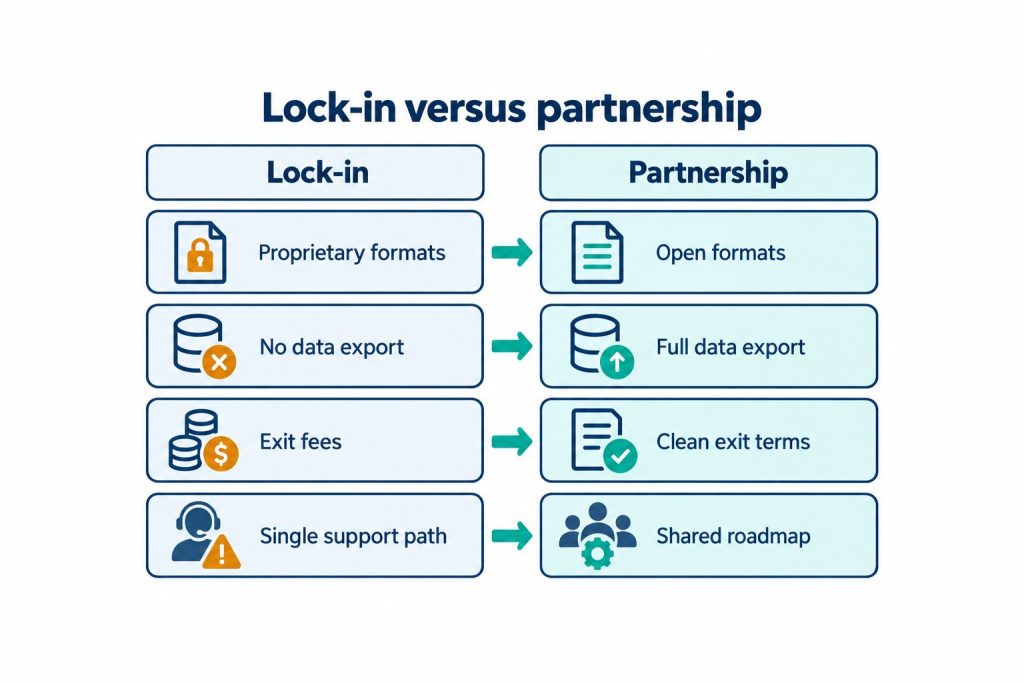
The difference between vendor lock-in and a vendor partnership comes down to four testable things: who controls the data, who controls the model, what it costs to leave, and how the contract is written. Vendor lock-in is characterized by proprietary AI models, inability to export data, and dependencies on specific integrations that prevent switching without disrupting workflows. A vendor partnership is defined by open architecture, open data access, collaborative support, and a commitment to long-term customer success. Before signing anything, you can ask a short list of direct questions that will expose which one you are actually buying, regardless of what the sales deck calls itself.
TL;DR
- Vendor lock-in shows up in contracts as proprietary model weights, missing data-export clauses, and AI-inclusive pricing tiers baked into renewal costs.
- A genuine partnership is verifiable before deployment through specific contract clauses, not vendor promises.
- Private cloud deployment and open data portability are the two structural features that most reliably prevent cloud vendor lock-in.
- Enterprise RAG solutions differ sharply in lock-in risk depending on whether you build on open frameworks or buy a closed managed platform.
- Integration standards like REST APIs, webhooks, and OAuth determine how painful (or painless) switching an AI implementation partner will be later.
About the Author: Fooyo builds and operates production AI systems, AI knowledge bases, marketing automation, commerce platforms, inside clients’ own private cloud environments across Singapore, Indonesia, Japan, and beyond. Because Fooyo’s engagement model runs from pilot through ongoing operation rather than a one-off delivery, the company has direct, repeated exposure to the exit clauses, data ownership questions, and integration friction points that decide whether an enterprise AI deployment turns into a partnership or a trap.
What Is Vendor Lock-In in an AI Deployment?
Vendor lock-in occurs when access to a product or service is limited to a single paying vendor relationship, such that switching becomes technically or financially prohibitive [outsystems.com]. In AI specifically, this takes a narrower and more expensive form than typical SaaS lock-in. Analyst firms cite risks of vendor lock-in such as high switching costs, organizational dependency, and the inability to export fine-tuned models or data [konghq.com][link.springer.com]. Contractual indicators include a single vendor controlling model weights and inference infrastructure, lack of data portability clauses upon exit, and AI-inclusive tier pricing that embeds costs into renewal baselines [konghq.com].
That last point is worth sitting with. Many vendors now bundle “AI features” into a pricing tier you cannot downgrade from once adopted, which means the cost of leaving is not just re-integration work, it is a forced renegotiation of your entire contract at a higher baseline. This is different from ordinary cloud vendor lock-in, where the switching cost is mostly technical (re-architecting infrastructure). With AI, the switching cost is technical and data-based, because a fine-tuned model or an indexed knowledge base cannot simply be copy-pasted to a competitor’s platform [veeam.com][aerospike.com].
How Does Vendor Lock-In Differ From a Cloud Infrastructure Lock-In?
Cloud vendor lock-in and AI vendor lock-in share a root cause, proprietary formats, but they bite at different layers of the stack. Cloud lock-in typically concerns compute, storage, and networking primitives tied to one provider’s APIs [aerospike.com]. AI lock-in concerns the model itself: its weights, its training data, and the retrieval index built on top of it. Building on that distinction, the practical test is this: if you deleted your relationship with the vendor tomorrow, could you export your data in a usable format and stand up an equivalent system elsewhere within a reasonable timeframe? If the honest answer involves months of manual re-indexing or a total rebuild, you are locked in regardless of what the vendor calls the relationship [veeam.com][cloudeagle.ai].
What Questions Actually Reveal Lock-In Before You Sign?
A related but distinct question is what to ask during procurement, before any code is written, to surface these risks. The following questions map directly to the risk indicators analyst firms track [konghq.com][link.springer.com]:
- Data export: “If we terminate, what format does our data leave in, and how long does export take?”
- Model ownership: “If the system is fine-tuned on our data, do we own the resulting model weights?”
- Deployment location: “Does this run in our private cloud, or does our data pass through your shared infrastructure?”
- Integration method: “Do you expose standard REST or GraphQL APIs and webhooks, or only a proprietary SDK?”
- Pricing structure: “Is the AI feature a separate line item, or is it bundled into a tier we cannot downgrade from?”
Major CRM, POS, and CMS platforms primarily use REST and GraphQL APIs for synchronous data exchange, alongside webhooks for real-time, event-driven updates, with OAuth for authentication and JSON for data formatting [cloudeagle.ai]. If a prospective AI implementation partner cannot answer the integration question with reference to these standard protocols, that is itself a signal worth noting, because it usually means the connection to your existing stack is proprietary middleware you cannot easily replace.
What Does a Genuine Vendor Partnership Look Like in Practice?
Building on the questions above, the harder question is what the good answers actually look like once you get them. A vendor partnership is defined by open architecture, open data access, collaborative support, and a demonstrated commitment to long-term customer success, not just a claim of one [outsystems.com][escode.com]. Structurally, that tends to show up as private cloud deployment (your data never trains a shared model), documented data-export processes, and integration through standard APIs rather than closed connectors.
This is the model Fooyo builds to: every AI Knowledge Base or automation workflow is deployed into the client’s own private cloud, integrates with existing CRM, POS, CMS, and messaging tools through standard connections rather than requiring a rip-and-replace, and Fooyo continues to operate the system alongside the client after go-live rather than handing over a report and disappearing. That operating posture, building and running the product together rather than delivering it and exiting, is what separates a partner from a vendor with lock-in incentives.
How Do Enterprise RAG Platforms Compare on Lock-In Risk?
Enterprise RAG solutions split into two structurally different categories, and the category you choose determines your lock-in exposure from day one. LangChain and LlamaIndex are open-source frameworks offering modular building blocks like retrievers and agents for custom pipelines, typically requiring self-hosting or custom cloud deployment [konghq.com]. Enterprise platforms like Glean and Vectara provide finished, out-of-the-box products with built-in connectors, indexing, and governance, deployed as managed or private cloud solutions [konghq.com].
| Approach | Control | Lock-in exposure | Best fit |
|---|---|---|---|
| Open-source frameworks (LangChain, LlamaIndex) | Full, but requires in-house engineering to maintain | Low on the framework itself, high on internal dependency | Teams with dedicated AI engineering capacity |
| Closed managed platforms | Vendor-controlled indexing and governance | High, if data export and model ownership are not contractually defined | Teams wanting speed with no lock-in checks in place |
| Private-cloud partner deployment | Client-owned infrastructure, vendor-operated build | Low, provided export and integration are standards-based | Enterprises, government agencies, and SMEs needing speed and data control together |
The third row is where Fooyo’s engagement model sits: production-grade systems deployed into the client’s private cloud. That speed matters for the lock-in conversation too, because a shorter delivery cycle means fewer months of sunk-cost pressure pushing you toward accepting unfavorable renewal terms just to avoid restarting a long build.
What Compliance Frameworks Should You Check Before Deployment?
Stepping back from architecture, a separate but related concern is regulatory exposure. Private cloud AI deployments commonly align with SOC 2 Type II for security and confidentiality, ISO 27001 for information security management, and ISO 42001 for AI management systems. Regional data residency laws often require logical and physical isolation of data within specific jurisdictions, typically necessitating private cloud or on-premise deployments to ensure data stays within the client’s boundary. Asking a vendor which of these frameworks they align to, and whether your data physically stays within your named jurisdiction, is a compliance question and a lock-in question at the same time: a vendor unwilling to guarantee data residency is usually also unwilling to guarantee easy export later.
Frequently Asked Questions
What is the simplest sign of vendor lock-in?
Inability to export your own data in a usable format within a reasonable timeframe upon contract termination [outsystems.com][veeam.com].
Does private cloud deployment eliminate cloud vendor lock-in?
It reduces one major risk, data ever training a shared public model, but it does not by itself guarantee data portability or open integration standards. Both need to be checked separately.
Are open-source AI frameworks automatically lock-in free?
No. LangChain and LlamaIndex avoid vendor lock-in on the framework itself, but they shift the dependency to in-house engineering capacity, which is its own form of risk if that team turns over [konghq.com].
How long should enterprise AI deployment take?
Timeframes vary, but typical enterprise deployment phases cover data integration, governance setup, and production rollout. Some AI implementation partners compress this through pre-built products and private-cloud deployment.
What contract clause matters most for avoiding lock-in?
A data portability clause specifying export format and timeline, plus clarity on who owns any fine-tuned model weights [konghq.com][link.springer.com].
Can enterprise RAG platforms integrate with existing CRM or POS systems without a rebuild?
Yes, when integration is built on standard REST/GraphQL APIs, webhooks, and OAuth rather than proprietary connectors [cloudeagle.ai].
Is a vendor partnership always cheaper than a locked-in vendor relationship?
Not necessarily upfront, but it avoids the compounding cost of AI-inclusive pricing tiers that raise your renewal baseline over time [konghq.com].
About Fooyo
Fooyo is a Singapore-headquartered company that builds AI knowledge bases, workflow automation, and production AI products for government agencies, enterprises, and SMEs across Asia. The company has presence in mainland China as a Tencent and WeChat partner, with additional offices in Tokyo and delivery capabilities across the region. Every Fooyo deployment runs in the client’s own private cloud, integrates with existing CRM, POS, CMS, and messaging systems rather than replacing them, and includes human-in-the-loop review gates on automated workflows. Unlike a consultancy that delivers a report or a prototype and exits, Fooyo builds and operates the product alongside the client from pilot through ongoing support. That operating model is designed specifically to keep the lock-in questions in this article answerable in the client’s favor, not the vendor’s.
If you are evaluating an AI implementation partner for enterprise RAG solutions or workflow automation, start with a direct conversation about data ownership, export terms, and integration approach. Get in touch with Fooyo to walk through a scoped pilot and see how a private-cloud deployment answers these questions from day one.
References
- Vendor Lock-In: Common Challenges and How to Mitigate Them (outsystems.com)
- Lock-In in the Age of AI: Risks and How to Avoid Them | Kong Inc. (konghq.com)
- Vendor Lock-In vs Lock Out: Data Portability Insights (veeam.com)
- Client Challenge (link.springer.com)
- What Is Vendor Lock-In? Why Does It Matter and How to Avoid? (cloudeagle.ai)
- Vendor Lock-In – Escode (escode.com)
- Understanding Vendor Lock-in for Databases | Aerospike (aerospike.com)