Migrating from a legacy chatbot to a grounded RAG knowledge base means moving your content, your query logs, and your retrieval logic into a new architecture that can cite its sources, without breaking the historical record of what users actually asked. The hard part isn’t connecting a new model to your documents. It’s preserving years of query history, intent patterns, and escalation data so the new system doesn’t start from zero. Done poorly, this is a data migration project with high failure rates and budget overruns. Done well, it’s a one-time re-platforming that makes every future answer traceable to a source document.
TL;DR
- A legacy chatbot usually relies on intent matching or keyword rules; a RAG knowledge base retrieves and cites actual source passages, which changes how query history needs to be structured and reused.
- Query history is an asset, not clutter. It contains your real intent taxonomy and should be mapped, not discarded, during migration.
- Most migration failures come from treating this as a content export job instead of a retrieval and metadata re-architecture.
- Data residency rules differ across Southeast Asia, so where the knowledge base and its logs are stored matters as much as what’s in them.
- Migrations should be scoped against the workflow and data readiness involved, not against a fixed industry-average week count.
About the Author: Fooyo builds and operates production RAG knowledge bases for government agencies, enterprises, and SMEs across Singapore, with operations in China and Japan as well, and deployments running in private cloud or fully on-premises depending on client data-residency needs. This article draws on that operational experience with grounded, source-cited retrieval systems rather than general commentary on the space.
What’s Actually Different Between a Legacy Chatbot and a Grounded RAG Knowledge Base?
A legacy chatbot answers from a fixed set of intents and scripted responses; a grounded RAG knowledge base retrieves relevant passages from your live content and generates an answer with a citation back to the source. The practical difference shows up the moment a user asks something the original designers didn’t anticipate. A rules-based bot either matches a trained intent or falls back to “I didn’t understand that.” A RAG system searches your knowledge base, pulls the most relevant chunks, and constructs an answer grounded in that retrieved content [instincthub.com]. This architecture combines large language models with retrieval over an internal knowledge base, allowing the system to reason over real content instead of a pre-scripted decision tree [instincthub.com].
That shift has a direct consequence for migration: the two systems store fundamentally different kinds of state. A legacy bot’s “memory” is its intent library and conversation flows. A RAG system’s memory is its document index, embeddings, and the metadata linking each retrieved passage to a source file [github.com]. If you only migrate content and skip the metadata layer, you get a chatbot that answers but can’t tell you where the answer came from, which defeats the point of moving to RAG in the first place.
Why Does Query History Matter So Much in This Migration?
Query history is the record of every question your users have actually asked your old chatbot, and it’s the single best source of truth for what your new knowledge base needs to retrieve well. Building on the architectural point above, the harder question is what happens to that history when the underlying system changes shape. Most teams treat query logs as an afterthought, something to export for reporting, when they should treat it as a training and validation set for the new retrieval layer.
Here’s the mechanism: a RAG system’s retrieval quality depends on how well its index covers the actual phrasing and intent patterns real users employ, not the phrasing a product team imagined when writing documentation. Historical queries reveal the gap between those two things. If your legacy chatbot logged three years of “how do I reset my password on the mobile app” phrased forty different ways, that’s forty real-world retrieval test cases you already have for free. Losing that history means your new system launches blind to the exact failure modes your old one already revealed.
- Intent coverage: query logs show which topics generate the most volume, so you can prioritize which documents get the richest metadata and chunking treatment first.
- Retrieval benchmarking: past queries paired with the (often wrong) old answers give you a baseline to measure whether the new RAG system actually improves accuracy.
- Escalation patterns: history showing where the old bot handed off to a human marks exactly where your new knowledge base has content gaps.
How Do You Migrate Query History Without Breaking It?
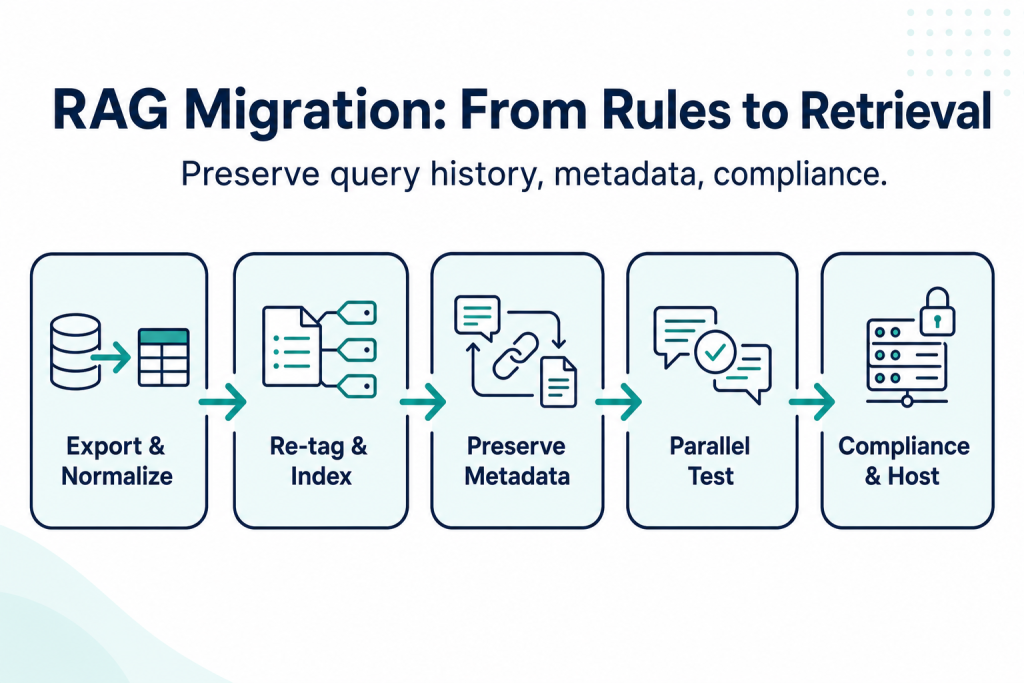
Migrating query history correctly means separating three layers: the raw query text, the old system’s response (right or wrong), and any resolution outcome, then re-mapping all three against your new retrieval index. A related but distinct question from coverage is structural: your legacy platform likely stored queries in a schema built around intents and slots, while your RAG system needs queries indexed against document chunks and embeddings. These are not the same shape of data, and a direct database copy will not work.
| Step | What it involves | Why it’s necessary |
|---|---|---|
| Export and normalize | Pull raw query text, timestamps, and old responses out of the legacy system’s native format | Legacy platforms often store this in proprietary schemas tied to their own intent engine |
| Re-tag against new taxonomy | Map each historical query to the document or topic it should have retrieved in the new knowledge base | Creates a ground-truth set for testing retrieval accuracy before go-live |
| Preserve metadata links | Keep the connection between each query, its source document, and resolution status | RAG systems require metadata links between retrieved passages and source documents to support citations and auditability |
| Run parallel testing | Feed historical queries into the new RAG system and compare outputs against old outcomes | Surfaces regressions before real users encounter them |
That third row deserves emphasis. RAG systems require retaining metadata links between retrieved passages and source documents to provide verifiable citations and auditability. This traceability helps users validate answers, though tracing every individual factual claim back to one specific source passage remains a practical challenge even in well-built production systems. Migrations that skip metadata preservation end up with a system that sounds confident but can’t show its work, which is often worse than the legacy bot it replaced.
Does Where You Host the Knowledge Base Change the Migration?
Yes, and this is a decision that needs to happen before migration starts, not after. Stepping back from the technical detail, a separate concern is jurisdictional: enterprises migrating knowledge bases in Asia have to navigate varying data residency laws. Indonesia’s Government Regulation No. 71/2019 mandates local storage for government data. Vietnam’s 2026 Personal Data Protection Law requires cross-border transfer assessments. Singapore’s PDPA takes a different approach, focusing on accountability for how data is handled rather than strict physical localization.
This matters for query history specifically because logs often contain personal information, customer identifiers, or regulated content embedded in the questions users asked. A private-cloud deployment keeps the knowledge base and its data on infrastructure the client controls, though queries may still reach an external model API for generation. A fully on-premises deployment means the data, including historical queries, never leaves the client’s own infrastructure at any point in the pipeline. Fooyo’s AI Knowledge Base supports both models, and the right choice depends on what regulatory regime governs the specific data involved, not a blanket preference for one over the other.
Why Do So Many of These Migrations Run Over Budget or Time?
Because teams scope the project as “move the content” when the real work is “re-architect retrieval, preserve metadata, and validate against history,” which is a fundamentally larger task. That mismatch between scope and estimate is the direct mechanical reason so many data migration projects run over budget or schedule. Industry benchmarks exist for integration work, but they represent averages across diverse circumstances and should not be treated as fixed timelines for your specific engagement.
In practice, the realistic answer is that migration timelines depend on the state of the existing content, how much query history needs re-mapping, how many systems the chatbot is integrated into, and how many approval stages the client’s compliance team requires. A knowledge base with a thousand well-structured articles and five years of clean logs moves faster than one with scattered PDFs, undocumented intents, and no query archive at all. Scoping against the actual workflow, rather than a fixed week count, is the only honest way to set expectations.
Frequently Asked Questions
Can I keep my old chatbot running during the migration?
Yes, and it’s generally advisable. Running both systems in parallel lets you compare answers on the same queries before cutting over, which is the clearest way to catch retrieval gaps.
What happens to query history that references outdated products or policies?
It still has value as an intent signal even if the specific answer is stale. The question phrasing tells you what users look for; the content behind it gets refreshed separately during migration.
Does a RAG knowledge base need the same volume of query history as the old chatbot had?
No. Even a partial history, several months of representative queries, is usually enough to validate retrieval accuracy and surface content gaps before launch.
Is a rag knowledge base harder to maintain than a rules-based chatbot once it’s live?
Maintenance shifts rather than increases. Instead of updating intent trees, you’re updating source documents and metadata, which tends to scale better as content grows.
Can query history be migrated if the legacy chatbot vendor won’t provide a clean export?
It depends on what access the vendor contract allows. This is worth checking before migration planning starts, since it directly affects timeline and scope.
Do I need full on-premises hosting to be compliant with regulations like Indonesia’s GR 71/2019?
Only if the data in question is classified as government data under that regulation. Private-cloud deployment with clear data handling controls satisfies many other compliance regimes, including Singapore’s PDPA.
About Fooyo
Fooyo is a Singapore-headquartered company, with additional offices in Chengdu and Tokyo, that builds and operates production AI systems for clients rather than handing over a report and walking away. Its AI Knowledge Base product is a RAG system built specifically for grounded, source-cited answers with metadata traceability built in from the start, deployed into a client’s private cloud or fully on-premises depending on data-residency requirements. Fooyo is trusted by government agencies, enterprises, and SMEs across Asia. Engagements start with a 30-minute demo and a scoped pilot, with the migration and integration timeline set against the actual state of your content and query history rather than a generic industry average.
If you’re planning a move off a legacy chatbot and want to keep your query history intact through the transition, get in touch with Fooyo to scope what that migration actually looks like for your data.
References
- OptyxStack/rag-knowledge-base-chatbot: RAG Support AI … (github.com)
- Kicking Off Our Customer Support Chatbot Project with RAG (instincthub.com)