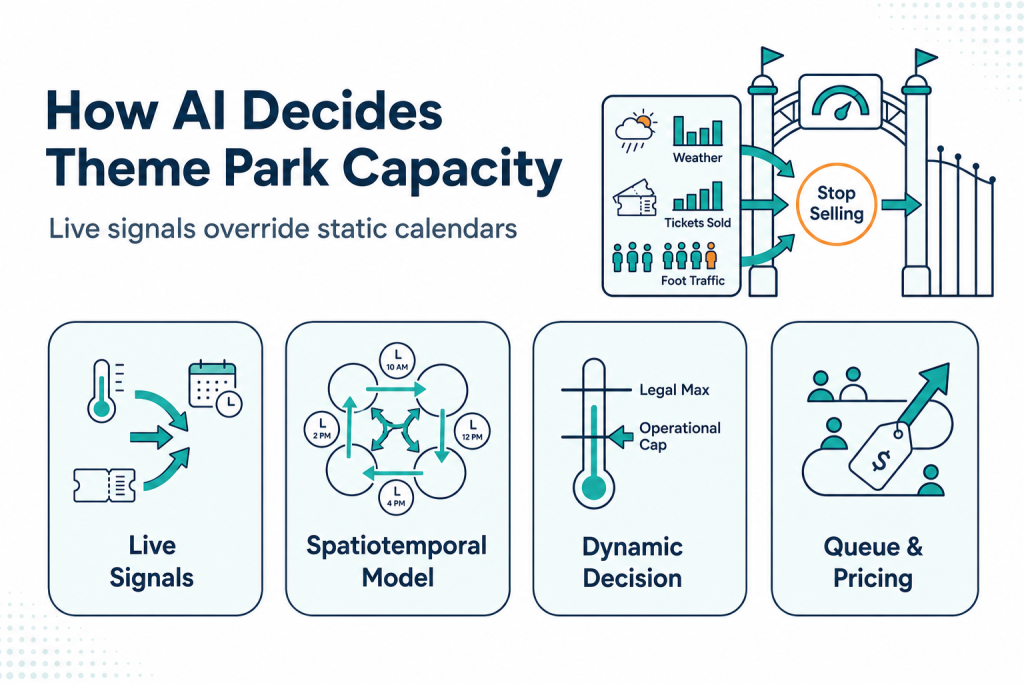
Theme parks stop selling tickets for a given day when a forecasting system predicts that incoming attendance will push a park past a safe or comfortable occupancy threshold, not when a fixed daily number is hit. That threshold is calculated continuously, using live inputs like ticket sales pace, reservation data, historical attendance patterns, weather, and in some cases real-time foot traffic sensors. The actual cap itself is rarely published. Operators such as Disney and Universal do not publicly disclose their exact ticketing caps or real-time capacity thresholds, treating that number as commercially sensitive. What has changed is the machinery behind the decision: parks increasingly rely on machine learning models, spatiotemporal graph learning, and computer vision rather than static spreadsheets built on last year’s attendance.
TL;DR
- Capacity caps are dynamic predictions, not fixed numbers; they shift daily based on live demand and operational signals.
- Local fire codes and occupancy regulations set the outer safety ceiling; AI forecasting decides when to stop selling well before that ceiling is reached.
- Vendors such as Convious, Ariadne Maps, and Panasonic already supply crowd-forecasting and foot-traffic analytics to the attractions industry.
- Dynamic pricing and virtual queuing driven by capacity forecasts can increase per-visitor revenue by 10 to 20 percent while also cutting wait times.
- The same forecasting and queuing logic used in theme parks applies directly to malls, museums, and other high-footfall destinations that need a smart queue management system.
About the Author: This article is written by the team at Fooyo, a Singapore-based company that builds AI knowledge bases and workflow automation for enterprises across hospitality and tourism, including a Smart Tourism platform that delivers live crowd data and guest-facing tools for destination operators across Asia.
What exactly is a theme park capacity cap?
A capacity cap is the maximum number of guests a park allows inside at one time before it pauses entry or stops selling same-day tickets. The number isn’t arbitrary. Maximum safe capacity limits are primarily dictated by local municipal regulations, building codes, and fire safety codes rather than any universal theme-park-industry standard. Those local codes define occupancy loads based on factors like available square footage per person, egress routes, and restroom counts. That means a park’s legal ceiling is set by its city or county, not by Disney or Universal corporate policy. The park’s own operational cap, the number at which it actually stops selling, typically sits well below the legal maximum, because operators also want to protect ride wait times, dining capacity, and the overall guest experience, not just stay within a fire code.
Guests sometimes ask how they’re supposed to know a park is near capacity before they arrive. On platforms like planDisney, visitors have asked directly how to tell if a park like Magic Kingdom is at capacity before trying to scan in [plandisney.disney.go.com]. The honest answer is that they generally can’t know with precision, because the underlying model and threshold aren’t published. What they can access are proxy signals: crowd calendars, historical wait-time data, and increasingly, live monitoring tools.
How do AI crowd forecasts actually predict demand before gates open?
AI crowd forecasting works by combining historical attendance patterns with live signals to project how many people will be inside the park at any given hour, not just by day’s end. Theme parks employ machine learning algorithms, spatiotemporal graph learning, and computer vision for predictive analytics and real-time foot traffic monitoring. Spatiotemporal graph learning is the key technical piece here: it models the park as a network of connected zones (queue lines, walkways, plazas) and learns how crowd density flows from one zone to another over time, the same way traffic models learn how congestion moves from one highway junction to the next. That lets the system forecast not just “how many people today” but “how many people will be standing at this specific intersection at 2pm.”
Vendors such as Convious, Ariadne Maps, and Panasonic provide specialized AI platforms to forecast crowds and optimize visitor flow. Alibaba Cloud’s smart tourism solutions apply similar forecasting logic to destinations across China. None of these systems need to guess blindly: they’re trained on years of ticketing data, weather correlation, school holiday calendars, and in many cases anonymized mobile location data or computer vision counts from entry gates.
Building on that forecasting layer, the harder operational question for a park isn’t “what will attendance be” but “at what predicted number do we actually stop selling.” That’s a business decision layered on top of a prediction, and it’s where capacity caps and queue management start to overlap.
Why does stopping ticket sales also mean managing the queue differently?
Stopping ticket sales is a blunt lever. A park that wants finer control over guest flow pairs capacity forecasting with a smart queue management system, which uses predicted demand to shape virtual queues, ride reservations, and entry pacing throughout the day rather than making one binary sell/don’t-sell decision at the gate. This is the layer that explains why a park can be “at capacity” for new ticket sales while guests already inside still move through rides at a reasonable pace.
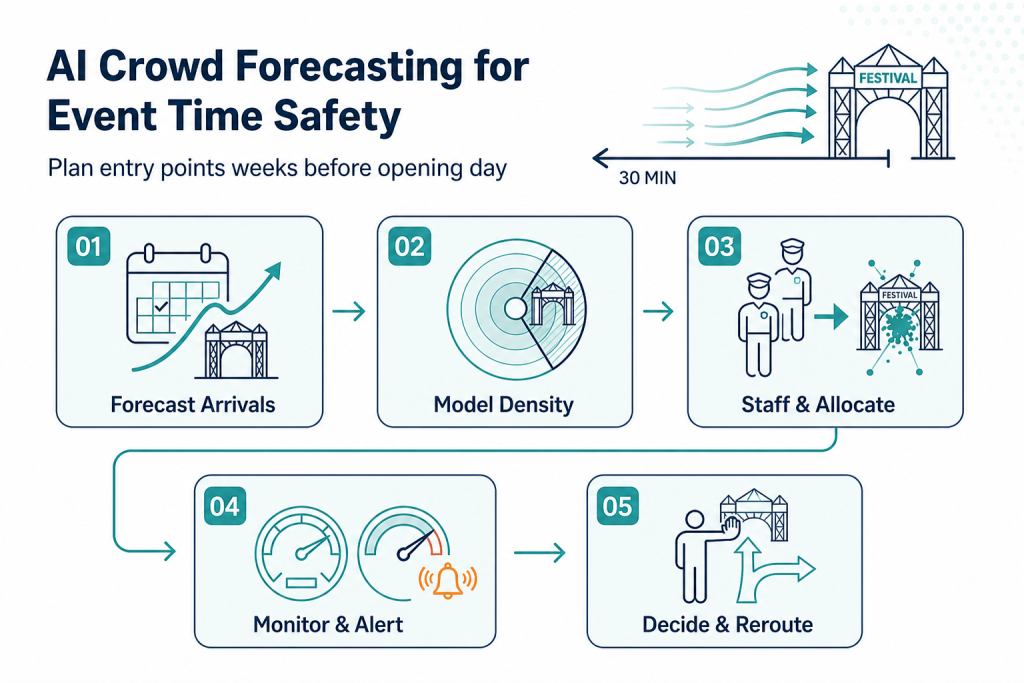
Crowd density analysis and congestion management powered by AI helps park operators allocate staff resources efficiently, ensuring that the right number of ride operators, food service staff, and security personnel are in the right zones at the right hour, rather than reacting after a line has already backed up. This is a meaningful distinction from older crowd calendar models. A crowd calendar scored a day as a single number, a general sense of “busy” or “quiet” that a guest could check a week out. A spatiotemporal forecasting system works at a finer grain, predicting standby wait times for specific attractions and triggering alerts when a chosen threshold is crossed. Some consumer tools now let guests set a watch on a specific attraction and get notified when, for example, the standby wait time drops below a chosen number [themeparkiq.com]. Disney’s crowd calendar tools similarly convert the underlying model into a simple 1-10 score to help guests pick a lighter day [supapark.com].
Is the old crowd calendar model still reliable?
The old crowd calendar model is becoming less reliable as the systems feeding it shift, which is why that question deserves a direct answer rather than a hedge. Crowd calendars still exist as a guest-facing product, but industry commentary points to the system behind them as increasingly outdated for how parks actually manage demand today [disneyfanatic.com]. The reason is straightforward: a calendar built on historical seasonal averages assumes that this year’s Tuesday in March will behave like last year’s. New ticketing policies, capacity caps tied to annual pass rules, and real-time demand-based pricing all break that assumption [plandisney.disney.go.com]. A forecasting system that ingests live ticket sales pace and current reservation data reacts to changes within the same day, something a static calendar published months in advance cannot do.
This is also where guest expectations are shifting. A large share of theme park visitors globally want AI-driven verification and personalization features built into their visit, including systems that use physical recognition to streamline entry and identity checks [blooloop.com]. That appetite extends naturally to wanting better, not just published-weeks-ahead, crowd predictions.
What does capacity-driven forecasting mean for revenue, not just safety?
Capacity forecasting is as much a revenue tool as a safety one, and conflating the two understates why parks invest in it. Implementing capacity-driven dynamic pricing and virtual queuing can increase per-visitor revenue by 10 to 20 percent while simultaneously improving the guest experience. The mechanism is simple: when a park can predict demand accurately enough to price tickets dynamically, it captures more revenue on high-demand days and can pull in attendance on low-demand days with lower prices, rather than charging a flat rate that under-monetizes peak days and under-fills slow ones. Reducing wait times and preventing overcrowding through the same forecasting data directly boosts visitor satisfaction and encourages repeat attendance, which is a longer-term revenue effect layered on top of the pricing one.
A speculative but recurring idea in industry commentary is a fully AI-run park experience, one where AI-driven queuing, dynamic capacity, and automated operations handle most guest flow decisions without manual intervention [insidethemagic.net], and there is early experimentation in congestion management for water parks, where AI-based density analysis is already being piloted to guide staffing and flow decisions in real time [assertai.com]. Most parks today sit well short of that, using AI as a decision-support layer behind human operators rather than a replacement for them.
Frequently Asked Questions
Do theme parks publish their exact capacity numbers?
No. Operators like Disney and Universal do not publicly disclose their exact ticketing caps or real-time capacity thresholds, treating them as competitive and security-sensitive information.
What sets the legal maximum capacity for a theme park?
Local municipal regulations, building codes, and fire safety codes, based on factors such as square footage per person, egress routes, and restroom counts, not a single theme-park-industry standard.
Is the operational stop-selling cap the same as the legal maximum?
No. Parks typically stop selling tickets well before the legal fire-code maximum, to protect wait times and guest experience rather than purely to meet a safety threshold.
What AI techniques do parks use to forecast crowds?
Machine learning models, spatiotemporal graph learning, and computer vision, applied to historical attendance, live ticket sales, weather, and foot traffic data.
Which companies provide AI crowd forecasting for attractions?
Convious, Ariadne Maps, Panasonic, and Alibaba Cloud’s smart tourism solutions are named providers in this space.
Does AI crowd forecasting actually increase revenue?
Yes. Capacity-driven dynamic pricing and virtual queuing can increase per-visitor revenue by 10 to 20 percent while also improving guest satisfaction through shorter waits.
Are crowd calendars still useful for planning a visit?
They still provide a general sense of a day’s busyness, but the underlying prediction system is shifting toward more granular, real-time forecasting, so a published calendar score is best treated as a rough guide rather than a precise forecast.
About Fooyo
Fooyo is a Singapore-headquartered company that builds AI knowledge bases and workflow automation for enterprises, government agencies, and SMEs across Asia. Fooyo has teams in Chengdu and Tokyo, with core presence in Singapore and Japan, and works with clients in Indonesia. Its Smart Tourism platform applies the same forecasting and automation logic covered in this article, live crowd data, AI-powered guides, bookings, and engagement tools, to help destination operators manage visitor flow without replacing their existing systems. Deployments run in a client’s private cloud or fully on-premises depending on data-residency needs, moving from pilot to production on a timeline scoped to each engagement’s integration complexity and data readiness. Fooyo works with its clients through each phase of implementation, from design through production operation.
If your organization is exploring AI-driven crowd forecasting, dynamic queuing, or a broader smart tourism deployment, get in touch with Fooyo to scope a pilot.
References
- FAQ – Theme Park IQ (themeparkiq.com)
- Disney World Crowd Calendar Explained – SupaPark (supapark.com)
- I understand the new rules for AP in regards to MK after | planDisney (plandisney.disney.go.com)
- Disney Park Shuts Down to Guests-AI Set to Take Over … (insidethemagic.net)
- Theme park visitor expectations of technology differ the … (blooloop.com)
- AI in water parks to enhance guest experience | Assert AI (assertai.com)
- The System That Once Predicted Disney World Crowds No … (disneyfanatic.com)