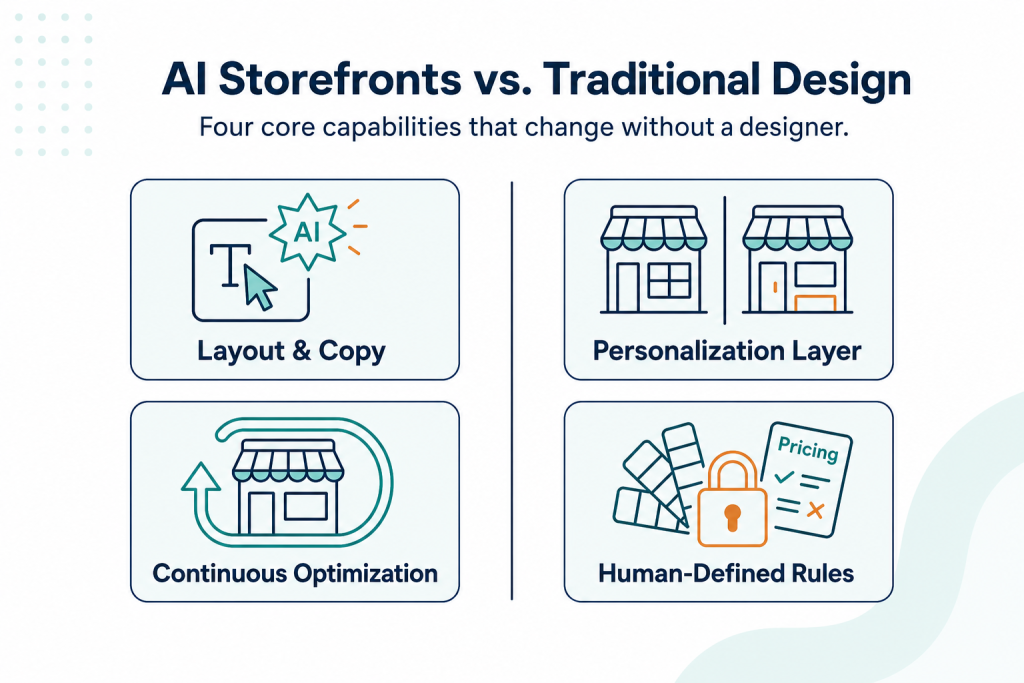
A business can now produce a storefront that looks and behaves like its brand without hiring a designer or a developer, because AI merchandising tools generate layouts, imagery, and copy directly from a brief and then keep adjusting them as customer behavior changes. This matters more than it sounds. AI-generated and AI-maintained storefronts collapse the design cycle into something a merchandising team can run on its own, eliminating the back-and-forth with external agencies and the frozen templates that can’t change after launch. AI merchandising keeps the store current instead of static.
TL;DR
- AI design tools can generate layouts, product descriptions, and image edits from text prompts, but they still need human judgment for complex business logic and brand nuance.
- AI-powered personalization has been shown to increase conversion rates by up to 15%, and AI merchandising by up to 20%, compared to manually designed, non-personalized storefronts.
- Shoppers who interact with AI tools on a storefront convert at roughly 12.3%, versus 3.1% for those who don’t engage with AI features at all.
- Singapore has no mandatory AI-content labeling law today, but the Consumer Protection (Fair Trading) Act still governs what AI-generated claims can say.
- The real skill isn’t picking an ecommerce platform, it’s deciding which merchandising decisions to automate and which to keep human-reviewed.
About the Author: This article is written by the Fooyo team, which builds Fooyo Commerce®, an AI-powered storefront platform used by government agencies, enterprises, and SMEs across Asia to launch and run branded storefronts without a dedicated design or development team.
What Does AI Merchandising Actually Mean for Storefront Design?
AI merchandising is the use of machine-generated or machine-assisted decisions to control what a storefront shows, to whom, and how it looks while showing it. That covers three distinct jobs that used to sit with three different people: the designer who set the visual theme, the merchandiser who decided which products get featured, and the copywriter who wrote the descriptions. Current AI design tools can automatically generate product descriptions, edit image backgrounds, and draft basic storefront layouts from text prompts. That’s a real capability, not a marketing claim; it’s also where the limits start. These tools don’t yet handle complex business logic well, things like regional pricing rules, inventory-driven featuring, or multi-brand catalogs with different tone requirements, and they depend heavily on how precisely the user writes the prompt. A vague brief produces a generic storefront. A specific one, with brand voice, color logic, and audience context spelled out, produces something usable.
How Does AI Generate a Branded Storefront Without a Designer?
The mechanism is closer to a trained assistant than a template picker. Instead of choosing from a fixed set of pre-built themes, the system takes a brief (brand colors, product category, target audience, tone) and generates a layout, copy, and imagery set that fits. Think of it the way a junior merchandiser would work from a style guide: given the guide and a few examples, they can produce new pages that feel consistent, without someone redesigning each page by hand. The AI version does this at a much larger scale and faster, generating variations and testing which ones perform rather than committing to one static version. This is the core shift from “design the store once” to “the store adjusts as it runs.” A personalized storefront can present different modules, imagery, or product groupings depending on where the visitor came from and what signals they’ve shown, a capability sometimes described as generating storefront experiences that match traffic source and context rather than showing every visitor the same page [trylexsis.com]. For brand consistency, the system still needs constraints: locked brand colors, approved imagery libraries, and a defined tone, so personalization varies the merchandising, not the brand identity.
What’s the Real Gap Between a No-Code Theme Customizer and a Fully Managed AI Storefront?
This is a question worth answering carefully, because the two get lumped together in ecommerce platform comparison articles when they solve different problems. A theme customizer is a visual editor, usually drag-and-drop, that lets a non-technical user adjust an existing template’s fonts, colors, and block order [launchmystore.help.center]. A fully managed AI storefront generates the layout logic itself and keeps optimizing it. The table below breaks down where each one actually helps.
| Capability | No-Code Theme Customizer | AI-Managed Storefront |
|---|---|---|
| Initial setup effort | Manual, template-based | Generated from a brief |
| Ongoing optimization | Manual edits required | Continuous, based on performance data |
| Personalization by visitor/traffic source | Limited or none | Built into the merchandising layer |
| Handling complex business logic | Requires custom code | Still needs human-defined rules |
| Design skill required | Low, but limited to template structure | Low, but prompt specificity matters |
Several Shopify-adjacent tools now sit in between these two categories, generating native theme code from natural-language prompts rather than offering a fixed set of blocks [clyro.com]. Some go further and let a merchant talk a full storefront into existence, handling script-like briefs for structure and copy together rather than as separate steps [ecomplify.com]. These are genuine advances in ecommerce storefront design. They still run into the same limitation stated above: strong on layout generation and copy drafting, weaker on business logic that’s specific to a merchant’s pricing or inventory rules.
Does AI Merchandising Actually Improve Conversion, or Is That a Marketing Claim?
The honest answer is it depends on whether the AI is actually doing merchandising work or just generating a prettier static page. When it’s doing real merchandising, meaning it’s adjusting what’s shown based on signals, not just how it looks, the data points in a consistent direction: AI-powered personalization has been shown to lift conversion rates by up to 15%, and AI merchandising by up to 20%, compared to manually designed, non-personalized storefronts. The gap is even starker at the engagement level. Shoppers who actively interact with an AI tool on a storefront, a chat widget, a recommendation prompt, a guided search, convert at around 12.3%, compared to 3.1% for shoppers who don’t engage with any AI feature. That’s not a small lift, it’s roughly a fourfold difference, and it points to something specific: the benefit isn’t the AI generating the page once, it’s the AI staying active in the shopping session, adjusting as the visitor behaves. A static AI-generated theme that never updates again captures the design-without-a-designer benefit but leaves most of that conversion lift on the table.
Where Does Fashion and Visual Merchandising Push AI Furthest?
Fashion retail is a useful stress test for AI merchandising because the product itself is visual, not just functional, and brand look-and-feel carries more weight in the buying decision than in most categories. AI in fashion retail now touches design iteration, supply chain forecasting, dynamic pricing, and customer support in addition to storefront presentation [crescendo.ai]. For storefront theming specifically, that means AI handling seasonal palette shifts, model/image variation for different markets, and layout changes tied to new collection drops, work that would otherwise require a designer on retainer. The limitation from the earlier section still applies here directly: AI can generate the visual variation convincingly, but a human still needs to define what’s on-brand before the system is let loose to generate at scale. Skipping that step is where storefronts start to look generic rather than distinctive.
How Should a Business Evaluate an AI Commerce Platform for Storefront Design?
Choosing between platforms is less about which one has the flashiest theme generator and more about what happens after week one. A few questions are worth asking directly:
- Does it generate from a brief or from a template library? Template-based tools are faster to start, generated-from-brief tools are more brand-specific but need a clearer prompt.
- Does it handle the full stack or just the theme? An enterprise ecommerce platform that covers product listings, payments, and storefront setup together avoids the integration gaps that come from stitching a theme tool onto a separate catalog system.
- Where is the data processed? If customer data is used to personalize the storefront, know whether that processing happens in a shared public model, a private cloud instance, or fully on-premises. Private cloud means data may still reach a model API; on-premises means it never leaves the client’s infrastructure.
- Can it support a B2B ecommerce platform use case? B2B storefronts often need account-specific pricing and catalogs, a heavier version of the “complex business logic” limitation mentioned earlier, and not every AI storefront generator handles this well out of the box.
Fooyo Commerce® approaches this as one connected system rather than a theme generator bolted onto separate commerce infrastructure: product listings, storefront setup, payments, and AI merchandising are built together, with deployment scoped to the client’s integration complexity and data-readiness rather than a fixed delivery date. For a team in Singapore evaluating an ecommerce platform built with Southeast Asia and China market readiness in mind, including WeChat Mini Program compatibility, that end-to-end structure tends to matter more than theme aesthetics alone.
Frequently Asked Questions
Can AI really replace a designer for storefront theming?
It can replace the need to hire one for initial layout, copy, and image generation. It does not replace the judgment needed to define brand constraints upfront or handle complex, business-specific logic.
How fast can an AI-generated storefront go live?
Timeline depends on the platform’s scope, catalog size, and integration requirements, scoped per engagement based on data readiness and approvals needed.
Is AI-generated storefront content legally required to be labeled in Singapore?
No. Singapore currently has no mandatory labeling law for AI-generated content, but claims made through that content still fall under the Consumer Protection (Fair Trading) Act.
Does AI merchandising work the same way in China as in Singapore?
No. China has specific generative AI regulations requiring providers to ensure content is lawful, accurate, and respects intellectual property, which is stricter than Singapore’s current approach.
What’s the biggest limitation of AI storefront generators today?
Deep customizability and complex business logic. They’re strong at layout and copy generation, weaker at pricing rules, multi-catalog logic, and anything requiring precise prompt engineering to get right.
Is an AI commerce platform suitable for B2B, or only B2C retail?
Both, but B2B storefronts typically need account-based pricing and catalog logic that a pure theme generator won’t handle without a platform built for that complexity.
About Fooyo
Fooyo is a Singapore-headquartered company building data platforms and AI agents for enterprises, with development out of Chengdu and business partnerships based in Tokyo, delivering across markets including Indonesia, Japan, Germany, and the U.S. Its product set spans an AI Knowledge Base for grounded, source-cited question answering, Kakis for brand-tuned marketing video, Fooyo Commerce® for AI-powered storefronts, and Smart Tourism for destination engagement. Fooyo deploys into a client’s private cloud or fully on-premises depending on data-residency needs, and works as a hands-on partner that builds and operates AI products rather than one that hands over a report and leaves. It is trusted by government agencies, enterprises, and SMEs across Asia.
If you’re weighing an ecommerce platform comparison for your next storefront build, worth seeing what an AI commerce platform looks like when it’s connected end-to-end rather than stitched together. Get in touch with Fooyo to see how Fooyo Commerce® handles merchandising, theming, and launch together.
References
- Personalized AI Storefronts for Every Traffic Source | Lexsis AI (trylexsis.com)
- Theme Customizer | Help Center – LaunchMyStore (launchmystore.help.center)
- The Ecommerce Store You Can Build by Simply Talking to AI. – Ecomplify Blog (ecomplify.com)
- Best Online Storefront Builder in 2026: Beyond Drag-and-Drop (clyro.com)
- AI in Fashion Retail Industry: Actionable Guide for 2026 (crescendo.ai)