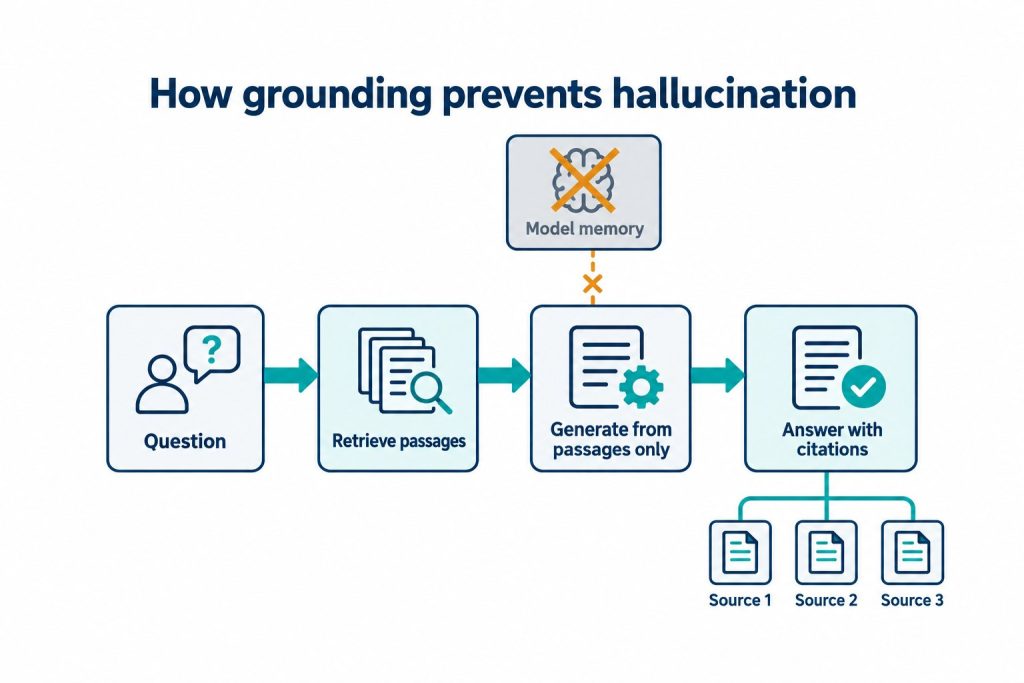
Grounded retrieval-augmented generation (RAG) reduces AI hallucination by forcing a language model to base its answer on specific retrieved documents, and by attaching a citation to each claim so a human can check it against the source. It does not eliminate hallucination outright: retrieval can still miss the right document, and the model can still override retrieved evidence with its own internal assumptions. What grounded RAG changes is verifiability. Instead of an answer you have to trust, you get an answer you can check line by line against the document it came from, in seconds. That single shift, from “trust the model” to “verify the source,” is what makes grounded RAG usable in settings where a wrong answer has a real cost: compliance, customer support, internal operations, government service delivery.
TL;DR
- Hallucination is a defined failure mode: LLMs generate fabricated, outdated, or unsupported content, and rates on complex domain-specific queries can run as high as 69 to 88 percent without retrieval grounding.
- Retrieval-augmented generation explained simply: the system fetches verified documents at query time and conditions the model’s answer on that retrieved text instead of its trained-in memory alone.
- Grounded RAG goes further than standard RAG by structuring retrieval around explicit relationships between facts, not just similarity between text chunks, which supports multi-hop reasoning and verification.
- RAG reduces but does not prevent hallucination. Retrieval failures and generation failures are documented, well-understood limitations, which is why human-in-the-loop AI review remains part of any serious deployment.
- Regulated industries increasingly require an audit trail for AI decisions, including source attribution and tamper-evident records, not just a plausible-sounding answer.
About the Author: This article is written by Fooyo, a Singapore-headquartered company that builds AI Knowledge Base software deployed in clients’ private cloud environments. Fooyo’s grounded RAG systems are used by government agencies, enterprises, and SMEs across Asia to turn internal documents into source-cited, auditable answers.
What Does “Hallucination” Actually Mean in an AI System?
Hallucination has a precise technical definition, not a vague one: it is the generation of content that deviates from factual correctness, producing fabricated, outdated, or unsupported information. It is not the model “lying.” A language model predicts the statistically likely next word based on patterns learned during training; it has no built-in mechanism to check whether that prediction is true. The scale of the problem depends heavily on the task. Documented hallucination rates in major LLMs without retrieval augmentation range from around 4 percent on general benchmarks to between 69 and 88 percent on complex, domain-specific queries such as legal research. That gap matters: a model can look reliable on a simple factual question and still be unreliable the moment you ask it something specific to your business, your contracts, or your internal policies, because that information was never in its training data to begin with.
How Does Retrieval-Augmented Generation Actually Reduce Hallucination?
Retrieval-augmented generation explained at the mechanism level works by integrating external knowledge retrieval with neural text generation. Rather than answering purely from what it learned during training, the system dynamically fetches verified documents at the moment a question is asked and conditions the model’s response on that retrieved context. This forces the model to ground its answer in external evidence instead of relying solely on its internal, parametric memory. Think of it like the difference between a colleague answering a question from memory versus that same colleague pulling up the actual policy document, reading the relevant paragraph, and answering based on what’s written there. The second approach is slower by a fraction of a second, but the answer is now traceable to something concrete. That traceability is the entire value proposition of RAG: it converts an unfalsifiable claim into a checkable one.
What’s the Difference Between Standard RAG and “Grounded” RAG?
Building on that mechanism, not all RAG systems are grounded to the same degree, and the distinction matters more than most explanations suggest. Standard RAG typically relies on semantic similarity to retrieve isolated, unstructured chunks of text from a vector database, essentially pulling passages that “sound like” they match the question. Grounded RAG goes a step further: it integrates structured domain relationships, explicit causal links between facts, and richer representations of how concepts connect, to assemble context more precisely. The practical effect is that grounded RAG can handle multi-hop reasoning, where an answer depends on connecting facts across two or three documents, and it supports fact-centric verification, where each part of the answer can be traced back to a specific source rather than a loosely related chunk of text.
| Aspect | Standard RAG | Grounded RAG |
|---|---|---|
| Retrieval method | Semantic similarity search over text chunks | Structured relationships between facts plus similarity search |
| Reasoning capability | Single-hop, one document at a time | Multi-hop, connects facts across documents |
| Verifiability | General source reference | Fact-level source attribution |
| Best suited for | Simple FAQ-style lookups | Operational, compliance, and cross-document queries |
Can RAG Actually Prevent Hallucination, or Just Reduce It?
Given that grounded RAG improves verifiability, the harder question is whether it eliminates the underlying problem, and it doesn’t. RAG reduces hallucination, it does not prevent it, and the distinction is not just semantic. There are two documented failure categories. Retrieval failures happen when the system misses relevant information entirely or surfaces outdated and irrelevant content that dilutes what the model pays attention to. Generation failures happen even after retrieval succeeds: if the retrieved evidence conflicts with what the model already “believes” from training, the model can overemphasize its internal knowledge instead of the document in front of it, or it can fail to synthesize the retrieved content accurately. In other words, giving a model the right document does not guarantee it will read that document correctly. This is precisely why source citations matter as a design feature, not a nice-to-have: if the model gets it wrong, a citation lets a human catch the error before it becomes a decision.
Why Does Human-in-the-Loop Review Still Matter With Grounded RAG?
Because retrieval and generation failures are both documented and unavoidable in principle, human-in-the-loop AI review is not a hedge against a weak system, it’s a structural requirement of any system built for real operational use. The practical pattern is straightforward: the AI drafts an answer, attaches the source passages it used, and a person with context can confirm, edit, or reject before that answer triggers an action, whether that’s a customer reply, a policy interpretation, or a workflow like updating a record or issuing a refund. This is also where regulation is heading, not just best practice. Under 2026 standards such as the EU AI Act Article 11, COSO’s February 2026 guidance, and PCAOB AS 2201, enterprise AI systems in regulated industries are expected to maintain audit-readiness, meaning they must produce an audit trail for AI decisions that includes source attribution, plain-language reasoning, and tamper-evident integrity proofs. A system that can’t show its sources can’t meet that bar, no matter how fluent its answers sound.
How Should a Business Actually Deploy Grounded RAG?
Translating this into a deployment decision, the practical question for most organizations isn’t “should we use RAG,” it’s “how tightly should retrieval be grounded, and where do humans need to sit in the loop.” A few principles hold up across sectors:
- Match grounding rigor to stakes. An internal FAQ bot can tolerate standard RAG. A system answering compliance or policy questions needs structured, fact-level grounding.
- Keep review gates on high-impact actions. Automate the retrieval and drafting; keep a human confirming anything that triggers a payment, a legal position, or a public-facing commitment.
- Deploy privately where data is sensitive. An AI knowledge base built on internal documents, contracts, or citizen records should run in a private cloud environment, not a shared public model, so that querying it doesn’t mean training a third party’s model on your data.
- Treat citations as a feature, not decoration. If the interface doesn’t show which document backs which sentence, there’s no way to audit the answer after the fact.
This is the operating model Fooyo builds around with its AI Knowledge Base product: a RAG system deployed into a client’s own private cloud that lets teams ask questions across an entire knowledge base and get grounded, source-cited answers, with review gates built into any automated action the answer triggers. It’s built for government agencies, enterprises, and SMEs across Asia that need answers they can check, not just answers that sound plausible, and it connects into existing systems like CRM, CMS, and messaging channels rather than requiring a rebuild of what’s already there.
Frequently Asked Questions
What is AI hallucination in simple terms?
It’s when an AI system generates an answer that sounds confident and coherent but is factually wrong, fabricated, or based on outdated information, because the model is predicting plausible text rather than checking facts.
Does retrieval-augmented generation fully solve hallucination?
No. It significantly reduces hallucination by grounding answers in retrieved documents, but retrieval can still miss relevant content and the model can still misread or override what it retrieved.
What makes RAG “grounded” specifically?
Grounded RAG uses structured relationships between facts, not just text similarity, to assemble context, which supports more precise multi-hop reasoning and lets each part of an answer be traced to a specific source.
Why do source citations matter in AI knowledge base software?
Citations turn an unverifiable claim into a checkable one. Without them, a user has no way to confirm whether an answer reflects an actual document or an internal assumption of the model.
Is human-in-the-loop AI still necessary if RAG is grounded?
Yes. Because retrieval and generation failures are documented limitations of RAG, a human review step remains necessary for any answer that triggers a real action or decision.
Are there compliance requirements around AI-generated answers?
Yes, in regulated industries. Standards emerging in 2026, including the EU AI Act Article 11, COSO guidance, and PCAOB AS 2201, require audit trails with source attribution and tamper-evident records for AI-assisted decisions.
Should sensitive company data be used in a public AI model?
Generally no, if data sensitivity or compliance is a concern. Private cloud deployment ensures internal documents are used to answer questions without training a shared, public model.
About Fooyo
Fooyo is a Singapore-headquartered company building data platforms and AI agents for enterprises, with presence in Singapore, China, and Japan. Its AI Knowledge Base product is a grounded RAG system deployed into each client’s own private cloud. Fooyo is trusted by government agencies, enterprises, and SMEs across Asia, and builds and operates AI products alongside clients, delivering source-cited answers integrated into their existing systems. If your team is evaluating how to deploy AI knowledge base software with source-cited, auditable answers, get in touch with Fooyo to see how a grounded RAG system would work against your own documents.