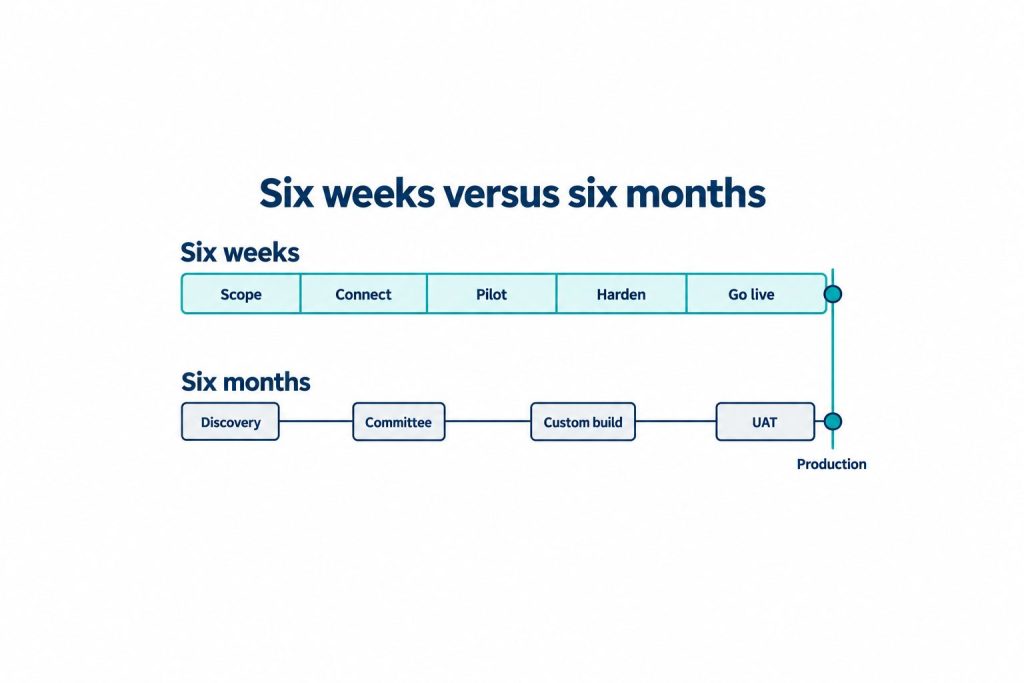
A six-week AI deployment and a six-month AI deployment are not the same project scaled differently. They are different delivery models with different cost structures, different governance assumptions, and different risk profiles. The industry-standard timeline for enterprise AI projects from concept to production deployment typically runs 6 to 12 months [alicelabs.ai][aiassemblylines.com], with 35 to 45 percent of that budget going to labor and implementation services and another 20 to 30 percent to infrastructure and cloud compute. A focused, workflow-specific deployment can compress that into 4 to 8 weeks and still show measurable results, often a 30 to 50 percent cycle time reduction, within 90 days. The gap between the two isn’t corner-cutting. It’s scope discipline.
TL;DR
- Enterprise AI projects typically take 6 to 12 months, with labor and implementation eating 35 to 45 percent of the budget.
- Rapid deployments (4 to 8 weeks) work by narrowing scope to one workflow at a time, not by skipping governance.
- Infrastructure choice matters more than most budgets account for: on-prem or private-cloud appliances carry monthly costs from roughly $6,000 to $31,000 depending on compute capacity.
- Managed RAG and vector database tooling can go live almost immediately; custom, self-hosted versions of the same stack take several weeks longer.
- The six-week model and the six-month model solve different problems: one is built for a first working product, the other for wall-to-wall organizational transformation.
About the Author: Fooyo is a Singapore-headquartered company that builds and operates production-grade AI knowledge bases and workflow automation for government agencies, enterprises, and SMEs across Singapore, Indonesia, and Japan, typically moving from prototype to private-cloud production in six weeks rather than the standard six-month cycle.
What Does a Standard Six-Month AI Budget Actually Pay For?
A six-month enterprise AI build is, in cost terms, mostly a labor and integration project rather than a technology purchase. Labor and implementation services account for 35 to 45 percent of the total budget, technology infrastructure and cloud compute take another 20 to 30 percent, and the remainder covers data preparation, tooling, and change management. That split tells you where the time actually goes: most of a six-month timeline isn’t spent training models, it’s spent on people mapping requirements, wiring integrations, and running approval cycles.
This is why AI implementation cost estimates vary so widely by company size and why an accurate ai cost comparison has to separate one-time build costs from recurring operational spend. A mid-market company and a large enterprise can run the identical RAG architecture and still land on very different total costs, because the labor line scales with the number of stakeholders, systems, and approval gates involved, not with the underlying model.
- Labor and implementation: 35 to 45 percent of budget
- Infrastructure and compute: 20 to 30 percent of budget
- Data prep, tooling, change management: the remainder
Why Do Most Enterprise AI Projects Take 6 to 12 Months?
Building on that cost breakdown, the harder question is what actually consumes the calendar time, since money and months don’t move together in a straight line. Enterprise AI projects run 6 to 12 months from concept to production largely because of scope, not because the underlying technology is slow to build [alicelabs.ai][aiassemblylines.com]. A first pilot alone can reach production in 3 to 6 months; scaling that pilot to a full function typically adds another 12 to 18 months [aiassemblylines.com]. Each additional system integration, security review, and stakeholder sign-off adds sequential time, and enterprise governance tends to review the whole program at once rather than one workflow at a time.
Think of it like renovating an entire house before letting anyone move in, versus renovating one room and living in it while the rest gets done later. Both approaches get to a finished house eventually. Only one of them lets you use part of the house in week six.
How Does a Six-Week AI Deployment Compress That Timeline Without Cutting Corners?
The six-week model works by inverting the sequence: instead of scoping the entire organization and building everything at once, it scopes one workflow, builds and deploys it, then repeats. A practical AI implementation roadmap compresses the traditional 6 to 12 month cycle into 6 to 8 focused weeks by running education, scoping, and build phases back to back rather than in long serial stages with idle time between them. Industry benchmarks back this up directly: rapid deployments focused on specific workflows over 4 to 8 weeks achieve measurable time-to-value and cycle time reductions of 30 to 50 percent within 90 days, while traditional 6-month-plus cycles more often suffer delayed ROI and higher failure rates tied to scope creep and governance overhead.
This is the model Fooyo runs on: a 30-minute demo, a scoped pilot, then private-cloud deployment and ongoing operation, with its AI Knowledge Base and similar products going live in weeks because the scope is fixed at “one workflow, done well” rather than “everything, eventually.” Human-in-the-loop review gates stay in place at every stage, so speed comes from narrower scope and parallel workstreams, not from removing oversight.
What Does AI Agent Development Cost Look Like at Each Speed?
Since scope drives both timeline and spend, ai agent development cost has to be read alongside how much of the organization is in scope at once. A six-month build spreads the same 35 to 45 percent labor allocation across a much longer engagement, with change management and data preparation work compounding as more departments get pulled in. A six-week deployment concentrates that same labor intensity into a shorter window focused on a single agent or workflow, which is one reason the smaller-scope model can look cheaper per project even before accounting for faster time-to-value.
Neither number is fixed. Cost depends heavily on company size, the complexity of the workflow being automated, and whether the deployment integrates with existing systems (CRM, POS, CMS, messaging channels) or requires building new interfaces from scratch. Integration-first approaches, plugging into what already exists rather than replacing it, generally keep both the timeline and the labor cost line lower, because there’s no rip-and-replace migration to budget for.
What Do Infrastructure Costs Add to Either Timeline?
A related but distinct question, separate from labor, is what the underlying infrastructure costs once a workflow goes live. For organizations that need private or on-premise deployment rather than shared public AI, infrastructure has documented, recurring costs that don’t disappear after go-live. AWS Outposts racks run between roughly $6,000 and $31,000 monthly depending on compute capacity, Azure Stack Hub bills consumption fees on base VM usage, and Google Distributed Cloud requires 36 or 60-month term commitments tied to specific hardware SKUs. These are ongoing operational costs, not one-time build costs, and they apply regardless of whether the AI itself was built in six weeks or six months.
This is a meaningful budgeting distinction: a fast build timeline does not automatically mean low infrastructure spend if the deployment requires dedicated private-cloud or on-prem hardware. Fooyo’s model deploys into the client’s own private cloud specifically so client data never trains a shared or public model, which is a security and data-governance decision, and clients should budget for the underlying cloud or infrastructure costs on their own hosting arrangement separately from the build and integration cost.
How Does Tooling Choice Change the Timeline?
Stepping back from infrastructure spend, the technology stack itself is the other lever that determines whether six weeks is realistic. Leading RAG frameworks and vector databases now offer hybrid search, metadata filtering, and real-time updates as standard capabilities, but deployment timelines for these still range from immediate, for managed SaaS options, to several weeks for custom, self-hosted architectures. A knowledge base built on a managed service can be live almost immediately; the same capability built as a fully custom, self-hosted system inside a private cloud takes longer, precisely because someone has to wire the retrieval layer, the source-citation logic, and the security boundary by hand.
This is where the six-week figure becomes credible rather than aspirational: it assumes a team that has already built the retrieval and integration layer before, so the “several weeks” for custom architecture isn’t spent inventing the approach, it’s spent adapting a proven one to the client’s specific data and systems.
How Does Fooyo’s Delivery Model Compare to Other Approaches?
Set against that backdrop, it’s worth being precise about what different providers in this space actually offer, rather than assuming they’re interchangeable. ReN3 is a Singapore-based agentic AI work platform built for document workflows, deployable air-gapped on-prem, in private cloud, or hybrid, with strengths in accuracy, deep localization, and no-code agent building for regulated, vertical use cases. OTG Lab offers a proprietary AI-enabled field service management product with a cloud-hosted admin panel and mobile app, running on a subscription SaaS model with AI-driven job assignment and offline mobile operation.
| Dimension | Fooyo | ReN3 | OTG Lab |
|---|---|---|---|
| Core focus | Production AI knowledge bases and agentic workflow automation | Agentic document workflows for regulated, vertical use cases | Field service management (job scheduling, tracking, reporting) |
| Deployment | Client’s own private cloud | Air-gapped on-prem, private cloud, or hybrid | Cloud-hosted web admin plus mobile app |
| Delivery model | End-to-end build and operate with the client | No-code agent building for specific vertical workflows | Subscription-based SaaS |
The relevant takeaway isn’t that one model is superior across the board. It’s that Fooyo’s approach is built specifically around going from prototype to private-cloud production across a broad set of enterprise use cases, from knowledge management to storefronts to marketing content, in weeks, with the same team that builds it staying on to run it.
Frequently Asked Questions
Is a six-week AI deployment less secure than a six-month one?
Not inherently. Security depends on deployment architecture, not calendar time. Private-cloud deployment, human-in-the-loop review gates, and source-cited answers can all be built into a fast timeline; the compression comes from scope discipline, not from skipping controls.
Can a six-week build scale to the whole organization later?
Yes, that’s typically the intended sequence: a scoped pilot goes live first, and further workflows are added in subsequent phases, rather than trying to design for every department before anything ships.
Why do six-month projects cost more in labor even at the same scope?
Longer timelines usually mean more stakeholders and more sequential approval cycles get folded into the same labor allocation, which compounds the 35 to 45 percent labor share of the budget over more months.
Does private-cloud deployment always cost more than shared public AI?
It carries additional, ongoing infrastructure costs (as seen with Outposts, Azure Stack Hub, or Google Distributed Cloud pricing), but the tradeoff is that client data never trains a shared model, which matters for regulated or sensitive data.
What’s the biggest hidden cost people miss when budgeting for AI?
Ongoing infrastructure and operational costs after go-live are frequently underestimated, since budgeting often focuses on the build cost and treats hosting as an afterthought.
Do managed RAG tools eliminate the need for custom development?
Not for private, source-cited enterprise use cases. Managed SaaS RAG tools can go live almost immediately, but custom, self-hosted architectures inside a private cloud still take several weeks to build correctly.
About Fooyo
Fooyo is a Singapore-headquartered company that builds data platforms and AI agents for enterprises, deploying production-grade products including an AI Knowledge Base directly into clients’ private cloud environments. With teams in Singapore, Chengdu, and Tokyo, the company serves government agencies, enterprises, and SMEs across Singapore, Indonesia, and Japan. Rather than handing over a report or a prototype, Fooyo builds and operates the product alongside the client, integrating with existing CRM, POS, CMS, and messaging systems instead of requiring a rip-and-replace migration.
If your team is weighing a six-week pilot against a six-month program, the right starting point is a scoped conversation about your specific workflow, not a generic estimate. Get in touch with Fooyo to talk through what a realistic timeline and budget look like for your organization.
References
- AI Implementation Timeline: How Long Does It Actually Take? (alicelabs.ai)
- AI Implementation Cost: How Much to Budget for AI in 2026 (iternal.ai)
- How Long Does AI Transformation Take? The Phase-by-Phase Timeline for Mid-Market Enterprises (aiassemblylines.com)
- AI Implementation Roadmap: Delivered in 6-8 Weeks (helium42.com)