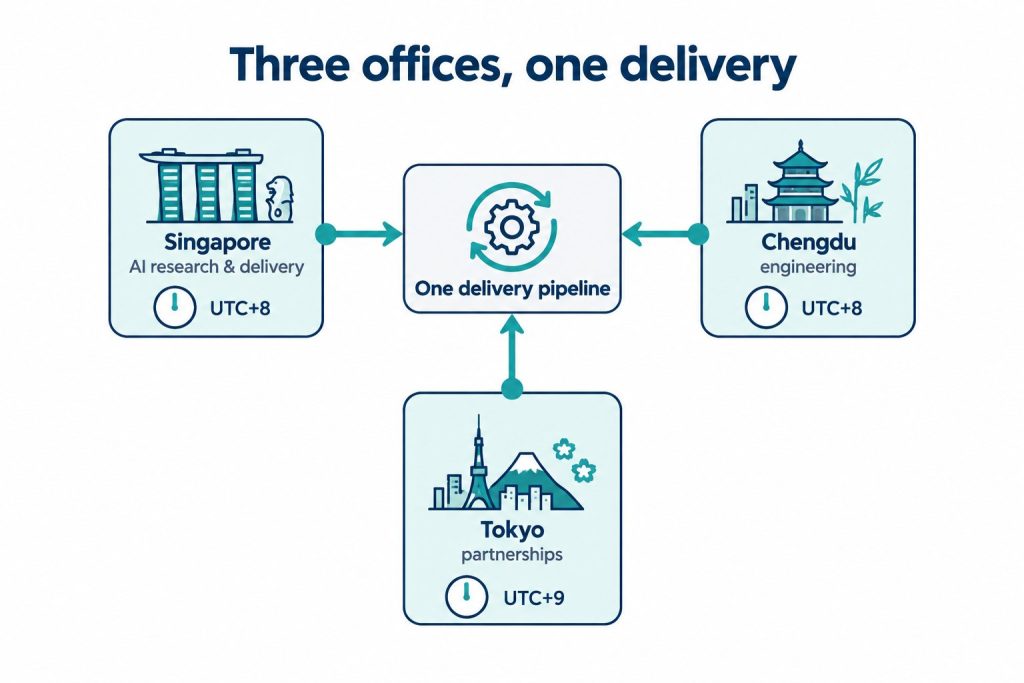
A three-office model works for cross-border AI delivery when each location maps to a distinct function rather than duplicating the same work in three places. Fooyo runs this exact structure: Singapore for governance, client operations, and private-cloud deployment; Chengdu for engineering and product development; Tokyo for business partnerships and market access. The result is an applied enterprise-AI company that can build in one jurisdiction, deploy under the compliance rules of another, and support clients in a third, without forcing every client through a single regulatory or infrastructure regime.
TL;DR
- Singapore, China, and Japan each regulate AI and data residency differently, and a delivery model has to be built around those differences rather than around them.
- Fooyo’s Singapore (governance/deployment), Chengdu (engineering), and Tokyo (partnerships) offices map directly to the compliance and market-access needs of each region.
- The Asia-Pacific enterprise AI market is worth an estimated $92.89 billion to $170.95 billion as of 2025-2026, growing at 32.7 to 39.93 percent CAGR, which is why regional structure matters more than a single headquarters model.
- Private, in-country cloud deployment is what lets one engineering team serve clients under different data residency rules without rebuilding the product each time.
- WeChat Mini Program development is a specific case where a Chengdu-based build team and Singapore-based governance produce a compliant, China-ready product for non-China clients.
About the Author: Fooyo is an applied enterprise-AI company headquartered in Singapore, with an engineering office in Chengdu and a partnerships office in Tokyo. The company builds and operates production AI systems, including AI knowledge bases and WeChat Mini Programs, for government agencies, enterprises, and SMEs across Singapore, China, and Japan.
Why Does Cross-Border AI Delivery Need More Than One Office?
Cross-border AI delivery fails when a single-office team tries to apply one country’s compliance assumptions to a client in a different jurisdiction. The three markets most relevant to Southeast Asian and China-adjacent business, Singapore, China, and Japan, have materially different rules on where data can sit and how AI systems must be governed. Singapore’s Personal Data Protection Act allows cross-border data transfers as long as the recipient provides comparable protection, and does not impose strict localization mandates. China enforces mandatory data localization and requires AI systems to be registered with regulators. Japan’s Act on the Protection of Personal Information restricts cross-border transfers but allows them with appropriate safeguards, and Japan has partnered with Singapore specifically to reduce this friction.
That is not a small difference. It means a knowledge base or agent built for a Japanese retail client and a Mini Program built for a China-facing brand cannot run on identical infrastructure assumptions. A company that tries to deliver both from one office, under one compliance posture, either over-engineers the simple case or under-complies on the hard one. Splitting functions by office is a direct response to that regulatory reality, not an org-chart preference.
How Does Fooyo’s Singapore Office Anchor Governance and Deployment?
Singapore functions as the governance and deployment anchor because its regulatory posture is the most flexible of the three, while still being credible to government and enterprise clients. The Infocomm Media Development Authority’s voluntary AI Verify toolkit and the Model AI Governance Framework, including the January 2026 update addressing agentic AI specifically, give Singapore-based teams a documented, auditable standard to build against [blogs.duanemorris.com][businesstimes.com.sg]. Singapore’s government has also been active in operationalizing this: a joint playbook from IMDA, SSG, and WSG published in May 2026 maps out AI transformation support for enterprises at different stages of adoption [imda.gov.sg].
Fooyo runs client-facing operations, private-cloud deployment, and ongoing support out of Singapore for this reason. Every deployment sits in the client’s own private cloud rather than a shared public model, which matters most in a hub jurisdiction because clients here span government agencies, MNCs, and SMEs with very different risk tolerances. A government agency and a five-person retail SME should not be onboarded through the same trust assumptions, and Singapore’s framework-driven, not rule-by-rule, regulatory model makes it practical to serve both from one base [edb.gov.sg].
What Does the Chengdu Office Actually Build?
Chengdu is Fooyo’s engineering center, and its purpose is speed and China-market technical fluency, not cost arbitrage. Building enterprise AI agents and RAG-based knowledge bases requires engineering depth in areas that are genuinely hard to shortcut: retrieval accuracy, source attribution, and privacy layers that stop personally identifiable information from ever reaching the underlying language model. In regulated deployments, this also means the system needs observability and audit trails robust enough to satisfy a compliance reviewer, not just a demo audience.
A Chengdu-based engineering team also gives Fooyo direct technical access to the China stack, most visibly through WeChat Mini Program development. Building a Mini Program is not a matter of shrinking a website; it requires working inside WeChat’s own component and API constraints and complying with China’s TC260 security guidance and its AIGC content labeling rules under GB 45438-2025. China’s data localization and mandatory AI registration requirements mean the underlying infrastructure decisions for a China-facing product are made differently from day one, not patched in later. Having engineers who build against those constraints natively, rather than translating a Singapore-built product after the fact, is the practical reason this function sits in Chengdu specifically.
What Role Does the Tokyo Office Play If It Isn’t Engineering?
Tokyo’s role is market access and partnership, which is a distinct function from both governance and engineering and deserves its own office rather than a rotating sales presence. Japan’s regulatory approach leans on voluntary, principles-based guidelines emphasizing transparency and human oversight, closer in spirit to Singapore’s model than to China’s mandatory registration regime. That regulatory closeness is precisely why Japan and Singapore have partnered to ease cross-border compliance friction between the two markets.
But regulatory compatibility does not automatically translate into commercial access. Japanese enterprise buying cycles, vendor vetting, and partnership norms are distinct enough that a local presence changes outcomes. Tokyo staff at Fooyo focus on relationship-building and go-to-market work, feeding client requirements back to Singapore and Chengdu rather than building product independently. This is what allows a company with core engineering in Chengdu to credibly serve Japanese enterprise clients without those clients ever needing to interact with the China-based build team directly.
How Does This Model Compare to a Single-Office or Fully Distributed Approach?
A useful comparison is a shipping company deciding whether to run one giant central warehouse or scatter small warehouses in every city it serves. One warehouse is efficient to manage but slow to deliver locally and blind to local rules. Scattering warehouses everywhere solves the speed problem but multiplies management overhead and inconsistency. The three-office model is closer to a hub-and-spoke system: one hub (Singapore) for control and compliance, one specialized production site (Chengdu) for building, one forward outpost (Tokyo) for local access, with private-cloud infrastructure playing the role of the delivery truck that adapts its route to each city’s traffic rules.
| Model | Strength | Weakness |
|---|---|---|
| Single office (e.g. Singapore-only) | Simple governance, one compliance standard | No native China engineering access; weaker Japan market presence |
| Fully distributed / many small offices | Local presence everywhere | Duplicated management, inconsistent product standards |
| Three-office model (Fooyo) | Compliance anchor + engineering depth + market access, each in the right jurisdiction | Requires tight coordination between offices |
This structure is also a direct response to the scale of the opportunity. The Asia-Pacific enterprise AI market is currently valued between $92.89 billion and $170.95 billion and is projected to grow at 32.7 to 39.93 percent CAGR through the early 2030s, making it the fastest-growing region globally for this category. A structure built for one market cannot capture growth that is distributed unevenly across three very different regulatory zones.
What Does This Mean for Enterprise AI Agents, Ecommerce, and Marketing Video Tools Specifically?
The three-office model is not abstract; it shows up directly in how specific products get built and shipped. An AI powered ecommerce platform serving a Southeast Asian retailer and a China-facing WeChat storefront cannot share identical backend assumptions, given China’s localization rules, so Chengdu engineering builds the China-compliant version while Singapore governs the deployment and client relationship for both. An AI marketing video generator used to turn a brand brief into short-form video at scale needs the same production quality regardless of market, but publishing rules, especially AIGC labeling requirements in China, differ by destination, so the compliance layer has to be market-aware even when the creative engine is shared.
This is also why enterprise AI agents built on retrieval-augmented generation need privacy and audit layers designed in from the start rather than bolted on. A knowledge base that cites its sources and gates automated actions behind human review is a governance decision as much as a technical one, and it has to be consistent whether the client sits in Singapore, Jakarta, or Tokyo.
Frequently Asked Questions
Why not just build everything in one location and deploy globally?
Because data residency and AI governance rules differ meaningfully between Singapore, China, and Japan. A single build location can still serve all three markets, but only if deployment and compliance decisions are made separately for each jurisdiction rather than assumed to be uniform.
Does a Chengdu engineering office mean client data sits in China?
Not by default. Fooyo deploys every solution into the client’s own private cloud, so a client in Singapore or Japan has their data hosted according to their jurisdiction’s requirements, not China’s, regardless of where the engineering team sits.
What makes WeChat Mini Program development different from building a regular website?
Mini Programs run inside WeChat’s own framework and component system, and China’s TC260 security guidance and AIGC labeling rules (GB 45438-2025) apply from the design stage, not as an afterthought.
How long does enterprise AI deployment typically take with a distributed team?
Industry benchmarks put average enterprise AI implementation at 6 to 12 months from scoping to production. Fooyo’s model is built to move faster than that by scoping a pilot early and deploying into private cloud within weeks rather than months.
Is Singapore’s regulatory approach stricter or looser than China’s?
Looser in structure. Singapore relies on a voluntary toolkit (AI Verify) and a governance framework rather than mandatory registration, while China requires mandatory AI system registration and strict data localization.
Can an SME access the same model as a large enterprise or government client?
Yes. Fooyo works with government agencies, enterprises, and SMEs across Asia under the same engagement model: demo, scoped pilot, private-cloud deployment, and ongoing support, sized to the client’s needs rather than gated by company size.
About Fooyo
Fooyo is a Singapore-headquartered applied enterprise-AI company that builds data platforms and production AI products, including AI knowledge bases, marketing video tooling, and AI-powered commerce storefronts, and deploys them into clients’ own private cloud environments. Its three-office structure, Singapore for governance and deployment, Chengdu for engineering, and Tokyo for partnerships, lets it serve government agencies, enterprises, and SMEs across Singapore, China, and Japan without forcing every deployment through one country’s compliance assumptions. Rather than handing over a report or a prototype, Fooyo builds and operates the product alongside the client, moving from first demo to production in weeks. The company is trusted by government agencies, enterprises, and SMEs across Asia for that combination of speed, private deployment, and hands-on delivery.
If your organization is weighing how to deploy enterprise AI across more than one regulatory jurisdiction, get in touch with Fooyo to see how a scoped pilot could work for your setup.
References
- New Playbook Charts a Clear AI Transformation Path for … (imda.gov.sg)
- Why Singapore is a hub in Asia for AI and tech innovation (edb.gov.sg)
- Singapore’s Digital & AI Governance: A Pro-Innovation, Framework-Driven Model – Duane Morris and Selvam (blogs.duanemorris.com)
- Asia has a three-year window to seize AI leadership through digital sovereignty – The Business Times (businesstimes.com.sg)