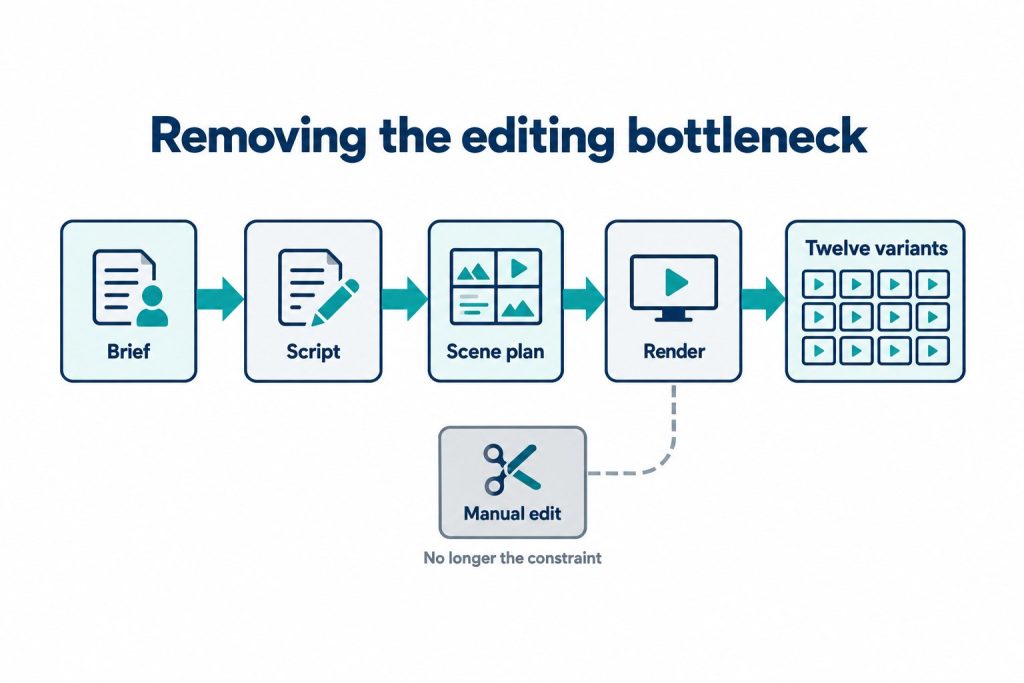
Automated short-form video production means using AI to handle the parts of the video pipeline that historically required a human editor sitting in a timeline for hours: cutting footage, syncing captions, resizing for different platforms, and pushing brand-approved variants live. It does not mean removing humans from the process entirely. In enterprise video production, post-production and manual editing consume a significant share of the total timeline, the single largest phase of any stage, ahead of pre-production, the actual shoot, and delivery. Automating that one stage is where most of the time savings actually come from, and understanding this breakdown is the key to evaluating whether an automated video editing software claim is real or just a marketing phrase.
TL;DR
- Editing and post-production represent the single biggest lever for automation in enterprise video timelines.
- An AI marketing video generator that only speeds up rendering but still requires manual review, resizing, and publishing hasn’t removed the bottleneck, just moved it.
- Coordination and revision overhead prevent much branded content from reaching the market, not creative failure.
- Regulatory disclosure requirements for AI-generated video are now active in some jurisdictions, and enterprises need workflows that build this in by default.
- Fooyo’s Kakis platform is built specifically for the brief-to-published-video pipeline at enterprise scale, with brand controls and human review gates.
About the Author: This article is written by the Fooyo team, which builds production AI products for government agencies, enterprises, and SMEs across Singapore, Japan, and China, including Kakis, a brand-tuned tool that turns a marketing brief into a published short-form video.
What Does “Automated” Actually Mean in Enterprise Video Production?
Automated video production means software performs specific, defined tasks in the pipeline without a person manually operating an editing tool for each one. That’s a narrower claim than it sounds. A tool that auto-generates subtitles is automating one task. A tool that takes a written brief and produces a finished, brand-compliant, multi-platform video ready to publish is automating an entire workflow. The difference matters because enterprises don’t get value from automating a single step if the surrounding steps still require the same number of people and the same number of approval cycles.
Consider the analogy of an assembly line versus a single power tool. A power drill makes one task faster, but if the parts still have to be carried by hand between stations, the overall production rate barely moves. Real automation at enterprise scale requires the whole line to move together: scripting, generation, brand review, resizing for each channel, and publishing. This is why the industry distinction between “AI video tools” and an “ai powered marketing platform” is not just semantic. A tool handles a task; a platform handles the workflow.
Why Is Manual Editing the Real Bottleneck, Not Video Generation?
The bottleneck in enterprise short-form video has never really been the shoot itself, it’s everything that happens after the footage exists. Enterprises consistently cite production inefficiencies such as location scouting, talent coordination, and lengthy revision cycles as the primary obstacles to scaling video content, and these hurdles are severe enough that much branded content produced never reaches the market. It means the constraint isn’t creative capacity or even budget in the way most teams assume, it’s coordination overhead and the revision loop between creative, brand, legal, and regional teams.
Building on that, the harder question is why generation speed gets so much attention when editing is the bigger time sink. Part of the answer is that AI video generation is more visually impressive as a demo. Watching a model turn a text prompt into an 8-second clip in under 15 seconds demonstrates the technology in action. But a demo is not a workflow. If that clip still needs to be manually recut for three aspect ratios, captioned separately for two languages, and routed through four rounds of email approval, the demo hasn’t touched the substantial portion of the timeline that actually determines throughput.
How Does an AI Video Generator Actually Work Under the Hood?
An AI video generator produces video frames from text, image, or brief inputs using a trained model rather than filmed footage. Current enterprise-grade models support video generation at standard resolutions and frame rates. Generation speed varies widely depending on the model’s design priorities: speed-optimized models can render a clip quickly, while high-fidelity models may require longer processing times for a single generation. Many of these platforms now include native audio generation, lip sync, and camera trajectory controls, which used to require separate specialist tools.
This is useful context when comparing platforms, because “ai video generator 2026” claims often blur the line between raw generation speed and end-to-end production speed. A model that renders quickly is not automatically a faster route to a published, on-brand asset if the surrounding review and distribution steps are still manual. When evaluating a video production software comparison, the generation benchmark tells you about the engine, not the vehicle.
What Should Enterprises Look for in an AI-Powered Marketing Platform?
An enterprise-grade platform for short-form video should cover the full path from brief to published post, not just the generation step. Fragmented tools force marketing teams to stitch together a generator, an editor, a caption tool, and a scheduler, which reintroduces the coordination overhead that automation was supposed to remove.
A few criteria are worth checking against directly:
- Brand consistency controls: does the tool encode brand voice, color, logo placement, and tone so every output matches guidelines without a manual check on each asset [aprimo.com]?
- Multi-format output: can one brief produce variants for different platforms and aspect ratios without separate manual edits?
- Publishing integration: does it connect to existing channels, or does someone still have to download and re-upload manually?
- Review gates: is there a defined point where a human signs off before anything goes live, rather than a fully unsupervised publish?
- Deployment model: does client data and brand material stay private, or does it train a shared public model?
Fooyo’s Kakis is built around this exact list. It’s a brand-tuned, multi-modal tool that takes a brief and handles script, production, and publishing at scale, with review points built in rather than a one-shot generate-and-post flow. That structure matters more than raw generation speed for teams trying to hit a consistent publishing cadence rather than a single viral clip.
Quality vs. Volume: Does Automation Mean Producing More Video, or Better Video?
Automation should raise the floor on consistency, not just the ceiling on output volume. It’s genuinely better to publish three well-made, on-brand videos a week than seven rushed ones that don’t land, because the audience is judging the brand on every post, not averaging across the week [project-aeon.com]. This is where a lot of automated video editing software claims oversell themselves: producing more assets faster is only useful if the review and brand-fit step keeps pace, otherwise volume just produces more content that gets rejected in review or performs poorly after publishing.
A related but distinct question is where the human should sit in this loop. The Deloitte 2026 enterprise AI research frames this clearly for AI systems generally: organizations need to define where humans stay in control, how automated decisions get audited, and what records of system behavior are retained [deloitte.com]. Applied to video, that means a defined checkpoint where a brand or compliance reviewer signs off before anything publishes, with a record of what was approved and by whom. Removing the editing bottleneck doesn’t mean removing oversight, it means moving oversight to the point where it adds the most value and away from repetitive manual cutting.
What Compliance Requirements Apply to AI-Generated Video Content?
Regulatory disclosure is now a live requirement in some markets, not a future consideration. Under the EU AI Act, enterprises must clearly disclose when video content has been artificially generated or manipulated. This includes mandatory labeling of deepfakes and embedding machine-readable marks in AI-generated content to help automated detection systems flag it. These obligations apply to anyone deploying synthetic media, with the stated goal of preventing deception and ensuring viewers give informed consent to what they’re watching.
For enterprises operating in Singapore, Japan, China, and Europe, this means disclosure can’t be a manual afterthought bolted onto the publishing step. It needs to be part of the workflow by default, generated automatically alongside the video rather than added inconsistently by whoever happens to be publishing that day.
Frequently Asked Questions
Is AI video generation the same as automated video production?
No. Generation is one step; production automation covers scripting, generation, brand review, formatting, and publishing as a connected workflow.
How fast can AI generate a short-form video clip in 2026?
Current enterprise-grade tools produce clips at standard resolutions and frame rates, with generation speed varying based on model design.
Why does so much branded video never get published?
Coordination overhead, including location scouting, talent scheduling, and multi-round revisions, prevents much branded content from reaching the market.
Does automating video removes the need for human review?
No. Human-in-the-loop review is still necessary for brand fit, compliance, and quality, particularly given active disclosure requirements for AI-generated content.
What’s the biggest time sink in enterprise video production?
Post-production and manual editing represent the largest single phase of enterprise video timelines, ahead of pre-production, filming, and delivery.
Do all AI video platforms require public cloud deployment?
No. Some platforms, including Fooyo’s, offer private cloud deployment so client brand assets and data don’t train a shared public model.
About Fooyo
Fooyo is a Singapore-headquartered company building data platforms and AI agents for enterprises, with operations across Asia including China and Japan. Its product Kakis addresses the short-form video bottleneck directly: a brand-tuned tool that turns a brief into script, production, and publishing without requiring a separate editor for every step. Alongside Kakis, Fooyo runs an AI Knowledge Base, Fooyo Commerce®, and a Smart Tourism platform, all deployed into clients’ private cloud environments and built to move from prototype to production in weeks rather than months. Fooyo is trusted by government agencies, enterprises, and SMEs across Asia.
If manual editing is the bottleneck slowing down your content calendar, it’s worth seeing what a connected brief-to-publish workflow looks like in practice. Get in touch with Fooyo to book a demo.
References
- A Guide to Short Form Video Marketing That Actually Works (project-aeon.com)
- The State of AI in the Enterprise – 2026 AI report | Deloitte US (deloitte.com)
- AI-Driven Marketing Strategies to Implement in 2026 (aprimo.com)