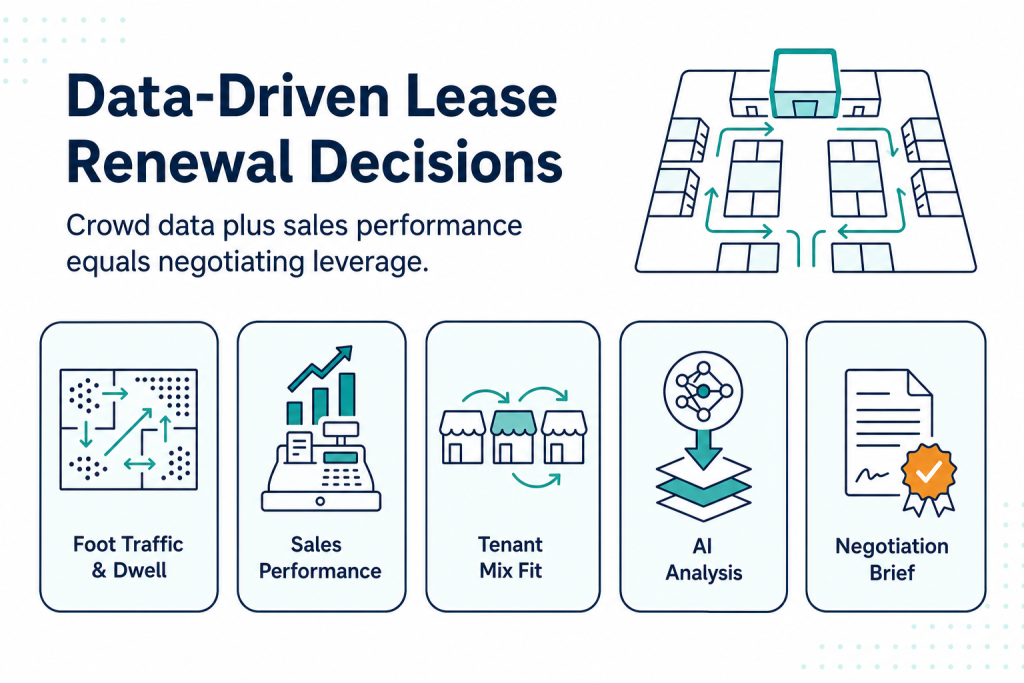
Lease renewal negotiations go better when the landlord shows up with evidence instead of opinion. AI analytics platforms that combine crowd counting, point-of-sale data, and tenant performance metrics give mall operators a data-backed position at the negotiating table: which tenants are pulling traffic, which are converting that traffic into sales, and which categories deserve more or less floor space at renewal time. This matters because lease renewal outcomes in commercial real estate are increasingly decided by numbers both sides can see, not just relationship history or gut feel about a tenant’s brand strength.
TL;DR
- Lease renewal leverage comes from pairing crowd data (foot traffic, dwell time, path analysis) with tenant sales performance, not from either data set alone.
- Singapore’s retail vacancy rate sat at 6.5% in Q3 2024, the lowest in a decade, which means landlords with strong occupancy also need strong data to keep it that way.
- Commercial retail leases in Singapore typically run 2 to 3 years for most SMEs and 5+ years for anchor tenants, so renewal cycles repeat often enough that a manual review process becomes a recurring cost.
- Property management AI tools that automate occupancy cost ratio and sales-per-square-foot tracking turn a quarterly guessing exercise into a continuous one.
- Private, source-cited AI analysis matters for landlords handling sensitive tenant sales data they cannot expose to a shared public model.
About the Author: This article is written from Fooyo’s experience building AI knowledge base and crowd-analytics systems for property and tourism operators across Singapore and the wider Asia region, including its Smart Tourism platform that delivers live crowd data to destination operators managing footfall and visitor flow.
What Is Tenant Mix and Why Does It Drive Lease Renewal Decisions?
Tenant mix is the deliberate combination of retail categories, brand tiers, and store sizes a mall operator assembles to maximize overall foot traffic, dwell time, and spend per visitor. A well-balanced mix is not just about filling vacant units: it is about placing a food and beverage anchor next to a fashion cluster so that each category pulls visitors toward the other, extending the average visit and lifting sales across neighboring stores [marqico.com]. When a lease comes up for renewal, the operator is not just deciding whether one tenant performed well in isolation. They are deciding whether that tenant’s presence is still generating positive spillover for its neighbors, or whether swapping it out would lift the mall’s overall performance more than keeping it would.
This is where tenant mix strategy and lease renewal decisions become inseparable. A tenant with mediocre standalone sales but high foot traffic contribution to adjacent stores may still be worth renewing on favorable terms, while a tenant with strong standalone sales but no traffic halo effect may warrant a harder negotiating stance. Making that call accurately requires data that most property teams historically tracked by hand, if at all.
What Crowd Data Actually Tells an Operator at Renewal Time?
Crowd data is the aggregated, anonymized measurement of how people move through a physical space, captured through sensors, Wi-Fi analytics, or camera-based counting systems. For lease negotiations, the relevant crowd data points are foot traffic by zone, dwell time per store frontage, and path analysis showing which stores visitors pass on the way to an anchor tenant. These three measurements answer a question that sales figures alone cannot: did this tenant attract the visit, or did it simply benefit from traffic someone else generated?
Shopping mall operators and landlords already evaluate renewal decisions using a defined set of metrics: foot traffic, sales per square foot, occupancy rates, rental income, customer satisfaction, revenue per tenant, occupancy cost ratio, tenant turnover, and lease renewal rates. What AI analytics changes is not the list of metrics but the frequency and granularity at which they are captured. Instead of a quarterly manual tally, crowd sensors and point-of-sale integrations can update these figures continuously, so by the time a Letter of Intent is due, the operator is working from months of granular trend data rather than a single snapshot.
Consider Singapore’s own tourism and retail traffic numbers as context for why this matters. Jewel Changi Airport saw 10% year-over-year visitor growth in 2024, crossing 80 million visitors. Traffic at that scale is not steady. It spikes around events, shifts with tourist seasonality, and moves between zones as new attractions open. An operator relying on last year’s average foot traffic figure during a renewal negotiation is working with a number that may already be stale.
How Does AI Analytics Change the Negotiation Itself?
AI analytics changes lease renewal negotiations by converting raw crowd and sales data into a performance narrative for each tenant and each category, before the negotiation starts rather than during it. The mechanism is straightforward: a system ingests point-of-sale feeds, crowd counts, and lease terms, then surfaces patterns a human analyst would take weeks to compile manually, such as which tenant’s dwell time correlates with higher spend at three neighboring stores, or which category is consistently below the occupancy cost ratio benchmark the mall targets.
Think of it the way a sports team uses game film. A coach does not walk into a contract renegotiation with a player’s win-loss record alone. They bring minutes played, performance under pressure, and how the player’s presence affects teammates’ output. Mall operators using AI analytics are doing the same thing with tenants: building a performance file that goes beyond the headline sales number, because the headline number by itself does not tell you whether this tenant should get a rent reduction, a renewal at the same terms, or a non-renewal notice.
In Singapore’s commercial retail leasing process, this data gets used well before the formal Tenancy Agreement stage. Negotiations commonly proceed through a Letter of Intent and landlord discussions before a formal Tenancy Agreement is signed, with the Code of Conduct for Leasing of Retail Premises setting expectations around good-faith negotiation, lease-agreement checklists, and how deviations and disputes get escalated. Having tenant performance data ready at the Letter of Intent stage means the landlord enters with a position, rather than reacting to whatever figures the tenant chooses to present.
What Role Does Commercial Real Estate Analytics Play in Tenant Mix Planning?
Commercial real estate analytics, applied specifically to tenant mix planning, means using historical and live performance data to decide which categories to add, shrink, or relocate within a property, rather than treating the current tenant roster as fixed. Building on the renewal-specific data above, the harder question an operator faces is forward-looking: not just “should I renew this tenant,” but “what should replace this unit if I don’t.”
Artificial intelligence applications in retail already analyze shopping patterns to predict demand and support inventory decisions [coherentmarketinsights.com], and the same underlying technique, pattern detection across large transactional and behavioral data sets, applies directly to tenant mix forecasting. AI-driven insight into tenant combinations is increasingly framed by mall operators as central to optimizing sales reporting and visitor experience simultaneously [blog.hyperin.com]. The practical output is a ranked list: which category combinations historically produce the highest co-visitation rate, and which underperform regardless of the specific brand occupying the space.
This matters more now because vacancy dynamics vary sharply by market and even by precinct within the same city. Singapore’s retail vacancy rate stood at 6.5% in Q3 2024, the lowest in a decade, with suburban malls at 4.6% versus Orchard Road at 7%. An operator in a tight suburban Singapore market has far less room to experiment with tenant mix changes than one managing a property with slack. Knowing precisely where your property sits on that spectrum, in near real time, changes how aggressively you negotiate.
What Should Operators Look for in Property Management AI Tools?
Property management AI tools, for the purpose of lease renewal and tenant mix decisions, should combine three capabilities: crowd and traffic sensing, tenant financial data integration, and a query interface that lets a leasing manager ask a direct question and get a sourced answer rather than a raw dashboard. The gap in many existing systems is not data collection, most malls already have some sensor or Wi-Fi analytics infrastructure, but the translation step from raw numbers to a negotiation-ready answer.
- Data integration without a rip-and-replace: the tool should connect to existing POS, CRM, and building management systems rather than requiring new infrastructure.
- Source-cited answers: when a leasing manager asks “which tenants in Zone B underperformed their occupancy cost ratio target this quarter,” the system should show the underlying transaction and traffic data behind the answer, not just a conclusion.
- Private deployment for sensitive tenant data: tenant sales figures are commercially sensitive. A private-cloud or fully on-premises deployment, where data stays within the operator’s infrastructure rather than training a shared public model, is a reasonable requirement for most landlords.
- Human-in-the-loop review: an AI recommendation to raise or hold rent should go through a leasing manager’s sign-off before it reaches a tenant conversation, not act as an automated final answer.
Fooyo’s AI Knowledge Base applies this same architecture, retrieval-augmented generation with grounded, source-cited responses and private deployment, to enterprise data generally, and its Smart Tourism platform already delivers live crowd data to destination operators managing visitor flow. The underlying approach, letting an operator ask a direct question across structured and unstructured data and get an answer traceable to its source, transfers directly to a mall operations team trying to settle a lease renewal with evidence rather than anecdote.
How Should Operators Use This Data Without Overreaching in Negotiations?
Data strengthens a negotiating position, but it does not replace judgment about relationships that extend beyond a single lease cycle. An anchor tenant with a flat quarter during a one-off disruption, a renovation next door, a one-time regional event, deserves context, not a mechanical rent increase triggered by a dip in foot traffic correlation. The right use of AI analytics here is as an evidence base an operator and tenant can both look at and agree reflects reality, not as a lever to extract maximum rent regardless of context.
This is also why tenant turnover and lease renewal rate are tracked as metrics in their own right. A mall that wins every individual negotiation but loses tenants at a high rate is optimizing the wrong variable. AI analytics should inform a renewal decision that balances near-term rent against long-term tenant mix stability, since replacing a tenant also means absorbing vacancy time, fit-out costs, and the risk that the new tenant performs worse.
Frequently Asked Questions
How long does a typical mall lease run in Singapore?
Most SME retail leases run 2 to 3 years, with anchor tenants often securing 5 years or more, and renewal options are commonly built into the original agreement.
What crowd data metrics matter most for lease renewal decisions?
Foot traffic by zone, dwell time at a specific storefront, and path analysis showing co-visitation with neighboring tenants are the three that most directly inform a renewal decision, alongside sales per square foot and occupancy cost ratio.
Can AI predict which tenant mix will perform best before signing new leases?
AI can identify historical patterns in which category combinations correlate with higher co-visitation and spend, which informs tenant mix planning, but it works from past and current data and should be treated as decision support rather than a guarantee of future performance.
Is tenant sales data safe to run through an AI analytics system?
It depends on deployment. Private-cloud hosting keeps data within a controlled environment but may still reach an external model API; fully on-premises deployment means data never leaves the operator’s own infrastructure. Operators handling sensitive tenant financials should clarify which model applies before adopting a tool.
How quickly can an AI analytics system be deployed for a mall operator?
Timelines depend on integration complexity, how many existing systems need to be connected, data readiness, and internal approval processes, rather than a fixed number of weeks.
Do small and mid-sized property operators need the same analytics as large mall operators?
The underlying metrics (foot traffic, occupancy cost ratio, sales per square foot) apply regardless of portfolio size. Smaller operators typically need a lighter integration footprint, not a different set of metrics.
About Fooyo
Fooyo is a Singapore-headquartered company building data platforms and AI agents for enterprises, with offices supporting development in Chengdu and business partnerships in Tokyo, and delivery experience across markets including Indonesia, Japan, Germany, and the U.S. Its products span an AI Knowledge Base for grounded, source-cited question answering, a Smart Tourism platform delivering live crowd data for destination and visitor-flow management, and commerce and marketing AI tools built for Southeast Asia and China, including WeChat Mini Program readiness. Fooyo is trusted by government agencies, enterprises, and SMEs across Asia, and deploys into a client’s private cloud or fully on-premises infrastructure depending on data-residency needs, rather than training shared public models on client data. The company operates as a hands-on partner that builds and runs AI products alongside its clients, not a consultancy that stops at a prototype or report.
If your property team is weighing how crowd data and tenant performance analytics could sharpen your next round of lease renewals, get in touch with Fooyo to discuss what a scoped pilot would look like for your portfolio.
References
- Artificial Intelligence in Retail Market Trends, 2026-2033 (coherentmarketinsights.com)
- The Ultimate Guide to Tenant Mix Strategy in Shopping Center Management – MarQi Co. (marqico.com)
- Embracing AI in Mall Management: The Next Frontier in Sales Reporting (blog.hyperin.com)