Most crowd count errors at malls and attractions do not come from bad sensors. They come from sensors placed in the wrong spot, at the wrong height, or pointed at the wrong angle. An overhead people counter mounted too close to a doorway will double-count shoppers who pause to check their phones; one mounted too high will miss children and wheelchair users entirely. Getting people counting technology to produce numbers operators can actually act on is less about which vendor you buy from and more about whether the installation accounts for ceiling height, foot traffic patterns, and the physical quirks of your specific entrance or zone.
TL;DR
- Placement errors, not sensor quality, cause most of the inflated or deflated crowd counts operators report.
- Video analytics typically run 96-98% accurate, thermal/infrared 95-97%, and Wi-Fi-based counting 70-80%, but all three degrade sharply with poor mounting.
- Entrances with glass doors, escalators nearby, or uneven ceiling heights are the most common failure points.
- A short calibration and spot-check routine catches most placement errors before they distort a full quarter of reporting.
- Fixing placement is cheaper than switching sensor vendors, and it is usually the first thing worth auditing when counts look off.
About the Author: Fooyo builds the Smart Tourism platform, providing live crowd data, AI-powered guides, and booking tools for destinations and attraction operators in Singapore, Indonesia, and Japan. This piece draws on patterns Fooyo’s team has observed deploying and troubleshooting people-counting setups for clients ranging from government-run attractions to mid-sized retail operators.
What Counts as a Sensor Placement Mistake?
A sensor placement mistake is any installation choice, height, angle, distance from a doorway, or proximity to another traffic source, that causes a people counter to systematically over- or under-report foot traffic. This is distinct from a sensor malfunction or a calibration bug in the software. A placement mistake persists even if the hardware and firmware are working exactly as designed, because the problem is geometric, not technical.
The practical test: if two identical sensors from the same vendor, running the same software, produce meaningfully different accuracy at two entrances in the same building, the gap is almost always placement, not product.
Why Does Sensor Accuracy Vary So Much by Technology Type?
Different counting technologies fail in different, predictable ways, and knowing the failure mode tells you where to look first. Video analytics typically achieve 96-98% accuracy, thermal and infrared sensors range from 95-97%, and Wi-Fi-based counting is less precise at 70-80% accuracy. These are industry-wide ranges, not vendor-specific guarantees, and they assume a reasonably correct installation.
Cameras often lose accuracy in low light, glare, or dense crowds because overlapping individuals are hard to separate visually. Wi-Fi sensors can overcount because they tally devices, not people, and a single shopper carrying a phone and a smartwatch, or a delivery rider passing through, gets logged as extra foot traffic. Infrared sensors struggle to distinguish individuals when several people cross the beam at once, which is exactly what happens at a busy mall entrance during lunch hour. All line-of-sight sensors, regardless of underlying technology, suffer from blind spots if they are not mounted at the correct height and angle for the space.
This matters for placement because it means the “right” mounting height and angle is not universal. A thermal sensor calibrated for a 3-meter ceiling will behave differently at 5 meters, and a camera angled to avoid glare from one direction may introduce a blind spot from another.
What Are the Most Common Placement Mistakes Operators Make?
Most recurring errors fall into a handful of categories that show up across malls, museums, and attractions alike.
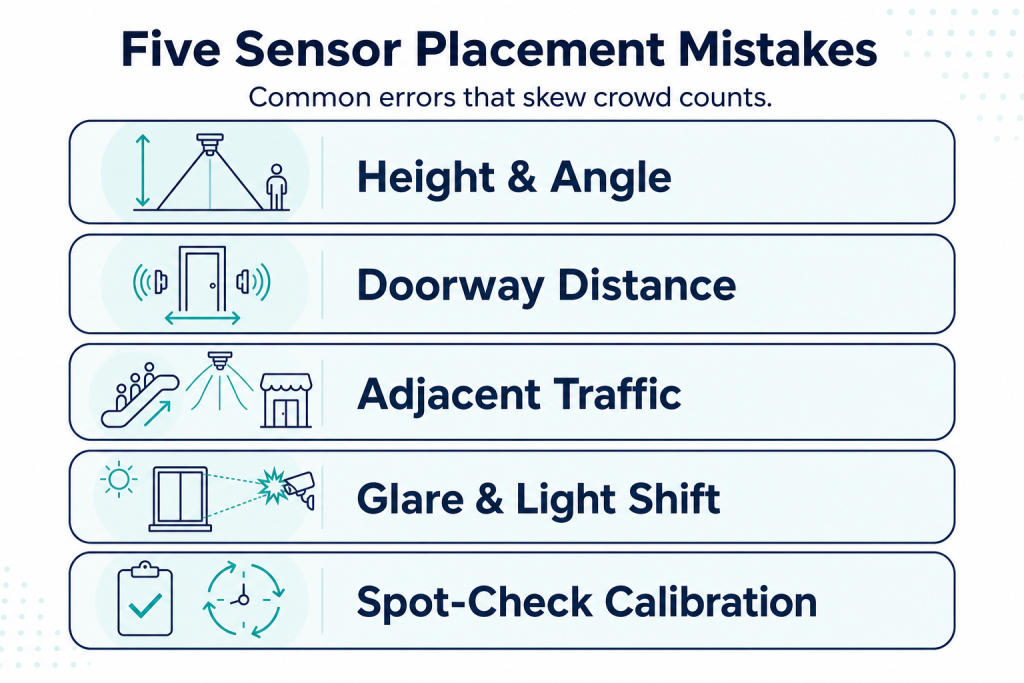
- Mounting too close to the doorway threshold. A sensor placed within a meter of the door often double-counts people who pause, turn back, or stand in the doorway to check a map or wait for a companion.
- Mounting too far from the threshold. The opposite problem: at wide entrances, people spread out sideways before the sensor’s detection zone, and some walk around the edge of the counting area entirely.
- Incorrect ceiling height calibration. An overhead people counter is typically tuned for a specific height range. Install it on a 6-meter atrium ceiling when it was calibrated for 3 meters, and the system may merge two people walking side by side into a single count, or miss shorter individuals and children.
- Placement near escalators, lifts, or adjacent store entrances. Sensors positioned where multiple traffic flows cross will attribute movement to the wrong zone, inflating counts for an entrance that is actually a pass-through corridor.
- Ignoring glare and lighting changes across the day. A camera that performs well at 10am can lose accuracy when afternoon sun hits a glass facade directly, a mistake only visible if someone checks the feed at different times of day.
- Treating Wi-Fi sensors as a primary count rather than a supplementary signal. Because Wi-Fi counting tracks devices, it is better suited to dwell time and repeat-visit analysis than to headline footfall numbers.
How Should Operators Choose and Position Sensors for Different Zones?
Building on the failure patterns above, the right answer depends on what each zone looks like physically, not on picking one “best” technology for the whole site.
| Zone Type | Best-Fit Approach | Key Placement Rule |
|---|---|---|
| Single narrow entrance | Overhead people counter (video or thermal) | Mount directly above the center of the doorway, calibrated to exact ceiling height |
| Wide mall atrium entrance | Multiple overhead counters or wide-angle video analytics | Space sensors to cover the full width with slight overlap, avoid single-sensor reliance |
| Outdoor attraction queue | Thermal or infrared | Avoid direct sun exposure angles; recalibrate seasonally for temperature shifts |
| Dwell-time or repeat-visit zones | Wi-Fi based counting | Use as a supplementary signal, not the primary headcount source |
| High-density event spaces | Video analytics with crowd-density modeling | Mount higher than standard retail height to reduce overlap in dense clusters |
A useful way to think about this: a sensor is like a camera at a sports stadium entry gate. Point it straight down the aisle and it reads one person at a time cleanly. Angle it sideways across a crowded concourse where people walk in clusters, and it starts merging bodies or missing the ones at the edge of frame. The mechanism is the same for every counting technology, detection accuracy depends on how cleanly individual bodies are separated in the sensor’s field of view, and placement is the main lever operators have to control that.
What Is a Practical Calibration Routine to Catch These Mistakes Early?
A related but distinct question from placement itself is how operators verify, after installation, that the placement is actually working. The fix is a short, repeatable calibration check rather than a one-time install-and-forget approach.
- Manual spot-check against live count. Have staff manually tally entries for a 15-minute window during both a quiet period and a peak period, then compare against sensor output. A gap larger than the technology’s expected accuracy range signals a placement issue.
- Check at three times of day. Morning, midday, and late afternoon light conditions change glare and shadow patterns, especially near glass entrances.
- Review footage or logs for double-counting patterns. Clustered counts right at opening or closing time, when people linger near doors, are a strong indicator of threshold placement problems.
- Re-measure after any physical change to the space. New signage, a kiosk, or rearranged furniture near an entrance can shift how people walk through the detection zone.
- Cross-reference multiple sensor types where stakes are high. Pairing a video-based overhead people counter with a secondary thermal check at a flagship entrance gives a fast way to spot drift in either system.
How Does Accurate Crowd Data Translate Into Operational Decisions?
Stepping back from installation mechanics, the reason placement accuracy matters at all is that crowd counts feed real decisions: staffing levels, queue management, marketing spend attribution, and safety planning during peak events. Mobility and footfall data is widely used by retail, real estate, and public sector operators precisely because it informs these kinds of operational and planning decisions [huq.io]. If the underlying count is skewed by 15-20% because a sensor sits too close to a doorway, every downstream decision built on that number inherits the same error.
This is the practical argument for treating sensor placement as an ongoing operational discipline rather than a one-time installation task. Fooyo’s Smart Tourism platform provides live crowd data for destinations alongside AI-powered guides and booking tools, and was built around this reality: raw sensor output only becomes useful once it is checked, contextualized, and tied to a decision an operator can act on the same day.
Frequently Asked Questions
What is the most common cause of inaccurate crowd counts?
Placement error is the most common cause, specifically sensors mounted at the wrong height or angle relative to the doorway or zone they are meant to cover.
Is an overhead people counter more accurate than a Wi-Fi based system?
Generally yes for raw footfall. Video and thermal overhead counters run 95-98% accuracy under correct installation, while Wi-Fi based counting runs 70-80% because it counts devices rather than people.
How often should sensor placement be reviewed?
At minimum, after any physical change to the entrance or zone, and as a quarterly spot-check even without visible changes, since lighting and traffic patterns shift seasonally.
Can one sensor cover a wide mall entrance accurately?
Usually not reliably. Wide entrances typically need multiple overhead counters with overlapping coverage rather than a single wide-angle unit.
Do weather conditions affect outdoor attraction sensors?
Yes. Thermal and infrared sensors are sensitive to ambient temperature shifts, and direct sun angles can affect both thermal and video-based accuracy outdoors.
Should operators rely on a single counting technology?
For high-stakes zones, pairing two technologies (for example video and thermal) at the same entrance gives a cross-check that catches drift neither system would reveal alone.
About Fooyo
Fooyo is a Singapore-headquartered company building data platforms and AI agents for enterprises, with development operations in China and business partnerships in Japan. Its Smart Tourism platform gives destination and attraction operators live crowd data alongside AI-powered guides, booking tools, and engagement features, deployed in each client’s own private cloud rather than a shared public model. Fooyo is trusted by government agencies, enterprises, and SMEs in Singapore, Indonesia, and Japan, and works as a hands-on partner that builds and operates these systems alongside clients rather than handing over a report and leaving. For operators looking to turn crowd data into decisions they can actually act on, that end-to-end involvement is the difference between a sensor installation and a working operational tool.
If your mall or attraction is seeing crowd counts that do not match what staff see on the floor, it is worth a closer look at placement before assuming the technology itself is the problem. Get in touch with Fooyo at https://fooyo.sg/ to talk through your setup.