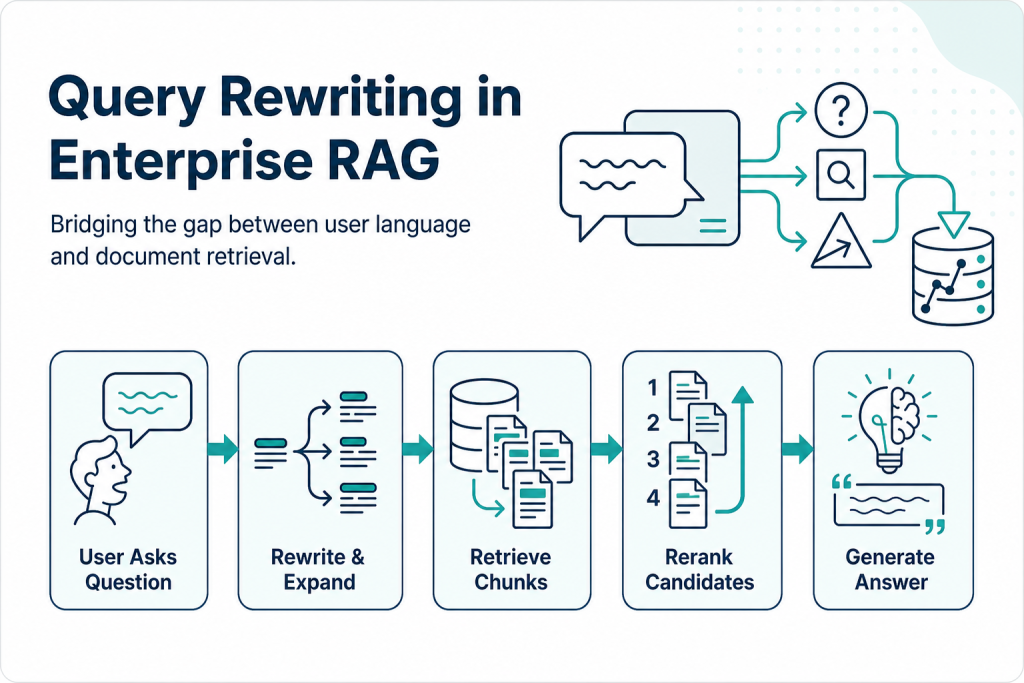
Query rewriting is the step in a retrieval-augmented generation (RAG) pipeline where a user’s raw question is transformed into one or more alternate queries before retrieval runs, closing the gap between how people phrase questions and how documents are actually indexed and worded. A staff member typing “can I expense a client dinner” is using conversational shorthand; the policy document says “entertainment expenditure reimbursement, section 4.2.” Without a rewriting step, the retriever searches for the user’s words and comes up empty or pulls the wrong section. This single architectural choice is one of the most under-discussed reasons enterprise RAG deployments either work reliably or quietly degrade after launch.
TL;DR
- Query rewriting reformulates a user’s literal input into retrieval-friendly queries, bridging the vocabulary gap between natural language and indexed document language.
- Retrieval failures are the dominant cause of RAG deployments losing reliability after launch, rather than weaknesses in the language model itself.
- Query rewriting paired with semantic reranking can meaningfully improve retrieval precision when measured against real test sets of user queries and known correct documents.
- Rewriting adds real latency, typically 200-800 milliseconds per request, so it has to be engineered deliberately rather than bolted on.
- Fooyo builds query rewriting into its AI Knowledge Base product as a core retrieval layer, not an afterthought, with private deployment so rewritten queries and source documents never leave client-approved infrastructure.
About the Author: This article is written from Fooyo’s experience building and operating production RAG systems, including its AI Knowledge Base product deployed for government agencies, enterprises, and SMEs across Asia, where retrieval accuracy directly determines whether grounded, source-cited answers actually get used.
What Is Query Rewriting in a RAG System?
Query rewriting is a preprocessing stage in rag system architecture that sits between the user’s input and the retrieval call, and understanding where it sits explains why it matters so much. A standard RAG pipeline looks like: user query → retrieve relevant chunks → feed chunks plus query to the LLM → generate answer. Query rewriting inserts itself at the first arrow. Instead of sending “can I expense a client dinner” straight to the vector database, the system first generates a better-formed query, or several candidate queries, and retrieves against those instead.
There are a few common rewriting strategies used in production:
- Expansion: adding synonyms or related terms (“expense” becomes “reimbursement, claim, disbursement”) to catch documents using different vocabulary.
- Decomposition: splitting a compound question (“what’s our refund policy and how do I process one”) into separate sub-queries that retrieve independently.
- Hypothetical document generation: asking the model to draft what an ideal answer passage might look like, then retrieving documents similar to that hypothetical passage rather than to the question itself.
- Context injection: folding in prior conversation turns so a follow-up question like “what about the EU version” retrieves correctly instead of searching for “EU version” with no context.
One academic framework, Rewrite-Retrieve-Read, formalizes this by treating the rewriting step as a trainable component rather than a fixed rule, allowing the system to learn what kind of rewrite produces better retrieval outcomes over time [arxiv.org]. That shift, from retrieve-then-read to rewrite-retrieve-read, is the conceptual core of why this matters: retrieval quality is not fixed by the embedding model alone, it is shaped by what you ask the embedding model to search for.
Why Does the Literal User Query Often Fail at Retrieval?
Building on the mechanics above, the practical question is why this gap causes so much damage in deployed systems. The short answer is vocabulary mismatch combined with scale. Enterprise documents are written in institutional language: policy numbers, department-specific terminology, legacy product names, acronyms specific to one team. Users write in plain, informal language shaped by how they’d ask a colleague. Vector embeddings capture semantic similarity reasonably well at small scale, but systems face challenges as document sets grow. As knowledge bases grow, retrieval quality tends to degrade without deliberate engineering, surfacing near-miss documents instead of the correct one.
This points to a broader pattern in deployed systems: retrieval failures are the dominant cause of RAG breakdowns rather than weaknesses in the generation model itself. Teams often troubleshoot RAG failures by swapping the LLM or tuning the prompt, when the actual defect is upstream, in what gets retrieved before the LLM ever sees it. A useful analogy: if a librarian hands you the wrong three books before you even start reading, no amount of careful reading fixes the outcome. Query rewriting is the mechanism that makes sure the librarian understood the real question first.
How Much Does Query Rewriting Actually Improve Retrieval Quality?
Given that retrieval failure is a primary cause of RAG degradation, the natural follow-up is whether rewriting meaningfully fixes it, and evidence from real deployments and evaluation frameworks says yes, measurably. Query rewriting that incorporates decomposition, expansion, and context injection can produce measurable gains in precision and recall when measured against a real test set of user queries paired with known correct documents.
The bigger jump comes from combining rewriting with semantic reranking, where a second model re-scores the initially retrieved candidates for relevance before they reach the generation step. That combination has shown meaningful improvements in retrieval quality in production environments. The implication is that rewriting and reranking are complementary layers, not substitutes for each other: rewriting improves what gets pulled into the candidate pool, reranking improves the ordering within it.
| Technique | What it does | When it helps most |
|---|---|---|
| Query rewriting alone | Reformulates query for term-based index matching | Vocabulary mismatch between user language and document language |
| Rewriting + semantic reranking | Reformulates query, then re-scores retrieved candidates | Large knowledge bases with semantic similarity challenges |
| No rewriting (literal query) | Retriever searches the user’s exact words | Baseline, most exposed to vocabulary mismatch |
What Does Query Rewriting Cost in Latency?
None of this accuracy gain is free, and treating it as free is where a lot of deployments get the engineering trade-off wrong. Every rewriting pass is an additional model call, and adding query rewriting and reranking to a production pipeline introduces measurable latency costs depending on model size and expansion strategy. Optimizing for acceptable latency requires deliberate engineering choices: using a smaller, faster rewriting model for simple lookups, reserving heavier decomposition steps for genuinely multi-part questions, and caching for queries that repeat across users.
This is the part of ai retrieval augmented generation system design that gets skipped in demos and shows up in production complaints. A knowledge base that answers accurately but takes four seconds to respond will get abandoned by users just as fast as one that answers quickly but wrong. The engineering discipline here is choosing where to spend the latency budget based on real measurements from your own system and user-query patterns.
How Should Enterprises Evaluate Retrieval Quality Before and After Rewriting?
Having established that rewriting has a real cost and a real benefit, the next question is how a team actually measures whether it’s working in their specific deployment rather than trusting published benchmarks. Established frameworks for this include RAGAS, TruLens, and DeepEval, which automate the computation of standard information retrieval metrics: Precision@K, Recall@K, Mean Reciprocal Rank (MRR), and NDCG. The useful property of these frameworks is that they assess retrieval quality independently from generation quality, which matters because a fluent, well-written answer can still be built on the wrong source documents.
A practical evaluation approach for enterprise teams:
- Build a test set of real user queries (not synthetic ones) paired with the correct source document for each.
- Run retrieval with and without query rewriting against that test set and compare Precision@K and NDCG@3.
- Track latency per request alongside accuracy, since the two trade off against each other.
- Re-run the test set periodically as the document corpus grows, since retrieval quality changes as scale increases.
Can You Rely on the LLM Provider’s API to Handle Query Rewriting?
A related but distinct question enterprise teams ask is whether this is something a foundation model vendor already handles. It is not, at least not as a packaged capability. Major LLM providers including OpenAI, Anthropic, Google, and Meta do not offer a dedicated query rewriting API. Their base models can perform query expansion and reformulation, but only through prompt engineering, function calling, and tool use that a team has to design and integrate into its own RAG framework. In other words, query rewriting is an architecture decision the enterprise or its implementation partner has to make deliberately, not a feature switched on by default.
This is where the distinction between a generic chatbot wrapper and a properly engineered enterprise search ai system becomes visible. Fooyo’s AI Knowledge Base builds query rewriting, retrieval, and source citation into the retrieval layer as a managed pipeline, so answers are grounded and traceable to the original document rather than generated from a weak or mismatched retrieval pass. For organizations handling regulated or sensitive data, that pipeline runs in private-cloud or fully on-premises infrastructure depending on data-residency requirements, meaning rewritten queries and retrieved documents stay within client-approved infrastructure rather than passing through a shared public model.
Frequently Asked Questions
Is query rewriting the same as query expansion?
Query expansion is one technique within query rewriting, adding related terms or synonyms to a query. Query rewriting is the broader category that also includes decomposition, hypothetical document generation, and context injection from prior conversation turns.
Does query rewriting require a separate model from the main LLM?
Not necessarily. Many production systems use a smaller, faster model for rewriting and reserve a larger model for final answer generation, which helps manage the latency cost.
Will query rewriting fix a poorly organized knowledge base?
No. Rewriting bridges vocabulary gaps between the query and the documents, but it can’t compensate for a knowledge base with outdated, duplicate, or poorly structured content. ai knowledge management practices such as document versioning and metadata tagging still matter upstream of retrieval.
How do I know if my RAG system needs query rewriting?
If users report that the system “doesn’t understand” their questions even though the answer exists somewhere in the knowledge base, that’s a retrieval problem, not a generation problem, and rewriting is a primary fix to test.
Does adding query rewriting always improve accuracy?
It improves accuracy when paired with evaluation against a real test set. Poorly tuned rewriting can over-expand a query and pull in irrelevant documents, which is why frameworks like RAGAS, TruLens, and DeepEval exist to measure the effect rather than assume it.
Is this only relevant for very large knowledge bases?
Smaller knowledge bases see less of the accuracy degradation that occurs as scale increases, but vocabulary mismatch between user phrasing and document language exists at any scale, so the benefit of rewriting shows up even in smaller SME deployments.
About Fooyo
Fooyo is a Singapore-headquartered company building data platforms and AI agents for enterprises, with additional presence in Chengdu for development and Tokyo for business partnerships. Its AI Knowledge Base product applies retrieval engineering, including query rewriting, grounded source citation, and human-in-the-loop review gates, to turn static documents into a system employees can actually query and act on. Fooyo deploys into a client’s private cloud or fully on-premises infrastructure depending on data-residency needs, and is trusted by government agencies, enterprises, and SMEs across Asia. Rather than handing over a report or a prototype, Fooyo builds and operates the system alongside the client, with timelines determined by integration complexity, data readiness, and approval cycles specific to each engagement.
If your team is seeing RAG answers that miss the mark even though the right document exists somewhere in your systems, the retrieval layer is the place to look first. Get in touch with Fooyo to scope a pilot for your knowledge base.