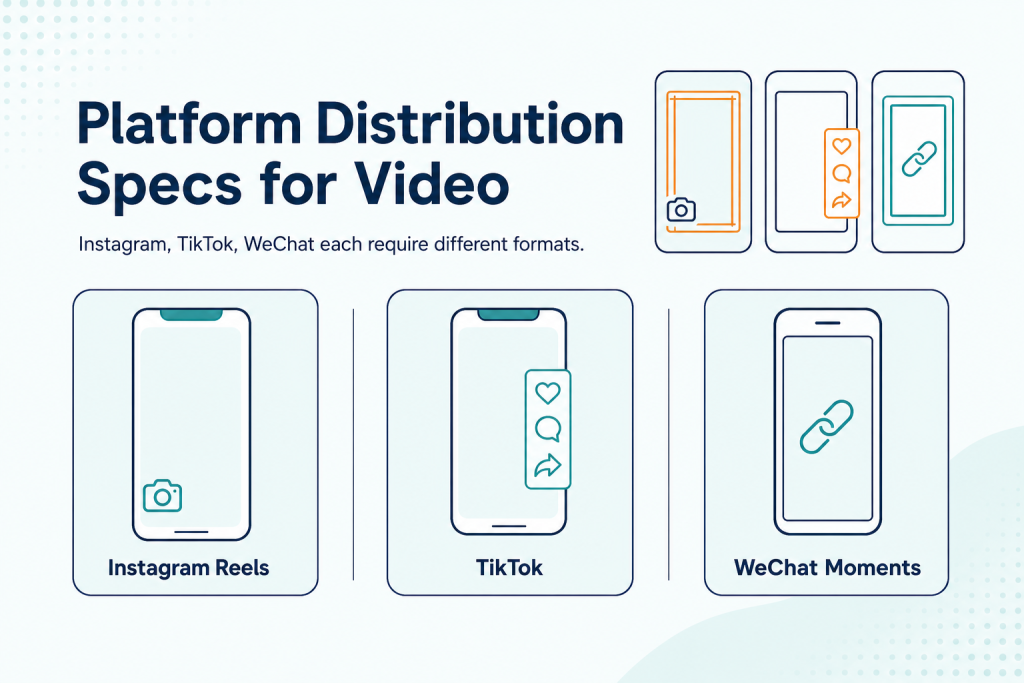
A single video file exported from an AI marketing video generator will not perform equally well on Instagram, TikTok, and WeChat, because each platform enforces different dimensions, codecs, bitrates, safe zones, and file size limits. Instagram Reels want 1080×1920 at 30fps with text kept out of defined UI margins. TikTok wants the same 9:16 frame but a different safe zone and a narrower bitrate band. WeChat Moments caps file size far below both, at 5MB for short clips. Treating “one video, three platforms” as a single export job is the most common reason brand video underperforms once it leaves the editing timeline.
TL;DR
- Instagram, TikTok, and WeChat each define different resolution, codec, bitrate, safe zone, and file size rules, so one master export cannot be optimal for all three.
- Instagram Reels and TikTok share a 9:16 frame but diverge on safe zones, hashtag strategy, and maximum duration.
- WeChat Moments is a closed social feed with strict file size caps (5MB short, 30MB long), making it structurally different from algorithmic discovery platforms.
- Getting distribution specs wrong is a leading, verifiable cause of AI-generated video underperformance, separate from script or production quality.
- Production workflows that bake in per-platform formatting at generation time, rather than as a manual afterthought, scale better than one-size-fits-all exports.
About the Author: Fooyo builds Kakis, a brand-tuned AI marketing video generator used by enterprises and SMEs across Singapore, Indonesia, and Japan to turn a single brief into publish-ready video for multiple channels, including WeChat Mini Programs and Moments, where Fooyo operates as a Tencent/WeChat partner.
What exactly is a “platform distribution spec,” and why does it matter for AI video?
A platform distribution spec is the full set of technical rules a social platform applies to video before and after publishing: frame dimensions, aspect ratio, frame rate, codec, container format, audio encoding, bitrate range, file size ceiling, duration limit, and on-screen safe zones for text and UI elements. These rules exist because each platform’s player, feed layout, and compression pipeline were engineered for a specific viewing context. Instagram Reels, for instance, standardizes on 1080×1920 (9:16) at 30fps for clips up to 20 minutes, encoded as MP4 or MOV with H.264 or H.265 video and AAC audio, playing back optimally in a 5 to 20 Mbps bitrate range. TikTok uses the same 1080×1920 frame and 30fps rate but supports videos up to 10 minutes in-app (60 minutes via web upload), requires MP4 or MOV with H.264 specifically, and targets a narrower 6 to 8 Mbps bitrate. WeChat Moments is the outlier: up to 750×1536 resolution, 30fps, 6 to 30 seconds for short videos or up to 5 minutes for long-form, MP4 with H.264/AVC and AAC audio, but at a much lower 800 to 2000 kbps bitrate. The gap between Instagram’s 20 Mbps ceiling and WeChat’s 2000 kbps ceiling is not a rounding difference. It is roughly a tenfold difference in how much data each platform expects to carry per frame, which is why a file engineered for Instagram looks compressed and blocky when forced through WeChat’s pipeline, and why a WeChat-optimized file looks soft and underwhelming on Instagram’s higher-fidelity player.
How do Instagram Reels and Instagram Stories video formats actually differ?
Instagram Reels and Instagram Stories share the same 1080×1920 (9:16) vertical frame, but they are not interchangeable formats once you account for duration and placement logic. The Instagram Reels video format is built for discoverable, algorithmically distributed content that can also appear in the main feed and Explore. The Instagram Stories video format is built for short, ephemeral, sequential clips that disappear after 24 hours and live in a dedicated tray at the top of the app, not the main feed. Because Reels get recommended to non-followers while Stories mostly reach existing followers, the same raw footage often needs a different edit pace and hook structure, not just a different export, even though the pixel dimensions match. This is a subtler trap than the cross-platform codec mismatch: two formats can be technically identical and still require different creative decisions because they are consumed in different contexts [sproutsocial.com][recurpost.com].
Why do TikTok and Instagram need different safe zones even though both use a 9:16 frame?
Safe zones exist because both platforms overlay interactive UI elements (like buttons, captions, usernames) directly on top of the video frame, and each app places those elements differently. Instagram Reels require keeping text and key visuals out of the top 14%, bottom 35%, and side 6% margins to avoid UI overlap. TikTok’s safe zone is defined in pixels rather than percentages: avoid the top 240 pixels, the bottom 660 pixels, and a 120-pixel margin on the right side where the like, comment, and share buttons sit. A caption centered perfectly for Instagram’s bottom 35% exclusion zone can still collide with TikTok’s 660-pixel bottom buffer, because the two platforms measure the “no-go” area with different units and different reference points. This is one of the most common, and most fixable, reasons an AI-generated clip looks “off” once published: the model generated clean footage, but the overlay logic wasn’t platform-aware [ourcodeworld.com]. WeChat Moments sidesteps this problem entirely. Because WeChat videos play in-feed without a heavy full-screen UI layer, standard central framing is sufficient and strict safe zone margins are not required, which is a structural difference worth knowing before assuming every platform needs the same defensive text placement.
Why does WeChat distribution behave so differently from Instagram and TikTok?
WeChat Moments is a closed social graph, not an open discovery feed, and that single architectural difference reshapes almost every spec around it. Instagram SEO depends on keyword-rich captions and a disciplined 3 to 5 relevant hashtags; TikTok’s discovery engine leans on keyword-rich titles, descriptions, and trending audio to feed its recommendation algorithm. WeChat does support hashtags, including within Moments, Channels, and chats, to help make content discoverable and link to related topics, but distribution still leans heavily on direct social connections and private sharing rather than an open algorithm surfacing content to strangers. That changes what “optimization” even means: on Instagram or TikTok, you are optimizing for a machine that decides who sees the video next; on WeChat, you are optimizing for a human decision to share. The file constraints reflect this too. WeChat Moments restricts short videos to 5MB and long videos to 30MB, dramatically tighter than Instagram’s 4GB ceiling for Reels or TikTok’s 4GB web-upload allowance for videos up to 60 minutes. A brand team exporting a single 4GB master file and trying to push it to WeChat will hit a hard technical wall long before any creative or algorithmic question comes into play.
| Platform | Dimensions / FPS | Max Duration | Codec / Container | Bitrate | Max File Size |
|---|---|---|---|---|---|
| Instagram Reels | 1080×1920, 30fps | 20 minutes | MP4/MOV, H.264/H.265, AAC audio | 5-20 Mbps | 4GB |
| TikTok | 1080×1920, 30fps | 10 min (app) / 60 min (web) | MP4/MOV, H.264, AAC audio | 6-8 Mbps | 4GB (web upload) |
| WeChat Moments | Up to 750×1536, 30fps | 6-30 sec (short) / 5 min (long) | MP4, H.264/AVC, AAC audio | 800-2000 kbps | 5MB (short) / 30MB (long) |
Is this a known, documented cause of AI-generated video underperformance?
Yes, and it is a distinct failure mode from weak scripting or poor visuals. Analysts covering AI-generated short-form video have pointed to weak distribution setup, repeated or generic-looking assets, and cold accounts as concrete reasons a video can launch to zero views despite reasonable production quality [tokportal.com]. Separately, practitioners troubleshooting why AI-generated video “looks off” point directly to mismatched aspect ratios and source-image framing as a fixable technical cause, not a creative one [ourcodeworld.com]. Put together, these point to a pattern worth stating plainly: a video can be well-written, well-produced, and still fail commercially because it was formatted for the wrong player. This is why any serious comparison of AI video generation pricing or any AI video generator comparison should ask not just “how good does the output look in isolation” but “does the tool export natively to each target platform’s spec, or does it hand you one file and leave the reformatting to you.”
What should a video production workflow do differently to handle this?
The practical fix is to treat platform formatting as part of generation, not as a post-production patch applied after the “real” creative work is done. A useful analogy: exporting one master video file for three platforms is like printing one document and expecting it to look correct on a phone screen, a printed page, and a projector screen without reflowing the layout for each. The content is the same; the presentation logic has to adapt to the output device, or parts of it get cut off or distorted. Concretely, a platform-aware workflow should:
- Generate or re-render per-platform exports with the correct resolution, frame rate, and codec for each destination, rather than one file resized afterward.
- Build text and caption placement around each platform’s documented safe zone, not a single centered template.
- Match bitrate and file size to the destination, especially for WeChat, where a 30MB-plus master file will simply not meet the platform’s cap.
- Adjust metadata strategy by channel: keyword-rich captions and 3 to 5 hashtags for Instagram, trending-audio-aware titles for TikTok, and hashtag and sharing-optimized framing for WeChat’s social feed.
- Keep a human review gate before publishing to each channel, since automated formatting reduces manual rework but does not remove the need for a final check against brand and platform guidelines.
This is the structural reason Fooyo built Kakis to handle script, production, and multi-platform publishing as one connected pipeline, including WeChat Mini Program and Moments distribution for teams working the China market, rather than shipping a single generic export and leaving the platform-by-platform rework to the marketing team. The goal isn’t more video generated per brief; it’s fewer formatting failures per platform launched.
Frequently Asked Questions
Can I use the same AI-generated video file on Instagram, TikTok, and WeChat?
Technically you can upload the same file, but it will not be optimized for any single platform. Differences in resolution ceiling, bitrate, safe zones, and file size mean a file tuned for one platform will underperform or get rejected outright on another, particularly WeChat given its strict 5MB/30MB caps.
Why does my AI-generated video look compressed or blocky on one platform but fine on another?
This usually traces to bitrate mismatch. A file encoded near Instagram’s 20 Mbps ceiling will look fine there but may be recompressed poorly if pushed through a platform like WeChat, which optimizes for 800-2000 kbps.
What is the biggest format difference between Instagram Reels and TikTok?
Both use the same 1080×1920 frame and 30fps rate, but their safe zones are measured differently (percentage-based for Instagram, pixel-based for TikTok) and their maximum durations and bitrate targets diverge.
Does WeChat support hashtags like Instagram and TikTok?
Yes. WeChat supports hashtags in Moments, Channels, and chats, which helps make content discoverable and link to related topics, though overall distribution still depends heavily on direct social connections and private sharing rather than an open discovery algorithm.
How much does AI video generation pricing typically depend on multi-platform export?
Pricing varies by vendor and scope; tools that generate and auto-format for multiple platforms within one workflow typically justify a different cost structure than single-export tools that require manual reformatting afterward.
Is a 30-second video safe for all three platforms?
Duration-wise, yes, since it fits within Instagram Reels, TikTok, and WeChat’s short-video window of 6 to 30 seconds. But duration compliance alone doesn’t solve resolution, codec, bitrate, or safe zone mismatches.
Should I evaluate AI video generator comparison tools on output quality alone?
No. Output quality matters, but whether the tool natively handles per-platform specs, including WeChat’s tighter file size limits, is a separate and equally important evaluation criterion.
About Fooyo
Fooyo is a Singapore-headquartered company building production-grade AI products for enterprises, government agencies, and SMEs across Asia, with offices supporting development in Chengdu and business partnerships in Tokyo. Its product suite includes Kakis, a brand-tuned marketing AI that turns a single brief into branded short-form video, handling script, production, and publishing at scale across channels including WeChat Mini Programs. Fooyo deploys into a client’s private cloud or fully on-premises infrastructure depending on data-residency needs, and works as a hands-on partner that builds and operates AI products with clients rather than handing over a report and walking away. Delivery timelines are scoped per engagement based on integration complexity, data readiness, and client approvals.
If platform-by-platform video reformatting is slowing your team down, get in touch with Fooyo at https://fooyo.sg/ to see how Kakis handles multi-platform video production and publishing in one workflow.
References
- Social Media Video Specs for Every Platform | Sprout Social (sproutsocial.com)
- Social Media Video Sizes 2026: Specs for 10 Platforms (recurpost.com)
- Why AI-Generated TikTok Videos Get 0 Views | TokPortal (tokportal.com)
- Why Your AI-Generated Video Looks Off (And the Fixes That Actually Work) | Our Code World (ourcodeworld.com)