A negative feedback loop in enterprise AI is a closed system where a user’s “wrong answer” flag does more than get logged in a ticket; it changes what the retrieval system fetches the next time a similar question is asked. Most enterprise search and knowledge base tools treat a thumbs-down as a satisfaction metric to report on in a dashboard. A smaller number of production systems treat it as a training signal that adjusts document rankings, metadata, or chunking rules. The difference between these two approaches is the difference between a system that stays broken in the same way for a year and one that gets measurably better with use.
TL;DR
- A “wrong answer” flag is only useful if it triggers a retrieval change, not just a support ticket.
- Most production RAG (retrieval-augmented generation) failures come from retrieval, not the language model, so feedback loops should target retrieval first.
- Retrieval precision can fall sharply as document volume grows, which is exactly where feedback signals matter most.
- Feedback loop machine learning in enterprise search works best as a human-reviewed update, not a fully automatic retrain.
- RAG evaluation metrics (precision, recall, groundedness, citation accuracy) should be tracked before and after each feedback-driven change, so improvement is measurable rather than assumed.
About the Author: Fooyo builds and operates production AI Knowledge Base systems for government agencies, enterprises, and SMEs across Singapore, Indonesia, Japan, and other Asian markets, with every deployment including grounded, source-cited answers and a human-in-the-loop review step. This piece draws on that operating experience, not a one-off research exercise.
What Is a Negative Feedback Loop in Enterprise AI?
A negative feedback loop, in this context, is a mechanism where a flagged incorrect answer is routed back into the retrieval pipeline as a correction rather than filed away as a complaint. In classic feedback loop machine learning terms, the system receives a signal (user says “this answer was wrong”), interprets it (why was it wrong: missing document, outdated document, bad chunking, wrong ranking), and acts on it (re-index, re-rank, or re-tag the source content). The loop is “negative” in the engineering sense: it works against the error, pulling the system back toward correct behavior, rather than reinforcing whatever it already does.
This is distinct from a support ticket workflow, which closes the loop at the human level (“someone will look into it”) but never closes it at the system level (“the retrieval index now ranks this differently”). An enterprise search AI that only logs complaints will keep making the same retrieval mistake on every repeat query until an engineer manually investigates the backlog, often weeks later.
Why Does Retrieval, Not the Language Model, Usually Cause Wrong Answers?
Retrieval failure is the dominant cause of wrong answers in retrieval-augmented systems, which is why feedback loops should target the retrieval layer before touching the model. The language model in a RAG system only answers using the documents it is handed; if the retriever hands it the wrong document, an outdated document, or no document at all, the model will either answer from stale context or guess. Enterprise RAG failures are commonly traced back to ungoverned data and weak retrieval strategy rather than to the underlying model. Separately, research into enterprise RAG deployments shows that many implementations fail within their first year due to design flaws introduced at launch, not because the underlying model was weak.
This matters for where a feedback loop should intervene. A “wrong answer” flag that only prompts a human to re-check the model’s phrasing is solving the wrong layer of the problem. A flag that prompts a re-check of which documents were retrieved, how they were chunked, and how they were ranked is solving the layer where the failure most likely originated.
How Do You Turn a “Wrong Answer” Flag Into a Retrieval Update?
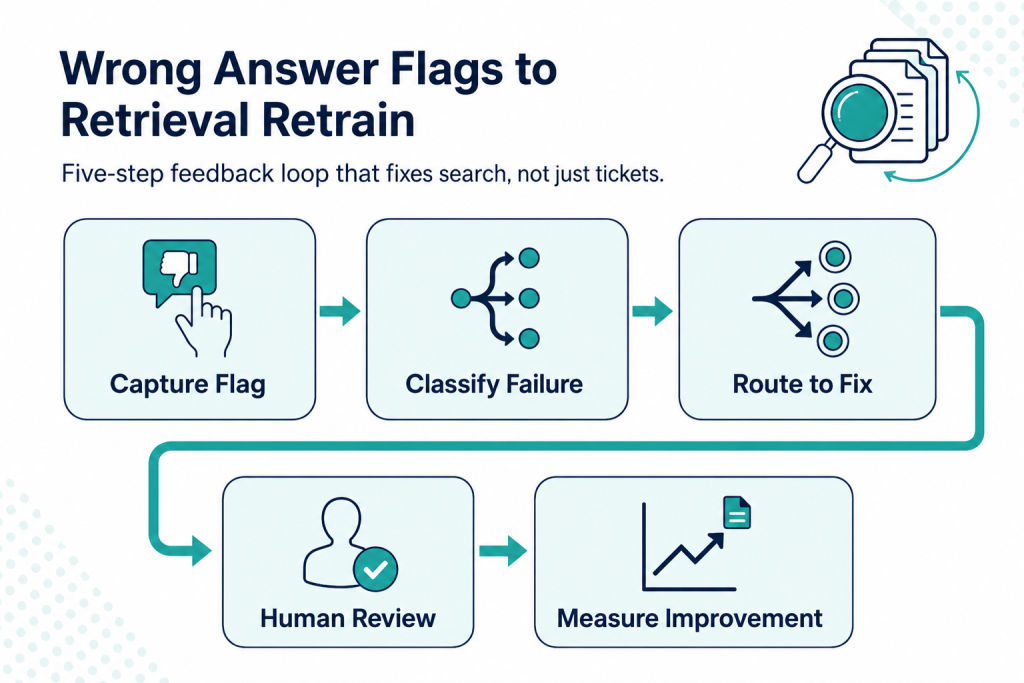
Turning a flag into a retrieval update requires a defined, repeatable path from the user’s click to a change in the index, not an ad hoc engineering fix. A practical version of this path looks like:
- Capture the flag with context. Record the query, the retrieved documents, the generated answer, and the specific reason the user gave (if the interface asks for one, such as “outdated,” “irrelevant source,” or “missing information”).
- Classify the failure type. Was the right document never in the index? Was it in the index but ranked too low? Was it retrieved but chunked in a way that cut off the relevant sentence? Each failure type has a different fix.
- Route to the correct intervention. Missing documents go to a content gap list for the knowledge owner. Ranking issues go to a re-ranking or metadata adjustment. Chunking issues go to a re-indexing pass.
- Apply the fix with a human checkpoint. A reviewer confirms the correction before it goes live, especially in regulated sectors like healthcare or finance where an unreviewed automatic change could introduce a new error.
- Re-test the flagged query and its near-neighbors. Confirm the fix resolves not just the exact query that was flagged, but the cluster of similar queries likely to hit the same retrieval path.
This is the structural difference between a system that “learns” from feedback and one that merely records it. The three-step logic here, minimizing threat while making the correction specific and actionable, mirrors well-established approaches to giving effective feedback in general: be specific about what went wrong, tie it to an observable cause, and make the next step concrete [neuroleadership.com]. The same discipline that makes feedback useful between two people also makes it useful between a user and a retrieval system.
Why Doesn’t Everyone Just Fine-Tune the Model Instead?
This is the practical fork most teams hit once they decide to act on feedback at all, and it’s worth being direct about it: retraining retrieval and fine-tuning the underlying model are not interchangeable fixes for the same problem. Fine-tuning changes the model’s internal weights based on examples, which is slow, requires a meaningful volume of labeled data, and produces a model that still cannot cite its sources or be corrected by swapping out a document. RAG, by contrast, keeps the model fixed and changes what it reads before it answers, which means a correction can take effect as soon as the index updates. This is the core of the rag vs fine-tuning tradeoff for any team building feedback loops: fine-tuning a model to “forget” one wrong fact is disproportionately expensive and risks degrading performance elsewhere, while updating a retrieval index to stop serving that one wrong document is fast, auditable, and reversible.
RAG systems also ground their answers in real, current documents rather than frozen training data, which is why they generally reduce hallucination rates substantially compared to a static language model answering from memory alone, and why feeding a retriever well-governed, curated content measurably improves answer accuracy compared to feeding it an unmanaged document dump. A negative feedback loop is, in effect, an ongoing governance mechanism for that document set: every flagged wrong answer is a signal that something in the governed content needs attention.
How Should Enterprises Measure Whether a Feedback Loop Is Actually Working?
If a feedback loop is working, it should show up in rag evaluation metrics tracked before and after each correction, not just in a falling complaint count. Useful metrics include:
| Metric | What it measures | Why it matters for feedback loops |
|---|---|---|
| Retrieval precision | Share of retrieved documents actually relevant to the query | Shows whether a ranking fix resolved the flagged issue without degrading other queries |
| Groundedness / citation accuracy | Whether the generated answer is actually supported by the cited source | Catches silent failures where the system sounds confident but is wrong |
| Repeat-flag rate | How often the same query or query cluster gets flagged again | Direct evidence the fix worked, not just that the ticket was closed |
| Time-to-correction | Elapsed time from flag to live fix | Distinguishes a true feedback loop from a quarterly manual review |
Tracking repeat-flag rate is the single most telling number here. A system that logs complaints but doesn’t retrain retrieval will show the same query flagged repeatedly over months. A system with a working feedback loop should show that number dropping toward zero for any given query cluster within a few correction cycles.
What Does This Mean for Data Residency and Who Reviews the Feedback?
Building on the correction workflow above, a separate but related question enterprises raise is where the flagged data and the retrieval index actually live. Retraining retrieval means continuously updating an index built from an organization’s internal documents, which raises the same data residency questions as the original deployment. Regulations such as Singapore’s PDPA require comparable protection for data that crosses borders rather than mandating strict in-country storage, but many regulated sectors, particularly healthcare and finance, still prefer to keep correction data, flagged queries, and the retrieval index entirely within their own infrastructure for auditability and control. This is the distinction between private-cloud hosting, where data stays within a dedicated cloud environment but may still reach a model API for generation, and fully on-premises deployment, where neither the documents nor the feedback data ever leave the client’s own infrastructure. The right choice depends on the sector and the sensitivity of the underlying content, not a blanket preference.
Frequently Asked Questions
Is a negative feedback loop the same as reinforcement learning?
No. Reinforcement learning adjusts a model’s weights based on a reward signal over many training cycles. A negative feedback loop in enterprise RAG typically adjusts the retrieval index, document metadata, or ranking rules, with the underlying language model left untouched.
Does every wrong answer need a human reviewer before the fix goes live?
In regulated or high-stakes contexts, yes. A human-in-the-loop checkpoint prevents an automatic correction from introducing a new error, which is especially important when the flagged query touches compliance, health, or financial information.
How is this different from just collecting user ratings?
Ratings tell you something is wrong. A feedback loop tells you what specifically failed (missing document, bad ranking, stale content) and routes that failure to a concrete fix. Without that classification step, a rating is just a number on a dashboard.
Can feedback loops fix knowledge that’s simply outdated?
Partly. A feedback loop can flag that an answer used a stale document, but someone still needs to update or replace that document. The loop shortens the time between “this is wrong” and “someone knows exactly what to fix,” it doesn’t eliminate the need for content ownership.
Do feedback loops work the same way for enterprise search as for customer-facing chatbots?
The mechanism is the same (flag, classify, correct, re-test), but the review threshold often differs. Internal enterprise search can sometimes tolerate faster, lighter-touch corrections; customer-facing systems usually warrant a stricter review gate before a correction goes live.
How quickly should a correction take effect after a flag?
It depends on the integration and how the index is updated, but the goal is to close the gap between flag and fix measurably, rather than batching corrections into an infrequent manual review cycle.
About Fooyo
Fooyo is a Singapore-headquartered company that builds AI knowledge bases and workflow automation for government agencies, enterprises, and SMEs across Asia. Its AI Knowledge Base product is a RAG-based system with grounded, source-cited answers and a human-in-the-loop review step built into every automated workflow, deployed into a client’s private cloud or fully on-premises infrastructure depending on data-residency requirements. Fooyo moves from pilot to production on a timeline scoped to each engagement’s integration complexity and data readiness, and integrates into existing CRM, POS, CMS, and messaging stacks rather than requiring a rip-and-replace rebuild. The company operates as a hands-on partner that builds and runs the product with its clients, not a consultancy that hands over a report and leaves.
If your organization is dealing with repeat retrieval errors that never seem to get fixed, it’s worth seeing how a feedback-driven knowledge base actually behaves in production. Get in touch with Fooyo to scope a pilot.
References
- Use This 3-Step Approach to Give Better Negative Feedback (neuroleadership.com)