A managed AI service level agreement should specify at minimum three things: an uptime commitment stated as a percentage with its corresponding downtime allowance, a response time target measured in milliseconds or seconds depending on the workload, and a penalty structure that credits you automatically when either is missed. Enterprise AI vendors typically commit to 99.9% or 99.99% uptime, and response time targets vary sharply by workload type, from 100 milliseconds for real-time inference to several seconds for retrieval-augmented systems. If your vendor’s contract is vague on any of these three items, you don’t have an SLA. You have a sales pitch with a signature on it.
TL;DR
- Demand uptime stated as a percentage with the actual downtime minutes it permits, not just a marketing number. 99.9% means 43.8 minutes of downtime a month; 99.99% means 4.38 minutes [source: verified facts].
- Response time SLAs should be workload-specific: real-time inference targets 100-500 milliseconds, RAG systems target 1-5 seconds, and batch jobs are measured in minutes or hours.
- Look beyond uptime. AI-specific quality standards like inference latency, hallucination thresholds, and explainability matter as much as raw availability.
- Insist on a tiered service credit structure, not a vague “we’ll look into it” promise, and get the credit percentages written into the contract.
- If you operate in a regulated sector in Singapore, MAS Technology Risk Management guidelines already set a hard downtime ceiling for critical systems, so your vendor SLA needs to meet or beat that bar.
About the Author: Fooyo builds and operates production AI systems (knowledge bases, marketing automation, commerce platforms) inside the private cloud environments of government agencies, enterprises, and SMEs in Singapore, Indonesia, Japan, Germany, and the US. Because Fooyo runs these systems day-to-day rather than handing over a report and leaving, it deals with SLA negotiation, uptime monitoring, and response time targets as an operational reality, not a theoretical exercise.
What Exactly Is a Managed AI SLA, and Why Does It Differ From a Regular IT SLA?
A managed AI SLA is a contract clause that defines the performance a vendor guarantees for an AI system it operates on your behalf, covering availability, response speed, and often output quality. Regular IT SLAs (for hosting, email, or ticketing systems) mostly care about uptime and support response time [xurrent.com][mydatapath.com]. AI systems add a layer regular software doesn’t have: probabilistic output. A web server either returns a page or it doesn’t. An AI model can be “up” and still return a wrong, slow, or nonsensical answer. That’s why recognized frameworks like ISO/IEC 25059 and ISO/IEC 42001 extend the definition of performance beyond uptime to include inference latency, accuracy rates, hallucination thresholds, explainability, fairness, and robustness against model drift. A managed AI SLA that only talks about server uptime is measuring the wrong thing for half the risk you’re actually taking on.
What Uptime Percentage Should You Actually Demand?
The uptime number to demand depends on how critical the AI system is to your operations, and the percentage difference matters more than it looks on paper. Enterprise AI vendors typically commit to 99.9% (three nines) or 99.99% (four nines) uptime. The gap between those two numbers isn’t small: 99.9% allows up to 43.8 minutes of downtime a month or 8.77 hours a year, while 99.99% allows just 4.38 minutes a month or 52.6 minutes a year. Major cloud providers including AWS, Azure, and Google Cloud typically anchor their managed AI and machine learning services at 99.9%, with select services like AWS SageMaker or Azure OpenAI provisioned throughput reaching 99.95% to 99.99% for multi-zone deployments.
Here’s a rough way to think about which tier you need:
| Use Case | Recommended Uptime Tier | Monthly Downtime Allowance |
|---|---|---|
| Internal knowledge base, non-urgent queries | 99.9% | Up to 43.8 minutes |
| Customer-facing chat, commerce, or booking systems | 99.9% to 99.99% | 4.38 to 43.8 minutes |
| Financial or regulated critical systems | 99.99% or higher, per regulator | Under 4.38 minutes |
If you’re in a regulated financial context in Singapore, the ceiling isn’t negotiable. MAS Technology Risk Management guidelines cap downtime at a maximum of 4 hours per year for critical systems, which includes AI-driven applications supporting those functions. A vendor SLA of 99.9% (8.77 hours a year of allowed downtime) doesn’t clear that bar on its own, so the contract needs to specify a tighter figure or add compensating controls like failover redundancy.
What Response Time Should You Expect for SLA Response Time Commitments?
Response time SLA targets should never be a single flat number across an entire AI system, because different workloads inside the same deployment have fundamentally different physics. Real-time inference, the kind used for fraud detection or live recommendation, usually targets 100 to 500 milliseconds. Retrieval-augmented generation (RAG) systems, which first search a knowledge base and then generate an answer, typically target 1 to 5 seconds because retrieval and generation are sequential steps, not one. Batch processing jobs, like nightly report generation or bulk document tagging, are reasonably measured in minutes or hours based on when the job actually finishes, not when it starts.
This distinction matters because vendors sometimes quote a single, fast SLA response time figure derived from the easiest workload in their stack, then apply it loosely across everything they sell you. If your use case is closer to RAG (which covers most enterprise knowledge base and support automation tools) a 200-millisecond promise is either marketing or measured from the wrong starting point. A separate but related trap: some vendors define “response time” as the moment a support ticket is opened and an automated acknowledgment is sent, not the moment a human or system actually resolves the issue [technologymatch.com]. Ask your vendor to define, in writing, whether “response” means acknowledgment or resolution, and for which specific workload the number applies.
What Happens When the Vendor Misses the SLA?
Building on the targets above, the harder question is what actually happens when they’re missed, because an SLA without enforcement is a description, not a commitment. Enterprise SLAs typically use a tiered service credit structure as the penalty mechanism. A common structure looks like this:
- Uptime between 99.0% and 99.9%: a 10% credit on the monthly bill
- Uptime between 95.0% and 99.0%: a 25% to 30% credit
- Uptime below 95.0%: up to a 100% credit
Two things to check before you sign. First, whether the credit is automatic or requires you to file a claim within a tight window, since many vendors quietly shift the burden of proof onto the customer. Second, whether the credit is capped, and at what percentage of your total spend, because an uncapped credit on a small monthly fee is a weak deterrent for a vendor running your production system.
How Does a “Managed AI Services” Contract Differ From a One-Off AI Project?
A managed AI services contract is an ongoing operational relationship where the vendor continues to run, monitor, and support the AI system after launch, rather than a fixed-scope build that ends at delivery. This distinction changes what your SLA should cover. A one-off project’s contract mostly cares about delivery date and acceptance criteria. A managed services contract needs monitoring cadence, incident response procedures, backup and recovery commitments, security duties, and reporting frequency written in, alongside uptime and response time [mydatapath.com][scopestack.io]. This is also where “human in the loop” review gates become an SLA-relevant detail rather than a nice-to-have feature. If an automated workflow is meant to trigger an action (say, updating inventory or issuing a refund), the SLA should specify how fast a human reviewer is expected to clear an exception queue, not just how fast the underlying model responds.
Fooyo’s own model for this leans specifically toward the “managed” end of that spectrum: it deploys AI Knowledge Base, Kakis, Fooyo Commerce®, and Smart Tourism into a client’s own private cloud and then continues operating the system, rather than handing over a build and stepping away. Because the same team that ships the pilot also carries the pager for the production system, SLA numbers aren’t abstractions negotiated once and forgotten; they’re operational targets the team is measured against every week.
What Should Actually Be Written Into Your Managed AI SLA Contract?
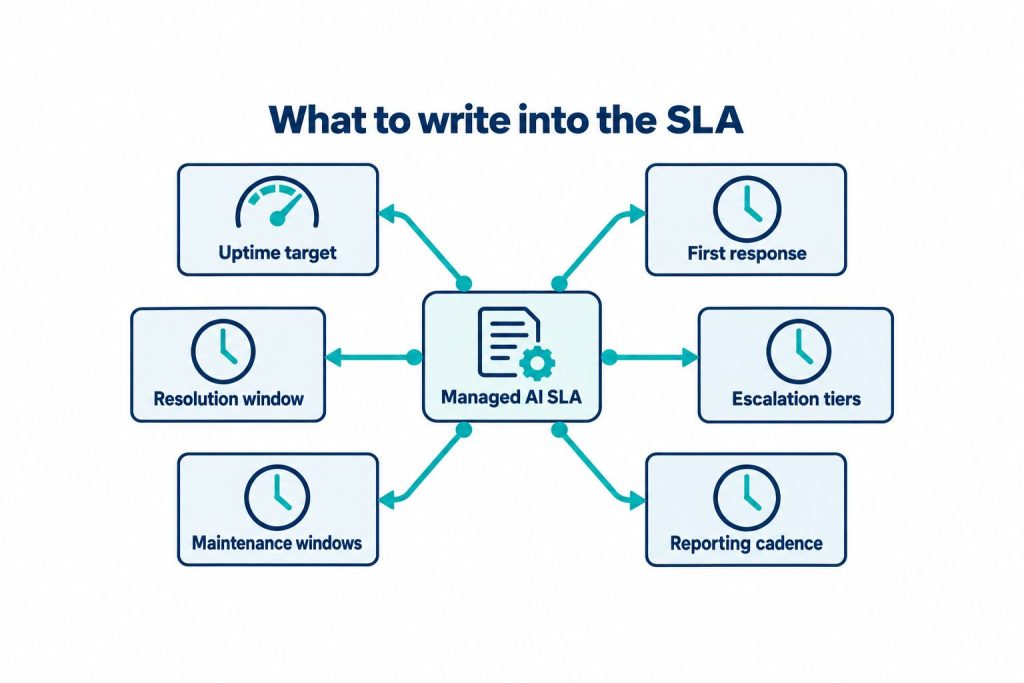
Pulling the pieces above together, a managed AI SLA worth signing should specify each of the following explicitly, not implicitly:
- Uptime percentage, stated with its downtime-per-month equivalent, not just the headline number
- Response time target broken out by workload type (real-time inference vs. RAG vs. batch)
- Whether “response” means acknowledgment or resolution
- AI-specific quality thresholds: accuracy rate, hallucination rate, and how they’re measured
- Service credit tiers, whether they’re automatic, and whether they’re capped
- Incident escalation path and who owns the exception queue for human-in-the-loop workflows
- Data residency and deployment model (private cloud vs. shared model), since this affects both compliance exposure and the practical uptime you can expect
Frequently Asked Questions
What is a good SLA response time for a customer-facing AI chatbot?
For most customer-facing tools built on retrieval-augmented generation, 1 to 5 seconds is the realistic target. Anything promising sub-second response for a RAG-based system should prompt you to ask what’s being measured.
Is 99.9% uptime good enough for a managed AI service?
It’s the industry standard baseline used by major cloud providers for most managed AI and machine learning services. Whether it’s “good enough” depends on your regulatory context; critical financial systems in Singapore need to clear the MAS TRM downtime ceiling, which is tighter than 99.9% allows on its own.
What’s the difference between uptime SLA and response time SLA?
Uptime SLA measures whether the system is available at all. Response time SLA measures how fast it answers once it’s available. A system can be 100% up and still miss its response time target if it’s simply slow.
Do AI SLAs need to cover accuracy, not just speed?
Yes. Frameworks like ISO/IEC 25059 and ISO/IEC 42001 treat accuracy, hallucination rate, and explainability as core performance metrics for AI systems, separate from uptime and latency.
What penalty should I expect if my vendor misses the SLA?
A tiered service credit is standard: roughly 10% back for uptime just under 99.9%, 25-30% for uptime in the mid-90s, and up to 100% for uptime below 95%. Confirm whether credits are automatic and capped before signing.
Does a private cloud deployment change the SLA conversation?
Yes. A private cloud deployment gives you more direct visibility into monitoring and incident logs than a shared public model, which makes it easier to verify whether the vendor actually hit the numbers in the contract.
About Fooyo
Fooyo is a Singapore-headquartered company that builds AI knowledge bases, marketing automation, commerce platforms, and tourism tools, then deploys them into a client’s own private cloud and continues to operate them. It moves from pilot to production in as little as six weeks, with client data never used to train a shared public model. Fooyo is trusted by government agencies, enterprises, and SMEs in Singapore, Indonesia, Japan, Germany, and the US, with offices in Singapore, Chengdu, and Tokyo. Every deployment includes human-in-the-loop review gates and source-cited answers, built for teams that need to know exactly what their AI system is doing and how fast.
If you’re evaluating a managed AI services vendor and want to talk through what uptime and response time commitments actually make sense for your use case, get in touch with Fooyo to discuss your needs, starting with a 30-minute demo.
References
- SLA Management Guide for IT Leaders (technologymatch.com)
- Delivering Excellent Service with the Right SLAs | Xurrent (xurrent.com)
- Managed IT SLA: What to Include | Datapath (mydatapath.com)
- The Complete Guide to Service Level Agreements (SLAs) for MSPs (scopestack.io)