RAG answer quality is measured across two separate layers: retrieval quality (did the system pull the right source documents) and generation quality (did the model produce an answer that is faithful to those documents and actually useful to the person asking). Buyers evaluating enterprise knowledge base software need a scorecard that checks both layers separately, because a system can retrieve perfectly and still hallucinate, or generate a fluent answer built on the wrong context entirely. This article lays out the specific rag evaluation metrics that matter, how they fit into a working rag evaluation framework, and what to ask vendors before you sign anything.
TL;DR
- RAG quality has two independent failure points: retrieval (wrong or missing context) and generation (hallucination despite correct context). Score them separately.
- Five core metrics cover most evaluation needs: context relevance, context sufficiency, answer relevance, answer correctness, and answer hallucination rate [patronus.ai].
- Common production failure modes include chunking errors, context fragmentation, over-retrieval noise, and grounding failures where the model ignores correct context entirely.
- Industry frameworks like RAGAS, TruLens, ARES, and DeepEval mostly use an LLM-as-a-Judge approach to score these metrics at scale.
- Procurement should treat source citation, private deployment, and human review gates as evaluation criteria, not just nice-to-haves.
About the Author: Fooyo builds and operates production RAG systems, including its AI Knowledge Base product, for government agencies, enterprises, and SMEs across Singapore, Indonesia, and Japan. This piece draws on that hands-on deployment experience rather than academic benchmarking alone.
What Does “RAG Answer Quality” Actually Mean?
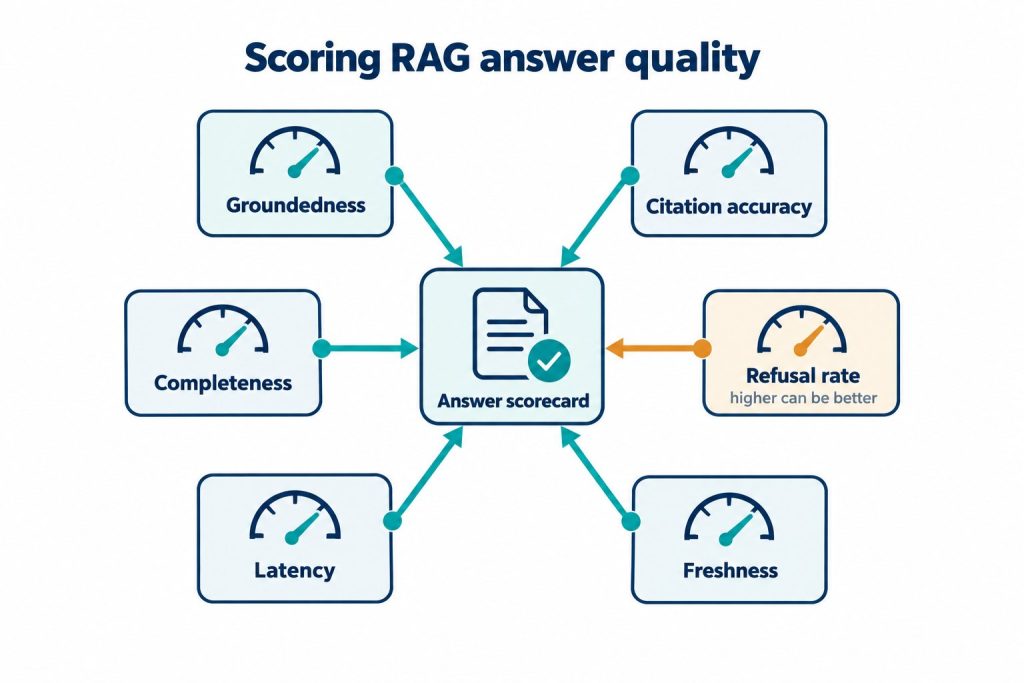
RAG answer quality is the degree to which a retrieval-augmented generation system returns answers that are both grounded in real source documents and genuinely responsive to the user’s question. Grounding without relevance is useless. Relevance without grounding is dangerous. A useful scorecard tests both, and it tests them at different stages of the pipeline rather than treating “quality” as one number.
The pipeline splits cleanly into two stages: retrieval and generation. Retrieval quality asks whether the system found the right documents in the knowledge base. Generation quality asks whether the language model then wrote an answer that reflects what those documents actually say [atlan.com][deepchecks.com]. Evaluating only the final output, which is what most non-technical buyers instinctively do, masks which stage is broken when something goes wrong.
Which RAG Evaluation Metrics Should Buyers Track?
Five metrics form the backbone of most working evaluation setups, and together they cover the retrieval and generation split described above. Context relevance and context sufficiency score retrieval; answer relevance, answer correctness, and answer hallucination score generation [patronus.ai].
| Metric | What it measures | Stage |
|---|---|---|
| Context relevance | Whether retrieved chunks are actually related to the query | Retrieval |
| Context sufficiency | Whether the retrieved chunks contain enough information to fully answer the question | Retrieval |
| Answer relevance | Whether the generated answer actually addresses what was asked | Generation |
| Answer correctness | Whether the answer matches ground truth or the source material’s actual claims | Generation |
| Answer hallucination | Whether the answer contains claims not supported by any retrieved source | Generation |
These five metrics [patronus.ai] map onto what most established evaluation guides recommend, whether they use the terms “faithfulness” and “context precision” or the labels above [evidentlyai.com][qdrant.tech][arxiv.org][braintrust.dev]. The naming varies by framework; the underlying question, does the answer trace back to a real document, does not.
Why Do RAG Systems Fail Even When Retrieval Looks Fine?
Building on the metric breakdown above, the harder question for buyers is knowing where things actually break in production, because a system can pass every retrieval check and still produce a bad answer. Grounding failures are the clearest example: the model receives the correct context but hallucinates anyway, ignoring the source text and generating a plausible-sounding but unsupported claim. This happens more often than retrieval failure in mature systems, because once retrieval is tuned, the remaining errors sit entirely in the generation step.
Other documented failure modes include:
- Retrieval misses: caused by poor chunking strategy or embedding drift, where the vector representation of a document no longer matches how users phrase questions about it.
- Context fragmentation: a document gets split into chunks in a way that separates a claim from the qualifier or caveat next to it, so the retrieved chunk technically matches the query but loses the original meaning.
- Over-retrieval: the system pulls too many chunks, flooding the model’s context window with noise and making it harder to identify which passage is actually relevant.
- Latency bottlenecks: retrieval and re-ranking steps that work fine in a demo slow down significantly at real query volumes.
A useful analogy: context fragmentation is like handing someone a single sentence torn out of a contract without the paragraph around it. The sentence might be technically true, but without the surrounding clause about exceptions or conditions, the reader draws the wrong conclusion. The retrieval system did its job (it found the sentence), but the chunking decision upstream determined whether that sentence still meant what it was supposed to mean.
What Do Analyst Firms and Industry Frameworks Recommend?
Stepping back from failure modes to what a rigorous evaluation setup actually looks like, the established frameworks in this space are RAGAS, TruLens, ARES, and DeepEval, and most of them rely on an LLM-as-a-Judge approach, where a separate language model scores retrieval and generation outputs against the metrics above. This isolates each pipeline component so a buyer or engineering team can tell exactly where a regression happened after a model update or a knowledge base change [evidentlyai.com][qdrant.tech][arxiv.org][comet.com].
Analyst firms like Gartner and Forrester layer on procurement-specific criteria beyond raw accuracy scores. Their guidance for evaluating enterprise knowledge base software emphasizes:
- Universal connectivity: pre-built connectors into existing systems rather than requiring custom integration work for every data source.
- Access controls: role-based permissions so the system doesn’t surface answers built on documents a given user shouldn’t see.
- Hybrid retrieval: combining keyword and semantic search rather than relying on vector search alone.
- Metadata management: tracking document source, freshness, and ownership so answers can be traced and audited.
- Strict grounding: responses tied explicitly to authoritative internal data to prevent hallucination.
This is where a rag evaluation framework needs to extend past academic metrics and into procurement checklists. A model can score well on context relevance in a lab test and still fail an enterprise audit if it can’t demonstrate which document backed a specific answer six months later.
How Should Buyers Build a Practical Scorecard?
Combining the metric layer with the procurement layer above gives you a scorecard with two halves: technical performance and operational readiness. A vendor demo should be able to answer specific questions from both.
Technical performance questions:
- Can you show context relevance and answer correctness scores on a test set drawn from our actual documents, not a generic benchmark?
- What is your hallucination rate when the correct context is present in the retrieved chunks versus absent?
- How do you handle chunking for long or structurally complex documents (contracts, technical manuals, policy documents)?
Operational readiness questions:
- Does every answer come with a source citation a user can click through to verify?
- Is there a human review gate before an automated action triggered by an answer actually executes?
- Where does the deployment run, and does our data ever train a shared or public model?
- Do you hold SOC 2 Type II or ISO 27001 certification, and what does your data residency setup look like under frameworks like GDPR or CCPA?
On timelines, it’s worth setting expectations early. Traditional custom RAG builds, complete with security reviews and legal approval cycles, typically run three to nine months. Packaged systems built for a specific enterprise use case can compress that to three to ten weeks, provided the vendor already has the connectors and compliance groundwork done. This is the model Fooyo’s AI Knowledge Base runs on: source-cited, grounded answers deployed into a client’s own private cloud, with human review gates built into any automated workflow the answers trigger, moving from scoped pilot to production typically in weeks rather than the traditional six-month cycle.
Frequently Asked Questions
What is the difference between retrieval quality and answer quality in RAG?
Retrieval quality measures whether the system found the right source documents. Answer quality measures whether the generated response is accurate and relevant given those documents. A system can score well on one and poorly on the other, which is why they need separate metrics [atlan.com][deepchecks.com].
Which rag evaluation metrics matter most for enterprise use cases?
Context relevance and context sufficiency for retrieval, and answer relevance, answer correctness, and answer hallucination for generation, form the core set most evaluation guides converge on [patronus.ai].
Can RAG evaluation be automated?
Yes. Frameworks like RAGAS, TruLens, ARES, and DeepEval typically use an LLM-as-a-Judge approach to score outputs against these metrics without requiring a human to manually review every answer, though spot-checking with human reviewers remains standard practice for high-stakes use cases.
What causes RAG hallucination if the correct document was retrieved?
This is a grounding failure: the model receives the right context but generates a claim not actually supported by it. It’s a distinct failure mode from retrieval error and requires generation-side fixes, not just better chunking or embeddings.
What compliance certifications should enterprise knowledge base software have?
Most enterprise buyers require SOC 2 Type II and ISO 27001 certification, along with adherence to privacy frameworks like GDPR or CCPA, data residency controls, role-based access permissions, and a guarantee that proprietary data never trains a shared model.
How long does it take to deploy a production RAG system?
Traditional custom builds take three to nine months due to security reviews and integration work. Packaged solutions built around a specific use case can deploy in three to ten weeks.
Do RAG systems need human review built in?
For any workflow where an answer triggers an automated action (updating a record, sending a communication, approving a request), a human review gate is standard practice to catch errors before they propagate.
About Fooyo
Fooyo is a Singapore-headquartered company that builds AI knowledge bases and workflow automation systems for government agencies, enterprises, and SMEs across Singapore, Indonesia, and Japan. Its AI Knowledge Base product is a RAG-based system that lets users ask questions across an entire knowledge base and automate actions triggered by the answers, with grounded, source-cited responses deployed privately into a client’s own cloud environment. Fooyo builds and operates the product with clients from pilot through ongoing support. It is trusted by government agencies, enterprises, and SMEs across Asia.
If you’re evaluating enterprise knowledge base software and want a system that grounds every answer in a citable source and runs entirely in your own private cloud, get in touch with Fooyo at https://fooyo.sg/.
References
- A complete guide to RAG evaluation: metrics, testing and best practices (evidentlyai.com)
- Best Practices in RAG Evaluation: A Comprehensive Guide – Qdrant (qdrant.tech)
- Evaluation of Retrieval-Augmented Generation: A Survey (arxiv.org)
- How to Evaluate RAG Systems: Metrics, Methods, and … – Comet (comet.com)
- RAG evaluation metrics: How to evaluate your RAG pipeline with Braintrust – Articles – Braintrust (braintrust.dev)
- RAG Evaluation: Metrics, Tools, and the Context Gap (2026) (atlan.com)
- Retrieval Quality VS. Answer Quality: Why RAG Evaluation Fails | Deepchecks (deepchecks.com)
- RAG Evaluation Metrics: Best Practices for Evaluating RAG Systems (patronus.ai)