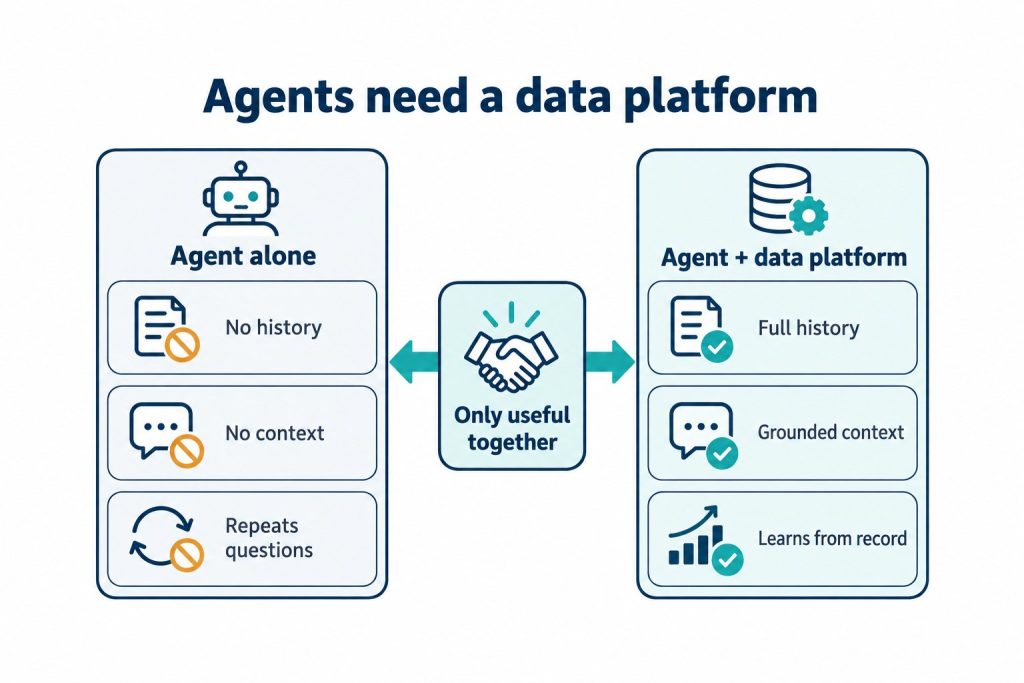
An AI agent without a connected data platform is a chatbot with opinions. It can talk, but it cannot check, act, or verify anything against what is actually happening inside the business. The two components, the agent that reasons and the platform that supplies live, governed data, form a single system: buy them apart and you get a demo that impresses in a meeting and fails within weeks of production use. Fooyo builds both pieces together as one deployed product, because separating them is where most enterprise AI agent integration efforts stall.
TL;DR
- AI agents deployed without unified, real-time data infrastructure frequently fail in production, mostly from hallucinations and compounding errors, not bad prompts.
- An agent is the reasoning layer; a data platform is the memory and evidence layer. Neither functions as a standalone enterprise product.
- Integration with existing systems, rather than replacement, is essential for enterprise AI adoption.
- Enterprise AI agent deployment timelines range from 6 weeks for scoped automations to 12 to 18 months for full LLM rollouts, depending on integration depth.
- Buying agents and data infrastructure from separate vendors adds an integration project the client has to manage themselves, which is exactly the gap that causes most of the failure risk above.
About the Author: This article is written by the Fooyo team, which builds AI knowledge bases and workflow automation deployed directly into client private cloud environments across Singapore, Indonesia, Japan, Germany, and the U.S., serving government agencies, enterprises, and SMEs across Asia.
What Is the Difference Between an AI Agent and a Data Platform?
An AI agent is software that takes an instruction, reasons over available information, and executes a multi-step task, sometimes with limited human checkpoints; a data platform is the infrastructure that stores, structures, and serves that information on demand. A multi-agent framework coordinates several such agents to solve problems too complex for a single one to handle [credal.ai]. But coordination between agents means nothing if the underlying data each agent pulls from is inconsistent, stale, or locked in a separate system nobody unified.
Think of it like a translator working in a courtroom. The translator (the agent) is skilled at converting intent into language and action. But if the translator has no access to the case file, the exhibits, or the witness testimony (the data platform), their fluency is irrelevant. They will confidently translate the wrong thing. This is the mechanism, not a metaphor for effort: the agent’s output quality is capped by the completeness and freshness of what it can query, and no amount of reasoning ability compensates for a missing or outdated data layer [home.mlops.community].
Why Do AI Agents Fail Without a Connected Data Platform?
AI agents deployed without unified, real-time data infrastructure frequently fail in production, driven primarily by compounding errors, hallucinations, and an inability to access or reason over current enterprise data. That pattern explains why so many pilot projects impress in a demo and then quietly get shelved. A demo runs on a curated dataset prepared in advance. Production runs on live, messy, constantly changing data spread across CRM, POS, ticketing, and document systems, and an agent without a real integration layer into that data has no way to tell a current record from a six-month-old one.
Compounding errors are the specific mechanism worth understanding. An agentic workflow often chains steps: retrieve information, interpret it, take an action, and then use the result of that action as input for the next step. If step one retrieves stale or wrong data, every downstream step inherits that error and often amplifies it, because the agent treats its own prior output as ground truth [mitsloan.mit.edu]. A single-step chatbot answering one question wrong is a minor annoyance. A multi-step agent that books, updates, and notifies based on a wrong initial retrieval can cause real operational damage before a human notices.
How Does an Agent Actually Use a Data Platform in Practice?
In a working deployment, the data platform functions as the agent’s memory, evidence base, and permission gate, all at once. Concretely, this involves several layers working together:
- Information layer: structured and unstructured data (documents, databases, transaction logs) that the agent can query, since an agent without data access is, functionally, a hallucination machine [home.mlops.community].
- Retrieval layer: a system, typically RAG-based (retrieval-augmented generation), that finds the relevant slice of data for a given query rather than dumping the entire dataset into the agent’s context.
- Governance layer: access controls, audit logs, and human review gates that determine what the agent is allowed to see and act on.
- Action layer: the integration into existing systems (CRM, POS, CMS, messaging) that lets the agent actually do something with what it retrieves, not just describe it.
This is why AI agent development cost estimates that only price the “agent” (the language model orchestration) tend to be misleading. The retrieval, governance, and integration layers are typically the majority of the engineering effort, and they are exactly the layers that determine whether the failure-rate statistics above apply to your deployment or not.
Why Can’t You Buy the Agent and the Data Platform Separately?
Buying an agent from one vendor and a data platform from another turns integration into the client’s problem, and integration is precisely where enterprise AI projects break down. Integration with existing technology stacks is essential for AI adoption, rather than pursuing rip-and-replace solutions. That principle cuts both ways: enterprises want to keep their existing CRM, POS, and CMS systems, but they also need the AI layer to genuinely connect to those systems rather than sit beside them.
When agent and data infrastructure come from separate vendors, someone still has to build and maintain the connective layer: authentication, data freshness checks, schema mapping, and error handling when one side changes its API. That work does not disappear because two products were purchased instead of one. It usually lands on an internal IT team that did not scope for it, which is a documented pattern behind stalled AI agent deployment timelines. Fooyo’s approach is to deliver the AI Knowledge Base and the underlying retrieval and integration infrastructure as one product, deployed into the client’s private cloud, precisely to remove that seam.
What Should Enterprise AI Use Cases Look Like When Built Correctly?
A correctly built enterprise AI use case pairs a specific, bounded task with a data platform that already has clean access to the information that task requires. Some illustrative patterns:
| Use Case | Data Platform Requirement | Agent Task |
|---|---|---|
| Internal policy Q&A | Unified document index with source citations | Answer employee questions, cite the source document |
| Storefront merchandising | Live product catalog and payment data | Adjust listings, trigger promotions |
| Tourism guide and booking | Live crowd and availability data | Recommend, book, and confirm in one flow |
| Marketing content at scale | Brand assets, past campaign performance | Turn a brief into a branded video, published on schedule |
Each of these fails without its data layer. A merchandising agent with no live inventory feed will recommend sold-out stock. A tourism guide agent with no live crowd data gives generic advice indistinguishable from a search engine. The AI Knowledge Base, Fooyo Commerce®, and Smart Tourism products are each built as agent-plus-data pairs for exactly this reason, rather than as a language model bolted onto whatever data happened to be exportable.
What Does Enterprise AI Integration Actually Cost and How Long Does It Take?
Enterprise AI agent pricing and timelines vary substantially by how much integration and governance work is required, not by the sophistication of the language model alone. The average enterprise AI implementation takes 6 to 12 months from scoping to production, according to McKinsey’s 2024 State of AI research. Simple, scoped automations can reach production in 6 to 10 weeks, while enterprise-wide LLM deployments typically require 12 to 18 months. That spread is almost entirely explained by integration and governance scope, not model choice.
Fooyo’s model targets the fast end of that range deliberately: production-ready deployments in as little as six weeks by scoping a specific use case (a knowledge base, a storefront, a marketing workflow) rather than attempting an enterprise-wide rollout on day one, then expanding from a working pilot. This mirrors how the AI agent pricing conversation should be framed: cost tracks the complexity of the systems you’re integrating into and the governance controls required, not a flat per-seat license fee.
Regulatory context matters here too. In Singapore and other Asian markets, data residency requirements and data sovereignty pressures increasingly mandate private cloud or on-premise deployment, with zero external cloud data transfer. An AI-powered ecommerce platform or knowledge base handling customer or citizen data cannot rely on a shared public model if it needs to satisfy these constraints, which is one reason Fooyo deploys every solution into the client’s own private cloud rather than a shared multi-tenant environment.
Frequently Asked Questions
Do I need a data platform if I’m only using one AI agent?
Yes. Even a single agent needs a connected, current source of information to act on; without one it will answer based on outdated or incomplete context, which is the leading cause of production failure.
What is the realistic AI agent development cost for an enterprise deployment?
Cost depends primarily on integration complexity (number of systems connected, data governance requirements) rather than the AI model itself. Scoped, single-use-case deployments cost significantly less than enterprise-wide rollouts.
How long does AI agent deployment typically take?
Simple, bounded automations can reach production in 6 to 10 weeks. Full enterprise-wide deployments typically take 12 to 18 months, according to industry research.
Can AI agents work with our existing CRM, POS, or CMS instead of replacing them?
Yes, and most enterprises require this. Integration with existing systems is essential rather than pursuing rip-and-replace approaches.
Is a RAG-based system the same as a data platform?
RAG (retrieval-augmented generation) is one method within a data platform, responsible for finding relevant information for a query. The broader platform also handles governance, access control, and system integrations.
What industries see the most reliable AI agent case studies?
Retail, hospitality, education, and government services show consistent patterns where bounded use cases (knowledge lookup, merchandising, booking) succeed because the data platform scope is well defined from the start.
Does private cloud deployment slow down AI agent integration?
Not inherently. It adds upfront architecture decisions but avoids the compliance rework that shared-model deployments often require later in regulated markets.
About Fooyo
Fooyo is a Singapore-headquartered company that builds AI knowledge bases, workflow automation, and production AI products, deploying them directly into clients’ private cloud environments rather than delivering prototypes or reports. Its four products, AI Knowledge Base, Kakis, Fooyo Commerce®, and Smart Tourism, are each built as an agent paired with its own data infrastructure, reflecting the argument above: the two cannot be meaningfully separated. With headquarters in Singapore, development in Chengdu, and partnerships in Tokyo, Fooyo serves government agencies, enterprises, and SMEs across Singapore, Indonesia, Japan, Germany, and the U.S. Its engagement model starts with a 30-minute demo and a scoped pilot, aiming for production in weeks rather than the industry-standard six-month cycle.
If your organization is evaluating an AI agent and finding that the harder question is what data it will actually run on, that conversation is worth having early. Get in touch with Fooyo to scope a pilot.
References
- The Complete Guide to Multi-Agent Platforms (credal.ai)
- Architecting the AI Agent Platform: A Definitive Guide – Blog | Agentic AI Foundation (home.mlops.community)
- Agentic AI, explained | MIT Sloan (mitsloan.mit.edu)