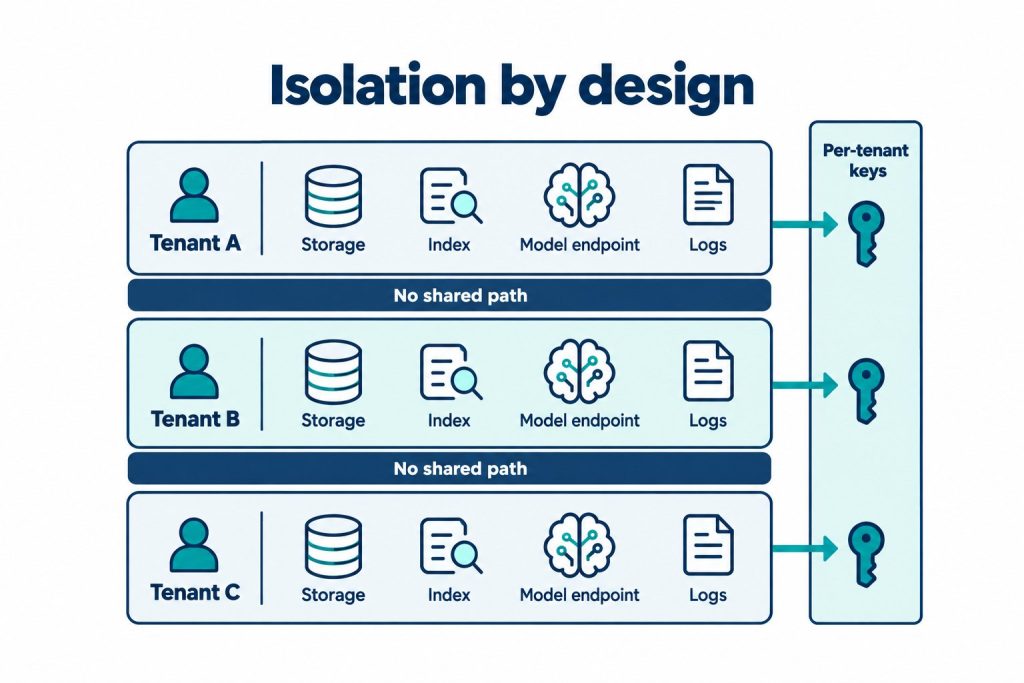
Fooyo isolates client data by deploying every AI agent, knowledge base, and automation workflow into the client’s own private cloud environment rather than a shared, multi-tenant public AI model. This means a retailer’s product data, a hospital’s patient records, or a government agency’s citizen data never sits alongside another organization’s data, and it never trains a model that anyone outside that organization can query. The architecture matters because the biggest risks in enterprise AI today are not about whether a model is smart enough. They are about whether the infrastructure around that model leaks data it should not.
TL;DR
- Private-cloud deployment means single-tenant infrastructure: one client, one environment, no data crossover.
- Shared public AI models carry documented risks including multi-tenant data leakage and exposure of sensitive data to public internet endpoints.
- Fooyo deploys AI knowledge bases and agentic workflows into a client’s own private cloud, with grounded, source-cited answers and human review gates built in.
- Standard enterprise AI builds take around six months; reusable agent infrastructure can bring this down to a matter of days or weeks.
- Compliance frameworks like SOC 2, ISO 27001, ISO 42001, HIPAA, PCI DSS, and FedRAMP shape how data isolation actually gets implemented, not just how it gets marketed.
About the Author: Fooyo is a Singapore-headquartered company that builds and operates production AI systems, including enterprise RAG solutions and agentic automation, for government agencies, enterprises, and SMEs across Singapore, Indonesia, Japan, and beyond. Every product it ships, from AI knowledge bases to hospitality booking agents, runs in the client’s private cloud by default, which makes data isolation a daily engineering concern rather than a slide in a sales deck.
What Does “Private-Cloud Architecture” Actually Mean for AI Agents?
A private cloud is infrastructure, virtual or physical, dedicated to a single organization rather than shared across multiple tenants over the public internet [thenewstack.io][ionos.com]. Virtualization is what makes this practical: it lets one physical set of servers be logically partitioned so that a client’s environment behaves like its own dedicated data center, even when the underlying hardware sits in a data center provider’s facility [unitedlayer.com]. For an AI agent, this distinction is not cosmetic. A public, multi-tenant AI service processes requests from many customers on shared compute, sometimes shared model weights, and shared logging pipelines. A private-cloud deployment means the agent, its vector database, its knowledge base, and its logs all live inside a boundary that only one organization controls.
Think of it like the difference between renting a serviced desk in an open-plan coworking space versus leasing your own locked office within the same building. The building’s plumbing and electricity might be shared infrastructure, but nobody else has a key to your office, nobody can see your filing cabinets, and nobody’s junior analyst can accidentally open your client folder while looking for their own. That is the mechanical difference between a shared AI model and a private-cloud AI agent: the isolation is enforced by the walls, not by a promise.
Why Does Data Isolation Matter More for AI Agents Than for Traditional Software?
Traditional enterprise software stores data. AI agents actively process, reason over, and sometimes learn from that data, which changes the risk profile. Shared public cloud AI deployments face documented risks such as multi-tenant data leakage, unauthorized model access, and exposure of sensitive data to public internet endpoints. Private-cloud architectures address these by using single-tenant environments, private networking, and localized hardware that removes data-in-transit compliance risk entirely.
The distinction that matters most for buyers evaluating an ai agent development company is whether client data ever touches a model that other customers also query. If it does, there is a structural possibility, however small, that patterns from one client’s data influence outputs served to another. If the agent runs in a private cloud on a single-tenant model instance, that possibility does not exist because there is no shared model to leak into. This is the core reason Fooyo’s AI Knowledge Base and agentic workflows are deployed privately by default rather than offered only as a shared SaaS tier: for regulated industries and government clients, a policy promise about data handling is not the same as an architectural guarantee.
How Do You Actually Enforce Isolation at the Network and Compute Layer?
Isolation is enforced through specific technical controls, not general policy statements. Major platforms secure AI agent deployments using AWS PrivateLink and Azure Private Endpoints, which route traffic over private network backbones instead of the public internet [broadcom.com]. On-premise or client-controlled Kubernetes clusters add another layer: dedicated orchestration with fine-grained access controls, hardened base images, and centralized secret management to protect API keys [broadcom.com].
Modern private-cloud designs increasingly go further, moving toward workload-level isolation and “assume-breach” architectures, where security is designed on the premise that a breach of one component should not compromise the rest [broadcom.com]. In practice this means:
- Network segmentation: the AI agent’s traffic never traverses public endpoints, even for internal calls between services.
- Workload isolation: each client’s compute, storage, and model instance run in logically or physically separate resources.
- Secret management: API keys and credentials are centrally managed and rotated, not hardcoded into scripts or shared across environments.
- Policy-driven access: who can query the agent, what data it can retrieve, and what actions it can trigger are all governed by explicit rules rather than implicit trust.
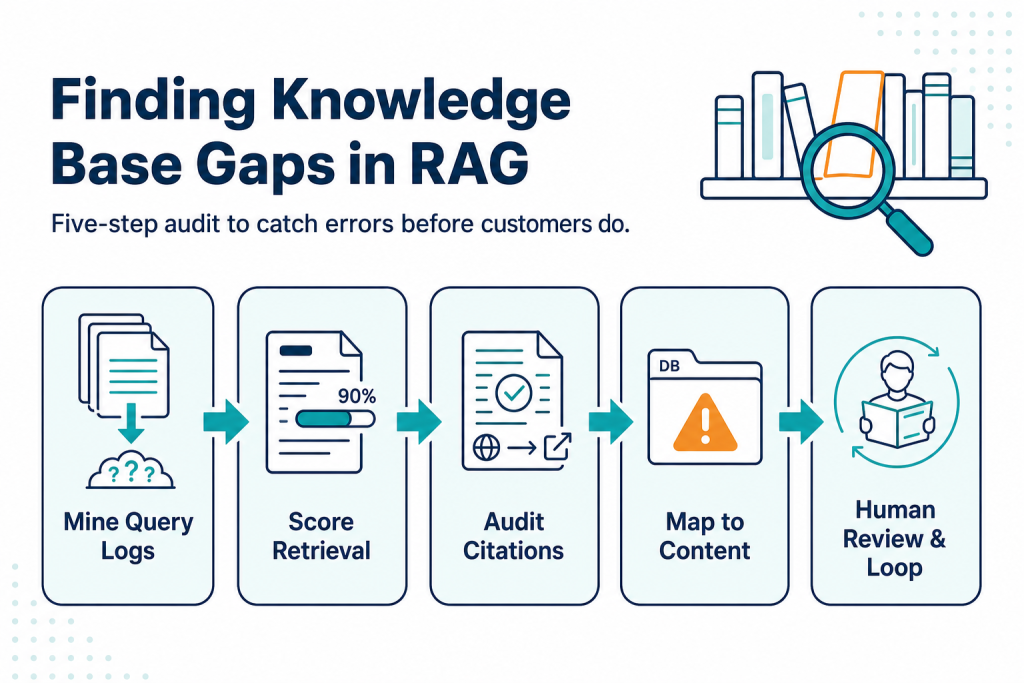
This is the architecture Fooyo builds into its private-cloud deployments: the AI Knowledge Base, for example, is a RAG-based enterprise system where every answer is grounded in a client’s own documents and source-cited, and the retrieval layer never leaves the client’s private environment.
What Compliance Standards Actually Govern This, and Why Should That Matter to a Buyer?
Compliance frameworks are not paperwork exercises; they specify concrete controls that map directly onto the technical isolation described above. Private-cloud AI deployments typically need to satisfy SOC 2 for continuous operation of security controls, ISO 27001 for information security management, and ISO 42001 for AI-specific governance. Depending on the sector, additional frameworks apply: HIPAA for healthcare data, PCI DSS for payment data, and FedRAMP for government data isolation.
A useful way to think about these standards: SOC 2 asks “are your controls actually operating, continuously, not just documented?” ISO 27001 asks “is your information security managed as a system, not a checklist?” ISO 42001 asks the newer question specific to AI: “do you govern how your models are trained, monitored, and constrained?” A vendor that can speak fluently to which of these applies to a given client’s sector, rather than citing all of them generically, is usually the one that has actually built to them.
How Does Private-Cloud Deployment Change the AI Development Timeline?
A fair question at this point is whether private, isolated deployment slows things down. It does not have to, and this is where reusable infrastructure changes the equation. Industry reports cite a traditional six-month cycle for enterprise AI deployment, driven by the time needed for one-off, bespoke builds requiring custom integration, testing, and deployment pipelines built from scratch. Reusable agent infrastructure has shortened that timeline significantly for narrower deployments.
Fooyo’s own delivery model reflects this shift, moving from a 30-minute scoping demo to a pilot to full private-cloud deployment within weeks, rather than the traditional six-month enterprise build cycle. The reason this is possible without compromising isolation is that the isolation pattern, private networking, workload separation, secret management, is templated and repeatable across clients, even though each client’s data, knowledge base, and integrations remain entirely their own.
How Does This Apply to an AI Knowledge Management System Specifically?
An ai knowledge management system built on retrieval-augmented generation (RAG) is arguably the highest-stakes case for data isolation, because by definition it ingests a company’s internal documents, policies, and records to answer questions against them. This is precisely the category Fooyo’s AI Knowledge Base sits in: a RAG-based enterprise RAG solution that lets staff ask questions across an entire internal knowledge base and trigger downstream actions from the answers.
Two design choices matter here beyond infrastructure. First, grounded, source-cited responses: the agent shows where an answer came from, so a reviewer can verify it against the original document rather than trusting an opaque output. Second, human-in-the-loop review gates on automated actions, so that when an agent’s answer triggers a workflow (updating a record, sending a notification, escalating a case), a person can approve or intervene before it executes. Isolation protects the data; these two controls protect the decisions made from that data.
What Does This Look Like in a Sector Like Hospitality?
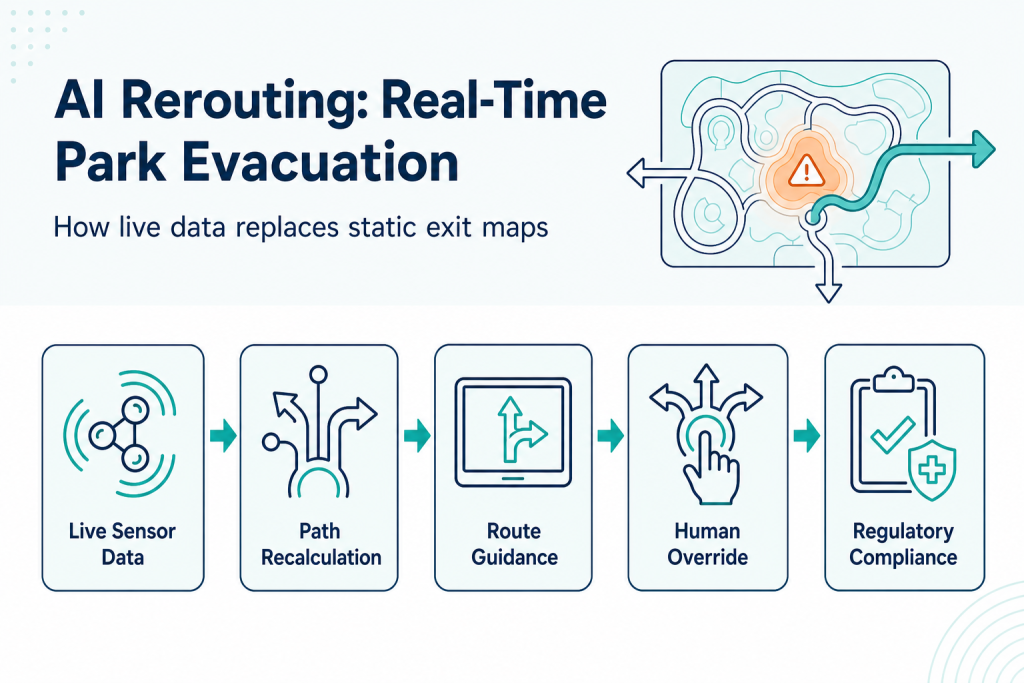
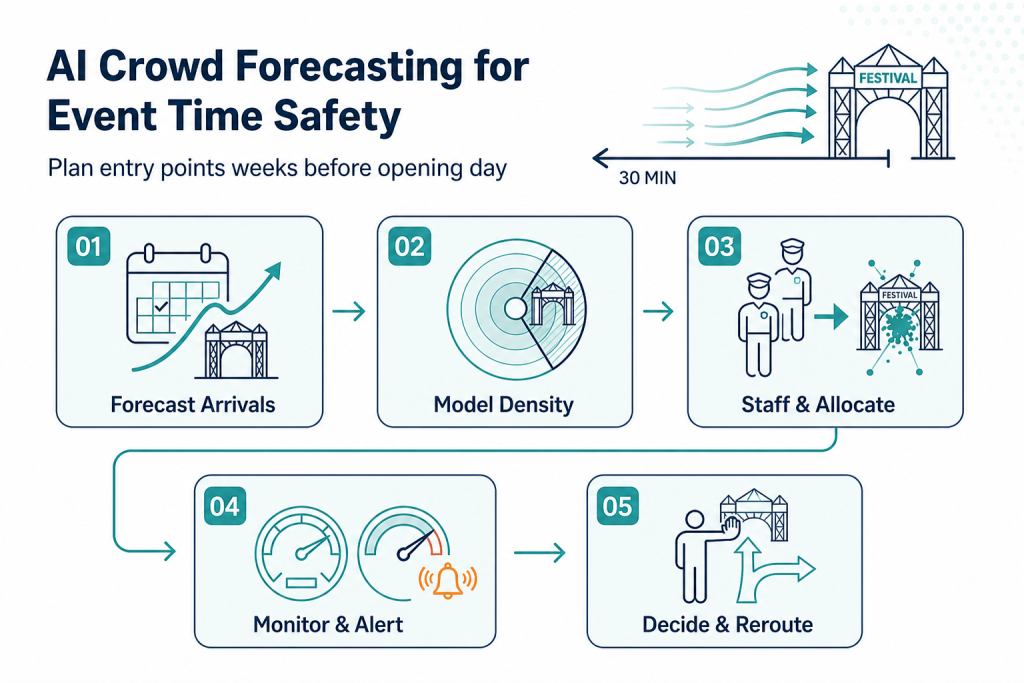
AI for hospitality industry use cases makes the isolation question concrete rather than abstract. A hotel group’s booking data, guest preferences, and loyalty records are commercially sensitive and often subject to jurisdiction-specific privacy rules. An AI concierge or smart tourism guide that recommends itineraries or answers guest questions needs access to that data to be useful, but a shared public model handling multiple hospitality brands’ data simultaneously introduces exactly the multi-tenant leakage risk described earlier. Private-cloud deployment means each operator’s guest data, booking history, and crowd analytics stay within their own environment. Fooyo’s Smart Tourism platform, which combines live crowd data with AI-powered guides and booking tools, follows this same private-by-default pattern rather than pooling data across destinations.
Frequently Asked Questions
Does private-cloud deployment mean the AI agent runs entirely on the client’s own servers?
Not necessarily. Private cloud can mean dedicated infrastructure hosted by a cloud provider (via private networking like AWS PrivateLink) or fully on-premise hardware. The defining feature is single-tenancy and private network boundaries, not physical location [ionos.com].
Is private-cloud AI more expensive than using a shared public model?
Cost depends on scale and provider, and current industry commentary points to cost and sovereignty as two of the leading considerations shaping private-cloud decisions in 2026 [broadcom.com]. The relevant comparison is usually risk-adjusted cost, not sticker price alone.
Can a private-cloud AI agent still integrate with existing tools like CRM or POS systems?
Yes. Private deployment governs where data and compute live, not whether the agent can connect to existing systems. Integration into a client’s existing CRM, POS, CMS, or messaging stack is standard practice and avoids a rip-and-replace approach.
Does client data ever get used to train a shared AI model?
In a properly isolated private-cloud deployment, no. The model instance and its outputs are scoped to that client only.
What compliance certifications should I ask an AI vendor about?
At minimum, ask about SOC 2, ISO 27001, and ISO 42001. If you’re in healthcare, payments, or government, also ask specifically about HIPAA, PCI DSS, or FedRAMP alignment, since these apply differently by sector.
How long does a private-cloud AI deployment typically take?
Traditional bespoke builds cite around six months. With reusable agent infrastructure, this can shrink to weeks.
About Fooyo
Fooyo is a Singapore-headquartered company that builds and operates production-grade AI systems, including enterprise RAG solutions and agentic automation workflows, for government agencies, enterprises, and SMEs across Asia with presence in Singapore, China, and Japan. Its production offerings include AI Knowledge Base, workflow automation, Smart Tourism, and other agentic platforms, each deployed into the client’s own private cloud rather than a shared public model, with grounded, source-cited answers and human review gates built into every automated workflow. Fooyo positions itself as a hands-on partner that builds and operates AI products alongside clients, rather than a consultancy that stops at a report or prototype. It is trusted by government agencies, enterprises, and SMEs across Asia.
If your organization is evaluating an ai agent development company for a knowledge base, hospitality platform, or agentic workflow that needs to keep data inside a private, auditable boundary, get in touch with Fooyo at https://fooyo.sg/ to scope a pilot.
References
- The Architect’s Guide to the New Private Cloud (thenewstack.io)
- Private Cloud Guide (unitedlayer.com)
- What is a private cloud? Definition and applications – IONOS (ionos.com)
- 2026 Private Cloud Predictions: Cost, Sovereignty, and the New Application Stack – Broadcom News and Stories (broadcom.com)