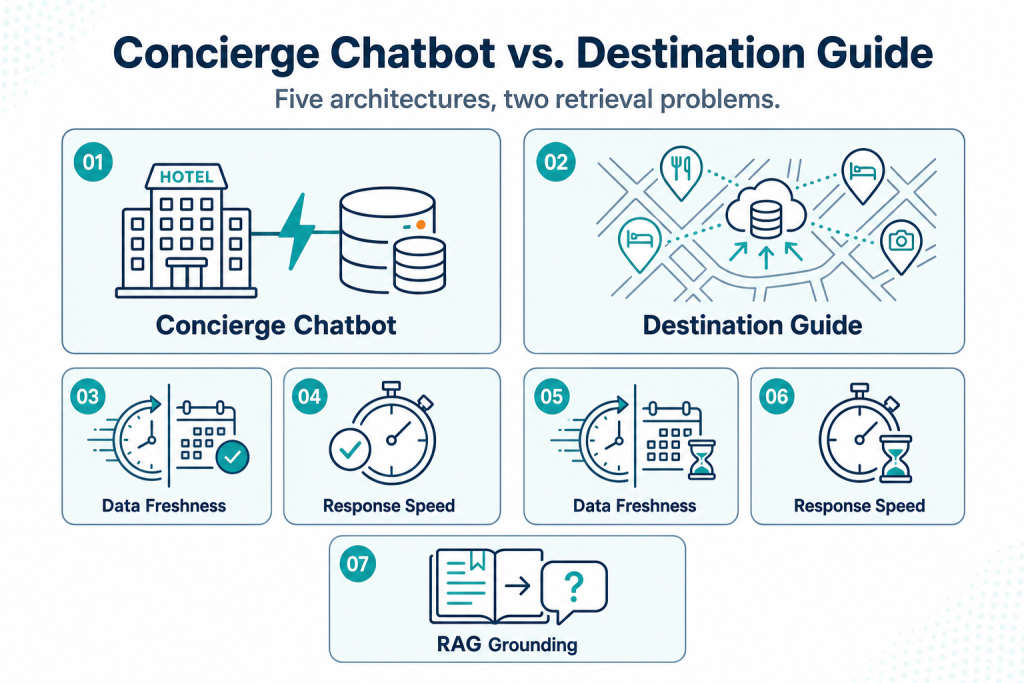
A hotel concierge chatbot and a destination AI guide look similar from the outside, both answer questions in natural language, but they are built on fundamentally different knowledge base architectures because they solve different retrieval problems. A concierge chatbot needs narrow, deep, frequently-changing data about one property: room inventory, booking policies, restaurant hours, loyalty terms. A destination guide needs broad, shallow, slower-changing data spanning hundreds of venues, events, and transport options across a city or region. Treating them as the same engineering problem is the single most common reason hospitality AI projects underdeliver.
TL;DR
- Concierge chatbots query a single-property knowledge base that updates in near real time (rates, availability, housekeeping status); destination guides query a federated knowledge base spanning many independent data owners.
- Retrieval-Augmented Generation (RAG) improves output accuracy by 10-20 percentage points over static LLM responses when paired with a high-quality knowledge base, and gives both chatbot types source-cited answers instead of unverifiable text.
- Response-time expectations differ by use case: concierge interactions need sub-2-second responses for guest satisfaction, while destination guide content generation can tolerate 3-5 seconds.
- Data residency rules (GDPR, Singapore’s PDPA, India’s DPDPA) shape whether a knowledge base can live in shared cloud infrastructure or must stay in a private or fully on-premises environment.
- Fooyo builds both architectures as production systems, not prototypes, deploying into a client’s private cloud or fully on-premises infrastructure depending on data-residency needs.
About the Author: This article is published by Fooyo, a Singapore-headquartered company that builds AI knowledge base and Smart Tourism products for government agencies, enterprises, and SMEs across Asia, with deployments spanning Singapore, Indonesia, and Japan.
What Is the Core Architectural Difference Between a Concierge Chatbot and a Destination AI Guide?
The core difference is scope and ownership of the underlying data, not the language model sitting on top of it. A concierge chatbot’s knowledge base is narrow and single-tenant: one property management system, one set of policies, one booking engine. A destination guide’s knowledge base is broad and multi-tenant: dozens or hundreds of attractions, restaurants, transit schedules, and events, each owned and updated by a different party. This changes everything downstream, how often data refreshes, who is accountable for accuracy, and how the retrieval layer decides which source to trust when two documents disagree.
Think of it like the difference between a concierge desk in a single hotel lobby and a tourism board’s visitor center. The concierge desk has one phone line to housekeeping and one system for room status. The visitor center has to reconcile information from fifty independent businesses that never agreed on a shared format. Both can answer “where should I eat tonight,” but the visitor center’s answer depends on pulling live, often inconsistent data from sources it doesn’t control.
Why Does Data Freshness Matter More for Concierge Chatbots Than for Destination Guides?
Data freshness matters more for concierge chatbots because guest-facing answers about availability, pricing, and service requests are time-sensitive in a way that destination content usually is not. If a chatbot tells a guest a room is available when housekeeping marked it out of service ten minutes ago, that’s an operational failure, not a stale fact. Industry benchmarks reflect this: AI chatbot response times for real-time hospitality services target under 2 seconds for guest satisfaction, with uptime requirements commonly set at 99.9% or higher.
Destination guides operate on a different clock. A museum’s opening hours or a festival’s schedule might update weekly, not minute by minute, which is why content generation for pre-planned trip guides can tolerate 3-5 seconds of latency without hurting the experience. The architectural implication is that concierge systems need tight, low-latency integration with live operational systems (PMS, booking engines), while destination guides can rely on scheduled data syncs from tourism boards, venue partners, and event calendars.
| Dimension | Hotel Concierge Chatbot | Destination AI Guide |
|---|---|---|
| Data scope | Single property, single operator | Many venues, multiple independent owners |
| Update frequency | Near real time (minutes) | Periodic (days to weeks) |
| Latency tolerance | Under 2 seconds for guest satisfaction | 3-5 seconds acceptable for content generation |
| Primary systems integrated | PMS, booking engine, CRM | Event calendars, crowd data feeds, mapping/transit data |
| Accountability for accuracy | One operator | Shared across venue partners and a destination manager |
How Does RAG Architecture Reduce Hallucination Risk in Travel AI Systems?
Retrieval-Augmented Generation reduces hallucination risk by grounding every generated answer in retrieved source documents rather than relying on what a model memorized during training. A plain large language model answers from static training data, which can be outdated and offers no way to trace a claim back to its origin. A RAG system instead retrieves the relevant passage, a rate sheet, a policy document, a venue’s current hours, and generates its answer from that passage, attaching a citation the user or operator can check.
This matters more in travel and hospitality than in most domains because the cost of a wrong answer is immediate and visible: a guest shows up to a restaurant that’s closed, or books a room type that doesn’t exist. High-quality knowledge bases paired with RAG have been shown to improve output accuracy by 10-20 percentage points over models without retrieval grounding. Building on that, the harder question for hospitality operators isn’t whether to use RAG, it’s whose documents go into the knowledge base and how often they’re refreshed, which loops back to the scope difference described above.
Fooyo’s AI Knowledge Base product applies this grounding approach directly: it lets users ask questions across an entire knowledge base and returns source-cited responses, with human-in-the-loop review gates built into any automated action the answer triggers. That review gate matters particularly for concierge use cases, where an automated action (rebooking a table, waiving a fee) should pass through a check before it executes.
How Should AI Travel Assistants Connect Pre-Trip Research, In-Destination Decisions, and Post-Stay Engagement?
An AI travel assistant connects pre-trip research, in-destination decisions, and post-stay engagement into a single conversational interface, rather than three separate tools. Guests increasingly discover destinations and form expectations through AI-mediated search and chat before they ever book, which means digital visibility and distinctive, well-structured content now matter as much as traditional SEO [lodgingmagazine.com]. A single, unified AI travel assistant can serve a traveler consistently from the planning stage (“what’s worth seeing in this city”) through the stay itself (“book me a table nearby tonight”).
Chatbots and virtual assistants already account for a meaningful share of AI adoption in hospitality and tourism. That growth is a signal that the underlying knowledge base work, not just the chat interface, is becoming the differentiator. A well-satisfied guest is also more likely to remain engaged with the property or destination after the stay because the initial interaction built trust in the brand [hotelsmag.com]. That trust effect is a direct argument for investing in retrieval accuracy over flashy conversational design.
How Should Hospitality Operators Choose Between a Standalone Chatbot, a Destination Platform, and an Integrated Build?
The right choice depends on who owns the data the system needs to answer from, not on which vendor has the most features. A single hotel with its own PMS and a narrow set of FAQs is a reasonable fit for a standalone concierge chatbot. A tourism board, mall, or multi-property group coordinating dozens of partners needs a knowledge base architecture built for federated, multi-owner data from day one, which is a materially different engineering problem.
It helps to compare how different categories of AI platforms approach this. Standalone agentic work platforms like ReN3 operate exclusively on an organization’s own provided knowledge base, deployable fully air-gapped on-premises, in private cloud, or hybrid, which suits a single-operator concierge use case well. Platforms like NCS’s Sunshine.AI suite take the opposite approach: a cloud-native suite designed to integrate into existing enterprise systems and cloud environments rather than run as a standalone application, which fits large organizations that already have infrastructure to plug into. Agencies like OTG Lab build custom chatbot and agentic AI projects for SMEs and enterprises on a cloud-connected architecture.
Fooyo’s Smart Tourism platform is built specifically for the destination-guide side of this split: it combines live crowd data, AI-powered guides, bookings, and engagement tools in one system designed to ingest and reconcile multi-venue data, rather than assuming a single data owner. For single-property concierge needs, Fooyo’s AI Knowledge Base product handles the narrower, operator-specific case, integrating into existing CRM, POS, CMS, and messaging channels instead of requiring a rip-and-replace of systems already in place.
What Data Residency Rules Apply to Hotel and Destination AI Systems?
Data residency rules determine where guest data can be stored and processed, and they differ meaningfully by jurisdiction. Singapore’s Personal Data Protection Act requires informed consent for AI purposes, purpose limitation, and safeguards for cross-border data flows. The EU’s GDPR requires explicit consent and strict rules on cross-border transfers for any business handling EU citizens’ data, and the EU AI Act, effective from August 2026, adds transparency obligations for limited-risk systems like chatbots and virtual concierges. India’s DPDPA adds its own data residency requirements for sensitive personal data.
This is where the distinction between private-cloud hosting and fully on-premises deployment becomes practically important, not just a technical footnote. Private-cloud hosting keeps a client’s data within its own cloud tenancy, but a query may still be sent to a model API outside that boundary. Fully on-premises deployment means data never leaves the client’s own infrastructure at all. A government tourism agency or a hotel group operating across Singapore, Indonesia, and Japan needs to know which of these two it’s actually getting, because the two offer materially different compliance guarantees. Fooyo deploys into a client’s private cloud or fully on-premises infrastructure depending on which the engagement requires, and client data is never used to train a shared or public model.
Frequently Asked Questions
Do concierge chatbots and destination guides use the same AI model?
They can use the same underlying language model, but the knowledge base feeding that model differs in scope, update frequency, and data ownership, which is the architectural distinction this article focuses on.
Is RAG necessary for a hotel concierge chatbot?
RAG is what lets the chatbot ground answers in current property data rather than a model’s static training data, and it provides source citations that help staff verify and correct answers, which plain LLM responses don’t offer.
How fast should a concierge chatbot respond?
Industry benchmarks put real-time hospitality chatbot responses at under 2 seconds for guest satisfaction, with some systems targeting 0.1-0.2 seconds as a technical gold standard.
Can a destination guide and a hotel concierge chatbot share infrastructure?
They can share the same underlying platform architecture, but the knowledge base layer typically needs separate ingestion pipelines because a destination guide pulls from many independent venue sources while a concierge system pulls from one operator’s systems.
What’s the difference between private-cloud and on-premises AI deployment?
Private-cloud hosting keeps data inside the client’s cloud tenancy but may still send queries to an external model API; fully on-premises deployment means data never leaves the client’s own infrastructure.
How long does it take to deploy a hospitality AI knowledge base?
Timelines are scoped per engagement based on integration complexity, data readiness, and client approvals, rather than following a fixed industry-wide timeline.
Do smaller hotels or SMEs need a different architecture than large hotel groups?
The core architecture principle (single-operator versus multi-owner data) applies regardless of size; an SME concierge system is simpler to scope but follows the same narrow, single-tenant knowledge base pattern as a larger property.
About Fooyo
Fooyo is a Singapore-headquartered company that builds data platforms and AI agents for enterprises, with additional offices in Chengdu and Tokyo supporting delivery across markets including Indonesia and Japan. Its product line spans an AI Knowledge Base for grounded, source-cited question answering, a Smart Tourism platform for live crowd data and destination guides, a marketing AI tool called Kakis, and an AI-powered storefront platform, Fooyo Commerce®. Fooyo is trusted by government agencies, enterprises, and SMEs across Asia, and works as a partner that builds and operates these systems with clients rather than handing over a report or a prototype. Deployment runs in a client’s private cloud or fully on-premises depending on data-residency needs, with integration into existing CRM, POS, CMS, and messaging systems instead of requiring a rip-and-replace.
If you’re weighing whether your property or destination needs a concierge chatbot, a destination guide, or both, get in touch with Fooyo to scope what the underlying knowledge base architecture should actually look like.
References
- How AI Chatbots Are (Surprisingly) Increasing Hotel Guest Loyalty, with Daan de Bruijn – HOTELSMag.com (hotelsmag.com)
- How AI Is Changing the Way Travelers Discover Hotels (lodgingmagazine.com)