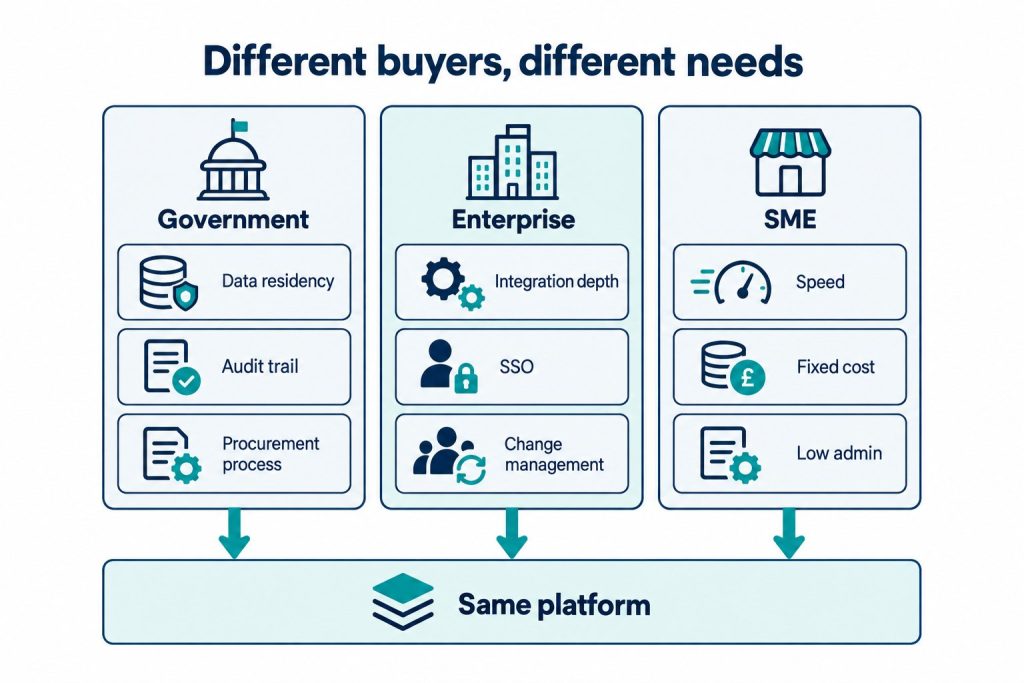
A government agency, a listed enterprise, and a family-run SME will all ask an AI vendor for “an AI system” and mean three completely different things. The agency needs data that never leaves domestic servers and an audit trail that survives scrutiny. The enterprise needs an AI knowledge base or automation layer that plugs into an existing CRM, ERP, and compliance stack without a rip-and-replace project. The SME needs something that works in weeks, on a budget that doesn’t require a board sign-off, without a full-time IT team to run it. Fooyo builds and operates AI products across all three client types across Singapore, China, and Japan, and the pattern that shows up again and again is that the technology stays largely the same across client types, but the deployment model, governance requirements, and support structure have to change completely.
TL;DR
- Government agencies prioritize data localization and audit logs over speed or cost; enterprises prioritize integration with existing systems; SMEs prioritize speed and low operational overhead.
- Data governance is the single biggest differentiator between client types, not the underlying AI model itself.
- SMEs and large enterprises show different adoption patterns, which reshapes what “vendor support” needs to mean for each group.
- Retrieval-augmented generation (RAG) is now a standard technical foundation across client segments, making it the shared architecture even when deployment requirements diverge.
- A vendor that can deploy the same core product into a sovereign cloud, a hybrid enterprise stack, and a lean SME environment, without three separate codebases, is solving a harder technical problem.
About the Author: This article is written from Fooyo’s operating experience building AI knowledge bases and automation products for government agencies, enterprises, and SMEs across Singapore, China, and Japan, with production deployments running in private cloud environments rather than shared public models.
Why Does Client Type Change What “Good AI” Even Means?
Client type changes the definition of a successful AI deployment because each buyer is optimizing for a different constraint, not because the AI itself needs to differ. A government agency’s constraint is regulatory exposure. An enterprise’s constraint is system fragmentation across departments and vendors. An SME’s constraint is cash flow and headcount. Ask any of the three “what does a good AI vendor look like,” and you’ll get different answers rooted in the same underlying capability: can the vendor reliably ground answers in real data and keep it under control. The mistake many AI vendors make is treating this as one product with one sales pitch. It’s three distinct operating problems wrapped around one technical core.
What Do Government Agencies Actually Require From an AI Vendor?
Government agencies require strict data localization above almost everything else. Asian government agencies typically mandate that sensitive data be processed and stored on domestic servers or sovereign clouds, and vendors must comply with national cybersecurity frameworks while providing explicit audit logs to prevent foreign data access. This isn’t a preference, it’s a procurement gate; a vendor that cannot demonstrate where data physically sits and who can access it will not clear the first round of evaluation, regardless of how capable the underlying model is.
Practically, this means:
- Sovereign or private cloud deployment is non-negotiable, not a premium add-on.
- Audit logging needs to be built into the product from day one, not bolted on after a compliance review flags a gap.
- Explainability matters more than speed. A source-cited answer that shows exactly where a fact came from is worth more to a government evaluator than a faster but opaque response.
This is also where a lot of generic AI tooling fails. Public AI models that train on user inputs are structurally incompatible with a data localization mandate, no matter how good the underlying model is. A vendor that runs every deployment in the client’s own private cloud, as Fooyo does, sidesteps this problem by design rather than by exception.
What Do Large Enterprises Need Differently From Government Agencies?
Large enterprises need cross-border compliance and integration with systems that already exist, which is a different problem from the single-jurisdiction data localization concern that dominates government procurement. Government agencies require strict data localization and sovereign cloud infrastructure, whereas large enterprises focus on cross-border compliance and hybrid-cloud integration to navigate regional laws such as China’s PIPL. An enterprise operating across Singapore, Japan, and mainland China isn’t asking “can this stay on one server,” it’s asking “can this respect different data rules in each market while still functioning as one system.”
The other defining enterprise requirement is integration depth. Most enterprises already run a CRM, a POS system, a CMS, and multiple messaging channels. An enterprise rag solutions vendor that requires ripping out any of that infrastructure to install its product is asking for a 6 to 12 month implementation cycle, which is the typical timeline for enterprise AI projects from initial scoping to full production deployment. That timeline is often the real cost of a rebuild-first approach, not a hidden fee anyone is charging on purpose. Enterprises that want to avoid it need a vendor whose product connects into what already exists rather than one that treats existing systems as legacy to be replaced.
Why Do SMEs Need a Fundamentally Different Engagement Model?
SMEs need speed and low operational overhead because they don’t have the internal capacity that enterprises and government agencies take for granted. This is the most under-discussed part of enterprise AI adoption. SME adoption lags behind enterprise adoption because deployment models are built for enterprise procurement cycles and enterprise IT teams, neither of which most SMEs have.
An SME evaluating an AI vendor should be asking a narrower, more practical set of questions:
- Does this require a dedicated IT hire to run, or can existing staff operate it?
- Can I see a working pilot in weeks, not quarters?
- Does pricing scale with my size, or am I paying enterprise rates for enterprise features I don’t need?
SMEs also typically lack dedicated data governance frameworks and rely on the built-in privacy controls of whatever third-party cloud vendor they already use. That’s a rational choice given resource constraints, but it means an AI vendor serving SMEs has to build sensible defaults into the product rather than expecting the client to configure governance themselves.
What Does a Vendor Need to Get Right Across All Three Client Types?
Building on the differences above, the harder question is what stays constant no matter who the client is. The answer is the technical foundation: grounded, verifiable answers instead of confident guesses. Retrieval-augmented generation, or RAG, is the architecture behind this. RAG connects a large language model to an organization’s internal knowledge base to retrieve verified data before generating an answer, which reduces hallucination risk. It’s the mechanism, not the marketing: instead of a model answering from what it was trained on months or years ago, it looks up the actual document, policy, or product record first, then answers based on what it finds, and cites where the answer came from.
This matters across every client type for a different reason. A government agency needs the citation for audit purposes. An enterprise needs it so a customer service answer matches what’s actually in the product catalog or policy document. An SME needs it because a wrong answer to a customer, at their scale, is disproportionately costly to their reputation. The technical requirement is identical; the reason it matters is different for each buyer.
| Client Type | Top Priority | Governance Approach | Deployment Speed Expectation |
|---|---|---|---|
| Government agencies | Data localization, audit trails | Sovereign cloud, strict compliance frameworks | Compliance review-driven, not speed-driven |
| Large enterprises | Cross-border compliance, system integration | Hybrid-cloud, regional law compliance (e.g. PIPL) | 6-12 months typical, faster is a differentiator |
| SMEs | Cost, speed, low maintenance burden | Relies on vendor’s built-in privacy defaults | Weeks, not months, is the expectation |
How Should a Vendor Actually Serve These Three Groups Without Fragmenting the Product?
The temptation for any AI vendor is to build three different products for three different client types. Fooyo’s approach instead has been to build one core set of production AI products, an AI knowledge base, marketing automation, commerce, and tourism tools, and deploy each into the client’s own private cloud environment regardless of whether that client is a ministry, a multinational, or a family business. Private cloud deployment means running the infrastructure in proprietary or localized data centers so the client keeps full control over hardware, software, and data flows, typically via microservices architectures, containerized applications, and API-led connectivity to existing systems. That structure happens to satisfy a government agency’s localization mandate, an enterprise’s integration requirement, and an SME’s need to avoid a rebuild, using the same underlying architecture rather than three separate ones.
The other constant across all three groups is human-in-the-loop oversight. A source-cited answer with a review gate before an automated action fires isn’t a compliance checkbox for a government client and a nice-to-have for an SME. It’s the same safety mechanism doing different jobs: satisfying an auditor in one case, and preventing a small business from sending a wrong answer to a customer at scale in the other.
Frequently Asked Questions
Do government agencies and enterprises need different AI models?
Not necessarily different models, but different deployment environments. The model and RAG architecture can be shared; what changes is where the infrastructure sits and how access is logged and audited.
Why do SMEs adopt AI more slowly than large enterprises?
SME adoption lags mainly due to resource constraints rather than lack of interest, since SMEs typically lack dedicated IT teams and governance frameworks.
What is retrieval-augmented generation (RAG) and why does it matter for all client types?
RAG connects a large language model to an organization’s own knowledge base so it retrieves verified data before generating an answer, reducing hallucinations. It’s relevant to government agencies for audit purposes, enterprises for accuracy at scale, and SMEs for customer trust.
How long does an enterprise AI implementation typically take?
The typical timeline runs 6 to 12 months from initial scoping to full production deployment, largely driven by integration complexity and compliance review, not model capability.
Can the same AI vendor realistically serve a government agency and a small business?
Yes, if the underlying product supports private, localized deployment as a default rather than an exception. The core technology can stay the same; what changes is the compliance layer, integration scope, and support model around it.
What’s the biggest governance difference between an enterprise and an SME client?
Enterprises typically manage cross-border compliance and hybrid-cloud setups to navigate laws like China’s PIPL, while SMEs generally rely on the built-in privacy controls of whatever cloud vendor they already use, rather than building their own governance framework.
Is private cloud deployment only relevant for government or highly regulated clients?
No. Private cloud deployment matters for any client that wants to ensure its data doesn’t train a shared public model, which increasingly includes enterprises and SMEs handling customer or proprietary data, not just government agencies.
About Fooyo
Fooyo is a Singapore-headquartered company that builds AI knowledge bases, workflow automation, and production AI products for government agencies, enterprises, and SMEs in Singapore, China, and Japan. Every deployment runs in the client’s own private cloud, so client data never trains a shared or public AI model, and every automated workflow includes human-in-the-loop review gates rather than fully unsupervised action. Fooyo moves from prototype to production in as little as six weeks by building and operating the product alongside the client, rather than handing over a report or a prototype and stepping away. Its product line, spanning AI knowledge bases, marketing automation, commerce, and smart tourism tools, is designed to plug into a client’s existing CRM, POS, CMS, and messaging systems instead of requiring a rebuild.
If you’re evaluating what an AI vendor should actually deliver for your organization, whether that’s a government agency, an enterprise, or an SME, talk to Fooyo about a pilot scoped to your specific governance and integration requirements.