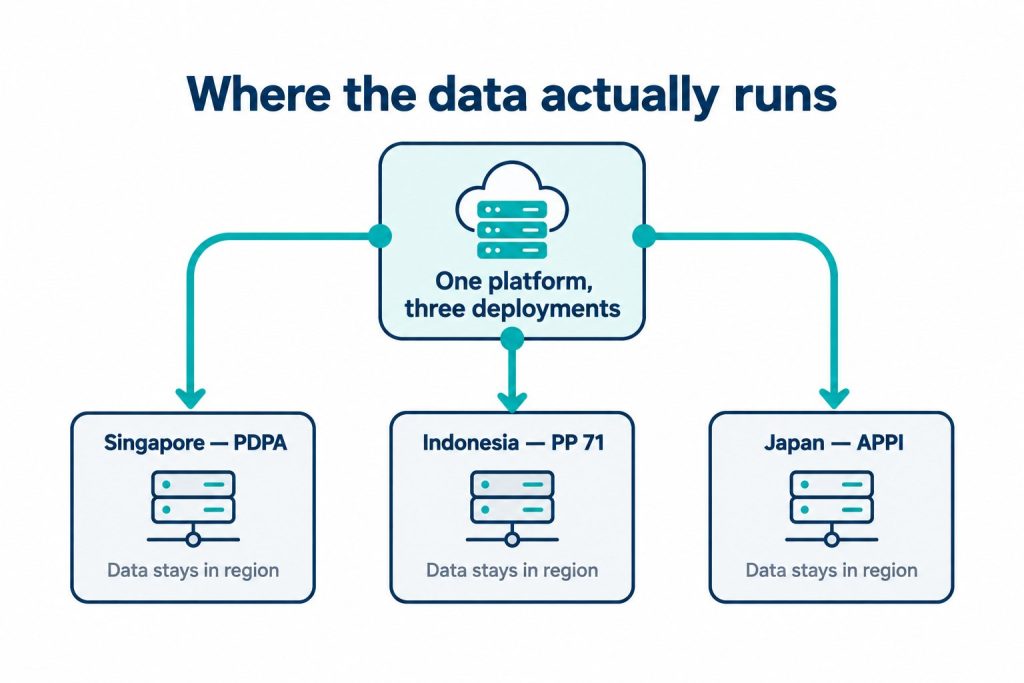
When a company deploys an AI system in Singapore, Indonesia, or Japan, the question that actually determines architecture isn’t “is this legal” but “where does the data physically sit, and what has to happen before it crosses a border.” None of the three markets impose a blanket rule that all data must stay local. Singapore’s PDPA permits cross-border transfer if the receiving party offers comparable protection. Indonesia’s PDP Law allows transfer with adequate protection, binding contracts, or consent. Japan’s APPI requires an equivalent framework, equivalent safeguards, or explicit opt-in consent. The practical result: AI systems that pull from customer records, government data, or regulated documents need a deployment model that can prove where data lives and who can access it, not just a compliance policy that says it will.
TL;DR
- Singapore, Indonesia, and Japan all regulate cross-border transfer of personal data rather than mandating strict local storage for most sectors.
- Indonesia’s data protection law (PDP Law, Law No. 27 of 2022) has been fully enforceable since October 17, 2024, and requires adequate protection, contractual safeguards, or consent for transfers abroad.
- Data residency, data sovereignty, and data localization are three distinct legal concepts, and conflating them leads to over-building or under-building AI infrastructure.
- Penalties are real: Singapore fines up to SGD 1 million or 10% of turnover, Indonesia allows criminal penalties up to 5 years, Japan allows fines up to 100 million JPY.
- Private-cloud AI deployment, where the model and data stay inside a client’s own environment, sidesteps most cross-border transfer questions by design rather than by policy exception.
About the Author: Fooyo builds and operates production AI systems for government agencies, enterprises, and SMEs across Singapore, Indonesia, Japan, and beyond, deploying every solution into a client’s own private cloud rather than a shared public model. This piece draws on that deployment experience across markets with materially different data protection regimes.
What Does “Data Residency” Actually Mean, and Why Does It Matter for AI?
Data residency is the physical location where an organization chooses to store its data [greennode.ai][expanso.io]. It’s a choice, not automatically a legal mandate, though regulated sectors often turn that choice into a requirement. This matters for AI specifically because every AI system, whether it’s a chatbot, a document search tool, or an automated workflow, has to store something: training data, embeddings, chat logs, or the source documents it retrieves answers from. Where that storage happens determines which country’s laws apply to it.
Three related but distinct concepts get used interchangeably, and the mix-up causes real architectural mistakes:
| Concept | Definition | Legal weight |
|---|---|---|
| Data residency | Physical location where data is stored [greennode.ai][expanso.io] | A choice, sometimes a contractual or regulatory expectation |
| Data sovereignty | Data is subject to the laws of the country where it sits [greennode.ai] | Automatic consequence of residency |
| Data localization | A strict legal mandate to store and process data only within one country’s borders [greennode.ai] | Enforceable law, but only in specific sectors in most Southeast Asian markets [rouse.com][hudson.org] |
An analogy that makes this concrete: think of data residency like choosing which country to park a car in, data sovereignty like the fact that the local traffic police, not your home country’s, can ticket you there, and data localization like a rule that says you’re not allowed to drive the car across the border at all. Most Southeast Asian jurisdictions regulate the driving (the transfer), not the parking (the residency) [rouse.com][hudson.org].
What Does Singapore’s PDPA Require for Cross-Border AI Deployments?
Singapore’s Personal Data Protection Act does not mandate strict data localization. It requires that any cross-border transfer include safeguards ensuring the destination country provides a comparable standard of protection. The PDPA was enacted in 2012, with its core data protection provisions taking effect on July 2, 2014.
For an AI knowledge base or agentic workflow tool built for a Singapore client, this means the legal question isn’t “can this data leave Singapore” but “can we demonstrate the receiving environment meets a comparable bar.” In practice, many organizations, particularly those in government, finance, and healthcare, choose not to test that boundary at all and instead keep AI processing inside a private cloud based in Singapore. That’s a risk-management decision layered on top of the law, not a requirement of the law itself.
Non-compliance carries teeth: PDPA violations can incur fines up to SGD 1 million or 10 percent of annual turnover for large organizations. For an enterprise running AI on customer data at scale, that scales the stakes of a poorly architected pipeline considerably.
What Does Indonesia’s PDP Law Mean for AI Systems Handling Local Data?
Building on the transfer-based logic above, Indonesia’s approach is structurally similar but procedurally heavier. Indonesia’s data protection law, formally Law No. 27 of 2022 on Personal Data Protection (commonly referred to as the Indonesia PDP Law or Indonesia data protection law), regulates cross-border transfers by requiring one of three things: adequate protection in the destination country, binding contractual safeguards, or explicit consent from the data subject. It does not impose a blanket data localization mandate. The law was enacted on October 17, 2022, and its two-year transitional period closed with a compliance deadline of October 17, 2024, meaning it is now fully enforceable.
Two things make the Indonesia PDP law distinct in practice from Singapore’s PDPA:
- Sectoral localization requirements exist elsewhere in Indonesian law. The PDP Law itself does not mandate data localization, but separate regulations, including Government Regulation No. 71 of 2019 and rules issued by financial sector regulators, require local storage and processing for public sector data and certain sensitive financial data. Private and non-financial sectors can generally store data offshore under regulatory oversight [rouse.com].
- Enforcement is more severe. Indonesia’s PDP Law enforces administrative sanctions, fines, and criminal penalties of up to 5 years in prison, a materially higher personal-liability exposure than Singapore’s corporate-fine model.
For an AI system serving an Indonesian retail chain or a public agency, this means the compliance question isn’t just “where does the vector database live” but “does this particular dataset fall under a sector-specific localization rule that requires local processing regardless of consent.” That’s a document-by-document, dataset-by-dataset determination, not a single company-wide policy.
How Does Japan’s APPI Treat Cross-Border AI Data Flows?
A related but distinct question is how Japan handles the same problem, because Japan’s regime introduces a third transfer path that neither Singapore nor Indonesia offers in quite the same form. Under Japan’s Act on the Protection of Personal Information (APPI), cross-border data transfers require one of three conditions: the destination country has an equivalent data protection framework, the recipient implements equivalent safeguards, or the data subject gives explicit opt-in consent. The APPI was most recently amended via a reform bill approved by the Cabinet in April 2026, reflecting the fact that this is a regime still actively being tightened rather than settled law.
Japan’s explicit opt-in consent standard is stricter in practice than Singapore’s “comparable protection” language, because it puts the burden on affirmative, specific consent rather than a general adequacy assessment. For AI products, such as automated customer service tools trained on user interaction logs, that means consent flows need to be built into the product itself, not bolted on as a legal disclaimer. Enforcement follows the same logic as elsewhere in Asia: Japan’s APPI allows for corrective orders and fines up to 100 million JPY for organizations.
How Should AI Architecture Actually Respond to These Rules?
Stepping back from the country-by-country detail, the harder question is architectural: given that none of these three regimes universally bans cross-border processing, why do so many organizations still choose to keep AI processing local anyway? The answer is that regulatory compliance is a floor, not a design target. Three practical patterns follow from that:
- Private-cloud deployment removes ambiguity. If an AI knowledge base or agent runs inside a client’s own private cloud in-country, most cross-border transfer questions simply don’t arise, because the data never leaves. This is a structural answer, not a policy workaround.
- Shared public AI models create a transfer event by default. Feeding customer or citizen data into a shared public model, where the training pipeline and inference endpoints may sit outside the jurisdiction, can itself constitute a cross-border transfer that then triggers the safeguards described above.
- Sectoral rules override general rules. A retailer and a government agency in the same country can face entirely different obligations for what looks like the same type of AI use case, because Indonesia’s sector-specific localization rules and Japan’s evolving APPI amendments apply unevenly [rouse.com][hudson.org].
This is the design principle Fooyo builds around: every AI Knowledge Base and agentic workflow it deploys runs in the client’s own private cloud, so client data is never used to train a shared public model, and residency questions are resolved by architecture rather than by after-the-fact legal review. That approach doesn’t eliminate the need to understand local law, particularly Indonesia’s sector-specific localization rules or Japan’s consent requirements, but it does mean the default posture is already aligned with the strictest common denominator across Singapore, Indonesia, and Japan.
Frequently Asked Questions
Does Singapore’s PDPA require data to be stored physically in Singapore?
No. The PDPA does not mandate data localization; it requires comparable protection standards for any cross-border transfer.
Is Indonesia’s PDP Law the same as Singapore’s PDPA?
No. Both regulate cross-border transfer rather than mandating blanket localization under the core data protection law itself, but Indonesia has separate sectoral regulations, such as Government Regulation No. 71 of 2019 and financial sector rules, that require localization for public sector and certain financial data. Indonesia’s PDP Law also carries criminal penalties up to 5 years, which Singapore’s PDPA does not.
When did Indonesia’s PDP Law become fully enforceable?
The law was enacted October 17, 2022, with a two-year transitional period ending October 17, 2024, after which full compliance became mandatory.
Can I use a shared public AI model with Indonesian or Japanese customer data?
It depends on whether the transfer to that model’s infrastructure meets the adequacy, contractual, or consent standards under the relevant law. Many organizations choose private-cloud deployment specifically to avoid making that determination on a case-by-case basis.
What’s the practical difference between data residency and data localization?
Residency is where you choose to store data. Localization is a legal mandate that removes the choice, requiring storage within one country’s borders.
Does Japan require opt-in consent for all cross-border AI data transfers?
Explicit opt-in consent is one of three valid pathways under the APPI; equivalent protection frameworks or equivalent safeguards implemented by the recipient are the other two.
What happens if an AI system violates these data transfer rules?
Penalties vary by country: Singapore allows fines up to SGD 1 million or 10 percent of turnover, Indonesia allows administrative sanctions plus criminal penalties up to 5 years, and Japan allows corrective orders plus fines up to 100 million JPY.
About Fooyo
Fooyo is a Singapore-headquartered company that builds data platforms and AI agents for government agencies, enterprises, and SMEs in Singapore, Indonesia, Japan, Chengdu, and other markets. Its AI Knowledge Base, Kakis marketing AI, Fooyo Commerce, and Smart Tourism products are all deployed into a client’s own private cloud rather than a shared public model, with systems typically ready for production use in weeks. Fooyo has worked with government agencies, enterprises, and SMEs across Asia, and integrates into existing systems like CRM, POS, and CMS rather than requiring a rip-and-replace. For a company weighing where its AI should actually run, given the rules across Singapore, Indonesia, and Japan, that private-deployment model is a starting architecture, not an afterthought.
If your organization needs an AI system that’s built for these rules from day one rather than retrofitted later, get in touch with Fooyo at https://fooyo.sg/.
References
- Data Residency vs. Data Sovereignty: Why the Difference Has Legal Consequences in Southeast Asia (greennode.ai)
- Data Residency Requirements: A Complete Guide for Distributed Teams | Expanso (expanso.io)
- Rouse – Data Localisation and Transfer Issues in Southeast Asia: What Businesses Need to Know (rouse.com)
- The Geopolitics and Risks of Data Localization in Southeast Asia | Hudson Institute (hudson.org)