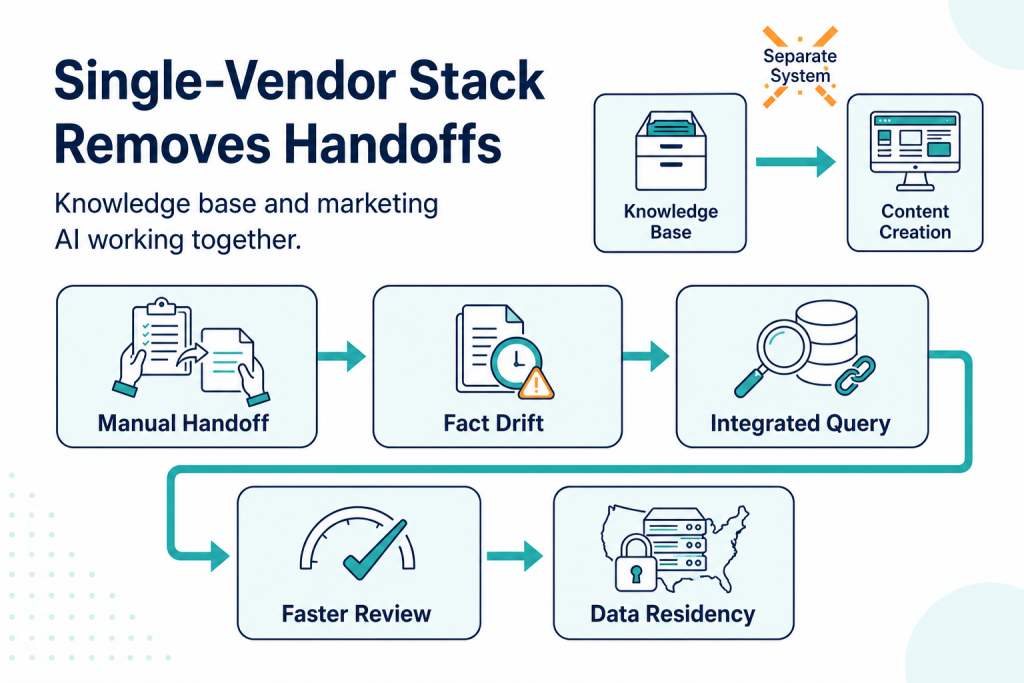
When a knowledge base and a marketing AI tool come from two different vendors, every campaign idea has to pass through a manual handoff: someone pulls facts from the knowledge system, reformats them, and feeds them into a separate content tool that knows nothing about what was just retrieved. A single-vendor stack removes that handoff by letting the marketing layer query the knowledge base directly, so the same grounded, source-cited facts that answer an internal question can also populate a product description or a video script without a human copying and pasting between two systems. The saving isn’t abstract: it shows up as fewer review cycles, fewer factual errors introduced at the handoff point, and faster time from brief to published asset.
TL;DR
- Handoffs between a knowledge base and a marketing tool are where facts get stale, reformatted incorrectly, or lost entirely.
- Consolidating marketing technology stacks and removing redundant tools can reduce the manual steps between systems, lowering operational friction.
- Grounded, retrieval-based approaches to AI are becoming standard in production deployments across industries, moving beyond early-stage use cases.
- Asia-based enterprises face real data-residency considerations (PDPA, Indonesia’s PDP Law, GDPR) that make vendor choice a compliance decision, not just a tooling one.
- A connected knowledge base and marketing AI system doesn’t just save time, it reduces the specific failure mode of marketing content contradicting what the company actually knows to be true.
About the Author: Fooyo builds and operates production AI systems, including an AI Knowledge Base and a marketing AI product called Kakis, for government agencies, enterprises, and SMEs across Singapore, Indonesia, and Japan, giving it direct visibility into how these two categories of tooling interact (or fail to) in live deployments.
What Is an AI Knowledge Base, and Why Does It Matter for Marketing?
An AI knowledge base is a retrieval system that lets users or other software ask questions across a company’s documents, product data, and internal records, and get back an answer with a citation to the source material rather than a generic language-model guess. Technically, building one requires several layers: ingesting and cleaning source documents, running hybrid retrieval that combines keyword and semantic search, reranking results for relevance, evaluating answer quality, and maintaining a governed layer that defines what terms mean consistently across the organization [atlan.com]. That governed semantic layer is the part most teams underestimate: without it, two departments can ask the same question and get answers built on different definitions of “active customer” or “in-stock.”
For marketing specifically, this matters because campaign content is only as good as the facts underneath it. A marketing team drafting a product launch video needs the current spec sheet, the latest pricing, and the approved claims list, not whatever version someone remembers from a meeting three weeks ago. Agentic patterns now emerging let a knowledge base be queried not just by people but by other AI agents and software-as-a-service tools, which is the technical foundation that makes a connected marketing workflow possible at all [thenewstack.io].
What Is a Marketing AI Platform, and How Does It Differ from Generic Generative AI Tools?
A marketing AI platform is software purpose-built to turn a brief into a finished, publishable asset: a video, a landing page, a social post, or an email sequence, generated and formatted to brand specifications rather than as a raw block of text a human then has to adapt. Generic generative AI tools can draft marketing copy, but marketers commonly use them piecemeal, producing one asset type at a time across separate sessions, with no persistent memory of brand voice or prior campaigns [databricks.com]. A dedicated marketing AI platform differs by treating the brief as a structured input and producing multiple coordinated outputs (script, visuals, captions, publishing schedule) from a single pass.
The distinction matters for the handoff question at the center of this article. A generic tool with no connection to company data will happily generate a confident, well-written paragraph that is also factually wrong, because it has no mechanism to check its output against what the company actually knows. A marketing AI platform wired into a knowledge base can ground its script or copy in retrieved, cited facts the same way the knowledge base grounds its own answers, which closes the gap between “sounds right” and “is right.”
Where Exactly Does a Handoff Cost Time and Money?
A handoff is any point where information has to leave one system, get reformatted or re-entered by a person, and enter another system, and each one is a place where errors and delays accumulate. Building on the grounding problem above, the most expensive handoffs in a typical marketing operation are:
- Fact lookup to brief: a marketer manually searches the knowledge base or asks a colleague for current specs, pricing, or compliance language before writing a brief.
- Brief to draft: the brief is pasted into a separate generative tool that has no access to the source documents, so claims have to be manually checked against the knowledge base afterward.
- Draft to review: legal or compliance reviewers re-verify facts because the draft tool cannot show where a claim came from, forcing a second trip back to source documents.
- Review to publish: approved content is manually reformatted for each channel because the marketing tool and the publishing system don’t share a workflow.
Each of these steps is individually small, but they compound. Consolidating a marketing technology stack and removing redundant tools can reduce the manual steps between systems, lowering operational friction and rework cycles. The same underlying mechanism applies to broader vendor consolidation efforts across an organization: fewer systems means fewer handoffs, and fewer handoffs means less rework.
What Does a Combined Knowledge Base and Marketing AI Workflow Look Like in Practice?
In a connected setup, the marketing AI tool queries the knowledge base directly as part of generating an asset, rather than relying on a person to supply facts manually. Concretely, a brief for a new product video can trigger a retrieval call to the knowledge base for the approved spec sheet and current pricing, the marketing tool then drafts a script grounded in those retrieved facts, and the citation trail from the original knowledge base answer carries through to the final script for a reviewer to check in seconds rather than re-researching from scratch.
This is close to what’s described as an agentic knowledge base pattern: the knowledge base becomes a service that other AI agents and tools call on demand, not a destination a human visits separately [thenewstack.io]. The practical effect for a marketing team is that the “is this still accurate” question gets answered automatically at generation time instead of manually at review time. Fooyo’s own product pairing, the AI Knowledge Base and Kakis, follows this pattern, where Kakis can draw on the same grounded, source-cited data layer rather than working from a brief alone.
Does a Single Vendor Actually Reduce Handoffs, or Just Move Them?
A fair challenge to the single-vendor argument is that consolidation only helps if the vendor’s components are genuinely integrated rather than two acquired products bolted together with a shared login screen. The test is whether the marketing tool can retrieve and cite from the knowledge base in a single workflow step, not whether both products appear on the same invoice. Enterprise AI agent deployments benefit specifically when data is converted into standard, structured formats, because that’s what lets an agent recognize and combine different data sources reliably [mitsloan.mit.edu]; a vendor whose knowledge base and marketing tool use incompatible data models hasn’t actually solved the handoff problem, regardless of branding.
A related but distinct question is whether consolidation creates vendor lock-in that outweighs the handoff savings. This is a legitimate trade-off, and the answer depends on whether the vendor integrates with a client’s existing CRM, POS, CMS, and messaging channels rather than requiring a rip-and-replace migration. Enterprise AI integration that plugs into what’s already running is a different commitment than one that demands the client rebuild their entire stack around a single product.
How Should Data Residency Factor Into Choosing a Combined Stack?
Enterprises in Asia increasingly consider on-premises or private cloud AI deployments as part of meeting data protection obligations under regulations such as Thailand’s PDPA and Indonesia’s PDP Law, while enterprises operating in or with Europe must account for the GDPR. These frameworks do not generally require that data stay within specific national borders outright; rather, they permit cross-border data transfers under defined conditions such as adequacy decisions, standard contractual clauses, binding corporate rules, or explicit consent. Still, many enterprises choose stricter in-country hosting to simplify compliance and reduce risk. This is a sharper requirement than it sounds: private-cloud hosting still means data may reach a model API outside the client’s own infrastructure, while fully on-premises deployment means the data never leaves the client’s infrastructure at all. A combined knowledge base and marketing AI stack has to satisfy this requirement twice, once for the facts stored in the knowledge base and again for whatever is generated and published by the marketing layer, since marketing copy drafted from regulated internal data can itself become a compliance concern if it’s processed through a public model.
Fooyo deploys both its AI Knowledge Base and Kakis into a client’s private cloud or fully on-premises infrastructure depending on the client’s data-residency needs, with human review gates built into the automated workflow and client data never used to train a shared or public model. The deployment timeline is scoped per engagement, depending on workflow complexity, integration depth, data readiness, and client approvals.
Frequently Asked Questions
What is an AI knowledge base software, in one sentence?
It’s a retrieval system that answers questions across a company’s documents and data with a citation back to the source, rather than generating an unverified answer from general training data.
Is a marketing automation AI tool the same as a marketing AI platform?
Not quite. Marketing automation AI tools often focus on scheduling and distribution; a marketing AI platform additionally generates the creative asset itself, such as a full script or video, from a brief.
Can an enterprise AI agent write marketing content and check facts in the same step?
Yes, if the agent has retrieval access to a knowledge base as part of its workflow rather than generating from the brief alone. This is the core mechanism behind the handoff savings described above.
Does combining these tools always reduce costs?
It reduces costs when the integration is genuine, meaning both tools share a data model and the marketing layer can query the knowledge base directly. A bundled product that doesn’t technically integrate won’t produce the same savings.
How long does enterprise AI integration like this typically take to deploy?
It depends on the engagement: integration complexity, how ready the underlying data is, and how many internal approvals are needed. There is no fixed universal timeline.
Does private cloud deployment guarantee my data stays in-country?
No. Private cloud hosting can still mean data reaches a model API elsewhere. Full data residency requires a fully on-premises deployment.
Is this kind of stack only for large enterprises?
No. Government agencies, large enterprises, and SMEs across Asia all use connected knowledge base and marketing AI setups, scoped to their own data volume and workflow needs.
About Fooyo
Fooyo is a Singapore-headquartered company, with additional offices in Chengdu and Tokyo, that builds and operates production AI products rather than delivering prototypes or reports. Its AI Knowledge Base gives grounded, source-cited answers across a client’s documents and data, while Kakis, its marketing AI product, turns a brief into a branded short-form video covering script, production, and publishing. Both are deployed into a client’s private cloud or fully on-premises infrastructure depending on data-residency needs, and both integrate with existing systems such as CRM, POS, CMS, and messaging channels instead of requiring a rip-and-replace migration. Fooyo is trusted by government agencies, enterprises, and SMEs across Singapore, Indonesia, and Japan.
If handoffs between your knowledge systems and your marketing output are costing your team review cycles and factual errors, it’s worth seeing what a connected setup looks like in practice. Get in touch with Fooyo for a demo.
References
- How to Build a Knowledge Base for AI Agents: 2026 Guide (atlan.com)
- Generative AI for Business: A Complete Strategy and … (databricks.com)
- 6 agentic knowledge base patterns emerging in the wild (thenewstack.io)
- Agentic AI, explained | MIT Sloan (mitsloan.mit.edu)