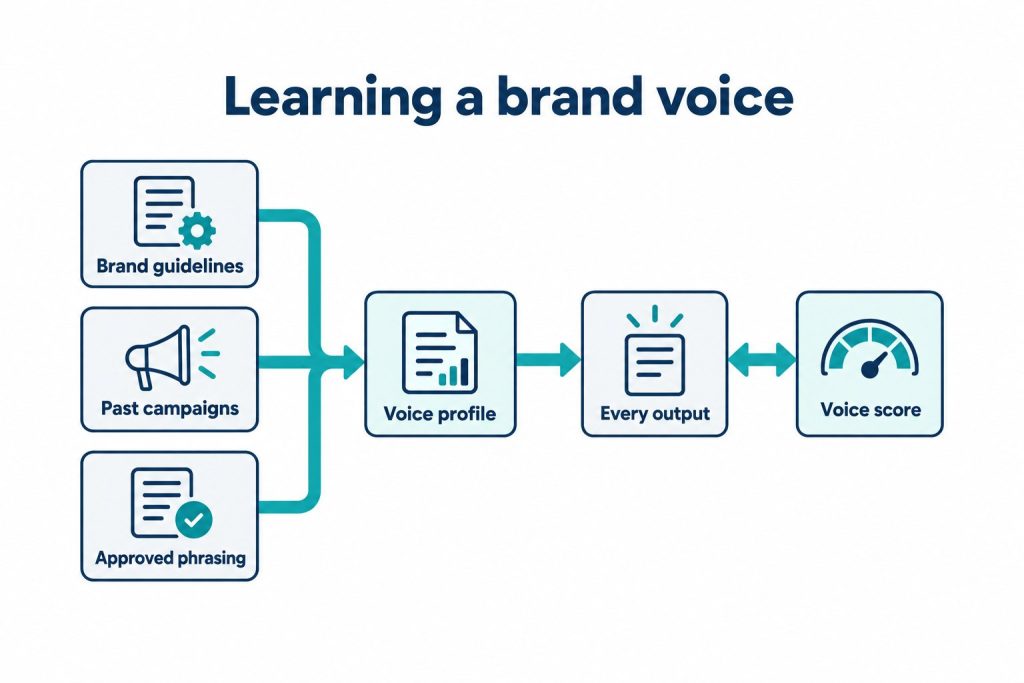
A brand-tuned AI video agent works by ingesting a company’s existing content (past scripts, brand guidelines, tone-of-voice documents, visual assets) and using that material as a constraint on every new output, rather than generating from a generic model default. This is the difference between an AI agent that produces “a video” and one that produces “your video.” Fooyo builds these systems for enterprises across Singapore, Indonesia, and Japan, and the recurring problem clients bring us isn’t that AI video tools can’t make content fast. It’s that the content they make doesn’t sound like anyone in particular. Industry data backs up why this matters: when companies struggle to maintain consistent messaging across channels despite having brand guidelines in place, messaging inconsistency can affect customer trust. The gap between intent and execution is real.
TL;DR
- Brand voice drift happens because most AI video generation tools optimize for output speed, not for matching a specific company’s tone, vocabulary, and visual identity.
- Multi-modal AI agents fix this by treating brand assets (scripts, style guides, past videos) as training constraints, not just reference material.
- Consistent messaging across multiple channels requires treating brand voice as a measurable operational problem, not just a design choice.
- Private cloud deployment matters for brand-tuned AI content, both for data control and because Asia-Pacific has no unified AI regulatory framework.
- Human-in-the-loop review gates remain necessary even with well-tuned brand voice AI, because tone consistency and factual accuracy are separate problems.
About the Author: Fooyo builds production-grade AI products, including Kakis, a multi-modal, brand-tuned video tool used by enterprises and SMEs across Southeast Asia to turn a brief into a published, on-brand video at scale. This article draws on that deployment experience.
What Does “Brand Voice” Actually Mean for an AI Agent?
Brand voice, in a technical sense, is a set of constraints: recurring vocabulary, sentence rhythm, visual style, tone of address, and things the company explicitly avoids saying. For a human copywriter, these constraints live in memory and habit built over years on an account. For an AI agent, they have to be made explicit and structured before generation ever happens. This is why a generic ai video generator, given the same brief as a brand-tuned one, tends to produce content that is technically correct but recognizably template-shaped. It hits the right words but not the right voice.
The practical fix is to treat a company’s existing content library as a grounding dataset. That means past marketing copy, brand guideline documents, approved scripts, and previously published videos all feed into the agent’s context before it writes a single new word. This is conceptually the same grounding approach used in retrieval-based knowledge systems, where an AI answers only from a defined source set instead of general training data. Applied to marketing, it turns a brand voice generator from a blind guesser into a system that can point to why it phrased something a certain way.
How Do Multi-Modal AI Agents Combine Vision, Voice, and Text Into One Consistent Output?
A multi-modal AI agent processes and generates across more than one format, typically text, image, audio, and video, within a single coordinated workflow [kanerika.com][ai-agentsplus.com]. In 2026, this class of system has moved from research demos into actual production pipelines across industries including marketing, customer service, and healthcare [ai-agentsplus.com]. For brand voice specifically, the coordination problem is harder than it sounds: script tone, voiceover pacing, on-screen visual style, and even font choice all have to agree with each other, or the final video reads as disjointed even if each individual piece is fine on its own [lyzr.ai].
Building on that coordination requirement, the practical architecture usually breaks into three linked stages:
- Script generation: text generation constrained by brand vocabulary and messaging rules, not a general-purpose language model default.
- Voice and visual production: text-to-speech and video generation tuned to a consistent voice profile, color palette, and pacing.
- Publishing and formatting: automatic adaptation of the same core asset into the aspect ratios and lengths different channels require.
An agent operating this way perceives inputs across modalities and acts across modalities too, generating typed text, produced video, and voice output from a single brief [futureagi.com]. That end-to-end loop is what separates ai marketing agents built for brand consistency from tools that only handle one stage, like script writing, and leave the rest to manual assembly.
Why Do Most AI Video Generation Tools Struggle to Sound Like a Specific Company?
This is where the gap between generic and brand-tuned tools becomes concrete rather than theoretical. Enterprise-grade platforms in this category tend to fall into two camps, each with a different failure mode. Avatar and template-based tools offer strong brand kit integration and custom avatars, but achieving deep, company-specific customization often requires significant additional investment beyond the base product. Fully generative tools sit at the other end: they produce visually striking, creative output but struggle to hold brand consistency, visual stability, and accurate on-screen text or font replication without heavy manual post-processing. Neither failure mode is a flaw in the underlying model. It’s a mismatch between what the tool was optimized for and what brand consistency actually requires. A template tool optimizes for ease of use and speed; a generative tool optimizes for creative range. Brand voice consistency requires optimizing for neither of those first. It requires optimizing for repeatability: the same company should sound like itself on the tenth video and the hundredth, across whichever team member wrote the brief.
| Tool Category | Strength | Limitation for Brand Voice |
|---|---|---|
| Avatar/template platforms | Strong brand kit and custom avatar support | Deep customization often requires significant added investment |
| Generative video models | Advanced creative range and visual variety | Weak visual/brand consistency without manual post-processing |
| Brand-tuned multi-modal agents | Script, voice, and visuals grounded in a company’s own content history | Requires an initial setup phase to build the brand’s reference dataset |
How Does a Brand-Tuned AI Agent Actually Learn a Company’s Voice?
Following on from the tool comparison above, the more useful question for a marketing team isn’t which platform to buy, it’s what the setup process for real brand voice tuning looks like. In practice, it comes down to feeding the agent a structured reference set rather than a one-line brief. That typically includes:
- A sample of 15 to 30 pieces of past approved content, spanning different formats and lengths.
- An explicit style document listing preferred vocabulary, sentence length norms, and phrases the brand avoids.
- Visual brand assets: logo placement rules, color codes, font files, and past video footage for tone reference.
- A review loop where early outputs are corrected by a human reviewer and those corrections feed back into future generations.
That last point matters more than it might seem. A brand voice generator that never receives correction converges on an average of its training inputs, which drifts toward generic over time. One that receives ongoing human correction sharpens instead. This is the same principle behind why Fooyo builds human-in-the-loop review gates into automated workflows generally, not just for video: an AI system that can be corrected stays useful longer than one that can only be reset.
What Does “Production-Grade” Mean for AI Content Production at Enterprise Scale?
Stepping back from individual tools, the harder operational question is what it takes to run automated video production as a repeatable business process rather than a series of one-off experiments. A prototype that makes one good video in a demo is a different thing entirely from a system that can turn 50 briefs a month into published, on-brand assets without a marketing team manually checking every frame. Production-grade ai content production means the pipeline handles script, voice, visuals, and publishing as one connected workflow, with review checkpoints built in rather than bolted on afterward.
This is also where deployment environment stops being a technical footnote and becomes a compliance question. The Asia-Pacific region has no unified regulatory framework for AI, so enterprises operating across markets have to work through a fragmented set of localized rules: Singapore’s AI Governance Framework, China’s algorithmic misconduct laws, and India’s DPDP Act, among others. That fragmentation is a real operational cost for any company generating brand content that touches customer data or crosses borders. It’s a large part of why organizations increasingly run AI content workloads in private cloud environments that offer auditable governance and localized control, rather than shared public models where data handling is harder to demonstrate to a regulator.
Where Does Fooyo Fit Into Brand Voice AI, and What Should You Look For in a Vendor?
Fooyo’s Kakis product handles the core workflow: turning a marketing brief into a branded short-form video, managing script, production, and publishing as one pipeline rather than three disconnected tools. It runs in a private cloud, which matters for the compliance reasons above and also for a simpler reason: a company’s brand voice and content history are competitive material, and they shouldn’t be training a shared public model that a competitor might also be querying.
When evaluating any ai video production software for this purpose, a few questions cut through most of the marketing noise:
- Does the tool learn from your specific content history, or does it apply one style template to every brief?
- Is there a human review gate before publishing, or does content go live automatically?
- Where does your brand data live, and does the vendor use it to train models shared with other customers?
- Can the tool integrate with your existing CMS, CRM, or publishing channels, or does it require a separate workflow?
Fooyo is trusted by government agencies, enterprises, and SMEs across Asia on exactly these deployment questions, integrating into existing client systems rather than requiring a rebuild of the marketing stack.
Frequently Asked Questions
Does brand-tuned AI video replace a marketing team?
No. It removes the repetitive production work (scripting, editing, format adaptation) so a team can focus on brief-writing, strategy, and review, with a human checkpoint still built into the workflow.
How much brand content is needed before an AI agent can match a company’s tone?
There’s no fixed number, but a broader, more varied sample of past approved content and a clear style document produces a noticeably better starting point than a single brand guideline PDF alone.
Is a brand voice generator the same as a general ai video generator?
No. A general tool generates from broad training data and a prompt. A brand voice generator is constrained by a specific company’s reference content, so outputs stay recognizable as that company’s rather than generic.
Why does private cloud deployment matter for marketing AI specifically?
Brand content and customer data used to tune the agent are competitive assets. Private deployment keeps that data from training any shared or public model, and helps meet the fragmented data residency rules across Asia-Pacific markets.
Can these tools handle multiple languages or regional markets?
Multi-modal agents can generate across languages, but tone consistency in each language still depends on having reference content in that language, not just a translated script.
What’s the biggest reason brand voice AI projects fail?
Skipping the review-and-correction loop. An agent that never gets human feedback on early outputs drifts toward generic phrasing over time instead of sharpening toward the brand’s actual voice.
About Fooyo
Fooyo is a Singapore-headquartered company building data platforms and production AI products, including AI Knowledge Base, Kakis (marketing AI), Fooyo Commerce®, and Smart Tourism. Every product deploys into a client’s own private cloud, moving from pilot to production in weeks rather than the typical six-month enterprise build cycle, and integrates into existing systems like CRM, POS, and CMS rather than requiring replacement. With offices in Singapore, Chengdu, and Tokyo, Fooyo is trusted by government agencies, enterprises, and SMEs across Asia.
If off-brand content is a recurring problem across your marketing channels, it’s worth seeing what a brand-tuned approach looks like in practice. Get in touch with Fooyo to learn more.
References
- Top 6 Multimodal AI Agents: Architecture & Use Cases 2026 (kanerika.com)
- Multimodal AI Agents: How Vision, Voice, and Text Come … (ai-agentsplus.com)
- What is Multimodal AI? A 2026 Enterprise Guide (lyzr.ai)
- Multimodal AI in 2026: What Works Now (futureagi.com)