AI merchandising is the use of machine learning models to decide what products a shopper sees, in what order, and at what price, based on real-time data about that shopper’s behavior and the behavior of everyone like them. The core mechanism is a recommendation engine: a system trained on purchase history, browsing patterns, and product attributes that scores every item in a catalog for relevance to a specific person, then re-ranks the storefront accordingly. This article breaks down the actual mechanics: the algorithms, the data pipelines, and the engineering trade-offs that make a recommendation appear on screen in under a tenth of a second.
TL;DR
- AI product recommendations run on three core techniques: collaborative filtering, content-based filtering, and hybrid models that combine both to avoid each method’s weaknesses.
- The “cold-start problem,” recommending to a new user or a new product with no history, is the hardest unsolved edge case, and hybrid models exist largely to soften it.
- Real-time ecommerce recommendation engines need sub-100 millisecond response times, which shapes the entire data architecture, not just the model choice.
- Personalization systems must operate inside data privacy rules like GDPR, CCPA, and PDPA, which govern consent and automated decision-making, not just storage.
About the Author: This article is written by the team at Fooyo, a Singapore-headquartered company that builds and operates production AI systems for enterprises across Asia, including Fooyo Commerce®, an AI-powered storefront platform with merchandising built into product listings, storefronts, and payments. Fooyo deploys these systems into clients’ private cloud environments for government agencies, enterprises, and SMEs across Singapore, Indonesia, Japan, and beyond.
What Is AI Merchandising and How Is It Different from Traditional Merchandising?
AI merchandising replaces fixed, manually-set product placement rules with a model that recalculates placement continuously based on live data. Traditional digital merchandising relies on a human category manager deciding, for example, that a bestseller stays pinned to the top of a category page for a month. AI merchandising instead uses artificial intelligence to analyze retail data, predict demand, and automate decisions about assortment and placement on an ongoing basis [axonify.com]. The system is not just recommending products in a sidebar, it is actively reordering search results, adjusting which items surface first in a category, and deciding which products to bundle, all driven by the same underlying prediction models [salesforce.com].
The practical difference shows up in maintenance effort. A manual merchandising rule set needs a person to update it every time inventory, season, or promotion changes. A model-driven system ingests those signals automatically and adjusts. Industry practice in digital merchandising shows that AI now handles macro tasks like ranking, personalization, and semantic matching that used to require manual category-by-category tuning [coveo.com].
How Does a Recommendation Engine Actually Learn What to Recommend?
A recommendation engine learns by finding patterns in historical interaction data and using those patterns to predict future behavior it hasn’t observed yet. There are three dominant approaches in recommendation engine machine learning, and understanding the mechanism behind each explains why most production systems use more than one.
| Approach | How it works | Main weakness |
|---|---|---|
| Collaborative filtering | Finds users or items with similar behavior patterns and recommends what similar users bought or liked | Fails for new users or new products with no interaction history (cold-start problem) |
| Content-based filtering | Matches product attributes (category, price, material, brand) to a user’s known preferences | Tends to over-recommend near-identical items, limiting discovery |
| Hybrid models | Combines both signals, weighting each based on how much data is available for a given user or item | More complex to build and tune, but consistently more accurate |
Hybrid models consistently outperform standalone methods on accuracy benchmarks such as precision, recall, and root mean square error, precisely because they can lean on content attributes when behavioral data is thin and lean on behavioral data when it’s rich. Think of it like a shop assistant who, on meeting a brand-new customer, starts by asking what department they’re browsing (content-based) rather than guessing based on the browsing history of a repeat customer (collaborative). As soon as that new customer starts clicking, the assistant switches strategies and leans on behavioral similarity instead. That switch, done algorithmically and continuously, is what a hybrid model does at scale.
What Data Actually Feeds a Product Recommendation Algorithm?
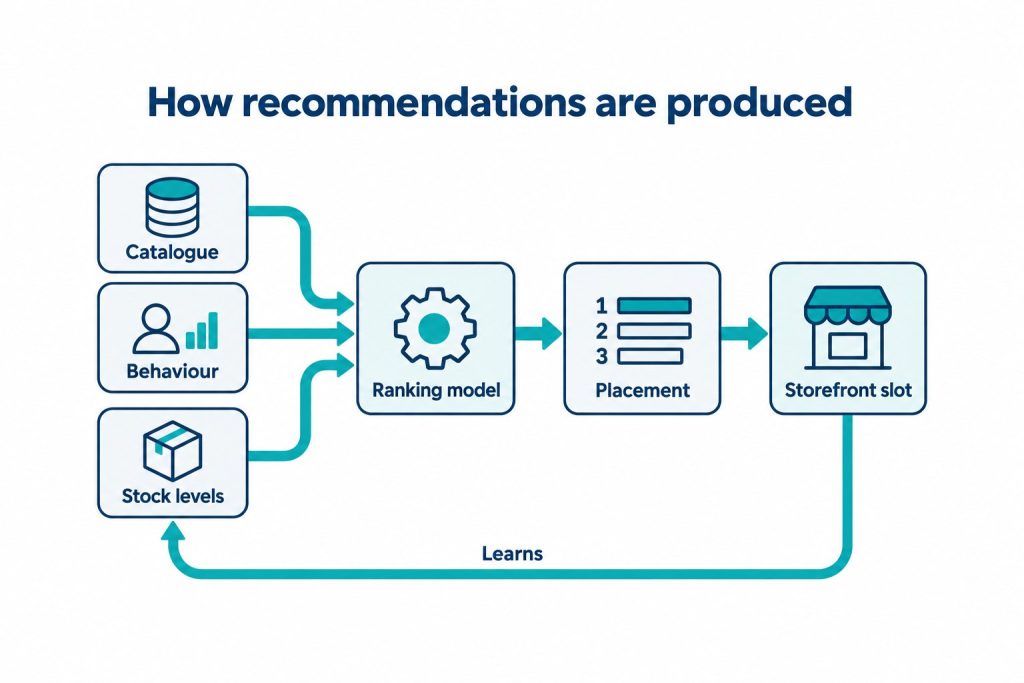
A product recommendation algorithm is only as good as the signals it’s fed, and those signals fall into a few clear categories. Purchase history and browsing behavior form the collaborative filtering layer. Product attributes such as category, price tier, and specifications form the content-based layer. Real-time signals, including what’s currently in a cart, what was just viewed, and even time of day or device type, adjust the ranking on the fly [coursiv.io][magazine.iwd.io].
Amazon’s own description of its recommendation stack illustrates this layering directly: personalized product recommendations and descriptions are generated from a customer’s previous shopping activity, combined with signals collected in the current session [trustworthyshopping.aboutamazon.com]. This is why the same shopper can see different rankings for the same category page an hour apart, the model isn’t recalculating from scratch, it’s blending a stable long-term profile with a fast-moving session signal.
Why Do Ecommerce Recommendation Engines Need to Respond in Milliseconds?
Speed is a functional requirement, not a nice-to-have, because a delayed recommendation arrives after the shopper has already moved on. Real-time recommendation engines in ecommerce are typically required to deliver sub-100 millisecond response times to maintain a seamless experience, and delays beyond a few hundred milliseconds can disrupt the shopping flow, increase cart abandonment, and lower conversion rates. This latency requirement is the reason recommendation infrastructure looks different from typical analytics infrastructure.
Most production systems solve this by splitting the workload into two stages:
- Offline scoring: heavy model training and bulk similarity calculations run in batches, hours or days apart, producing pre-computed candidate lists per user segment or product.
- Online ranking: a lightweight model re-ranks that pre-computed shortlist in real time using only the freshest signals, cart contents, current page, session length, which is fast because it’s working with a small candidate pool rather than the full catalog.
This two-stage design is why a recommendation engine ecommerce platform can feel instant even though the underlying model may have taken hours to train.
What Are the Hardest Problems in Personalized Product Recommendations?
Building on the mechanics above, the harder question is what happens when the data itself is incomplete or contested. The cold-start problem is the most persistent: a brand-new shopper or a newly listed product has no history for collaborative filtering to work with, which is exactly why hybrid models exist, they fall back on content attributes until enough behavioral data accumulates [as covered above].
A separate concern, less technical and more regulatory, is data privacy. Personalization systems run on user behavior data, and that puts them squarely inside frameworks like the GDPR in the EU, the CCPA in California, and the PDPA in Singapore. These regulations require businesses to obtain consent for data collection, provide transparency about automated decision-making, and grant users rights to access, correct, or delete their data. This isn’t a checkbox exercise, it directly constrains what data a recommendation engine can legally use and for how long it can retain it, which is why private, auditable deployment of these systems matters as much as their accuracy.
How Does AI Merchandising Extend Beyond the Recommendation Widget?
A recommendation carousel is the most visible output, but it’s a small part of what AI merchandising actually does across a storefront. The same underlying models drive dynamic search ranking, inventory-aware assortment (surfacing what’s in stock and de-prioritizing what isn’t), and personalized bundling for cross-sell [axonify.com][awayco.com]. In fashion retail specifically, these systems are also being extended into post-purchase support, resolving order tracking, refund, and return queries by connecting the same customer profile data to a conversational interface [crescendo.ai].
This is where merchandising AI and customer service AI start to converge on the same underlying data platform. A storefront that knows a customer’s size preference and return history isn’t just recommending better products, it’s also able to pre-empt a return-related question before the customer types it. Fooyo Commerce® is built around this convergence: product listings, storefront setup, payments, and merchandising sit on one platform rather than as bolted-together plugins, which is part of why it can go from brief to a live storefront in weeks rather than the typical six-month build cycle for custom ecommerce personalization software.
Frequently Asked Questions
What is the difference between a recommendation engine and AI merchandising?
A recommendation engine is the underlying model that scores product relevance. AI merchandising is the broader application of that scoring across a storefront, including search ranking, assortment, and pricing decisions, not just a recommendation widget.
Does AI product recommendation software work for a small catalog?
Content-based filtering works reasonably well even with a small catalog since it relies on product attributes rather than large volumes of behavioral data. Collaborative filtering needs more volume, which is why hybrid approaches are common for smaller retailers.
How long does it take to implement an ecommerce recommendation engine?
Timeline depends on whether it’s built from scratch or deployed as part of an existing storefront platform. A platform with merchandising already integrated can go live faster than a custom-built model pipeline developed independently.
Can AI merchandising work with an existing CRM or POS system?
Yes, and it generally should. Recommendation accuracy improves when the model can pull purchase and customer data directly from existing CRM, POS, or CMS systems rather than starting from an isolated dataset.
Is customer data used to train recommendation models shared across other companies?
It depends entirely on the deployment model. Systems trained on a shared public model can blend data across customers, while private-cloud deployments keep a company’s data isolated and used only for that company’s own models.
What causes a recommendation engine to show irrelevant products?
Usually a cold-start scenario (not enough data on the user or item), a model that hasn’t been retrained recently against changing inventory, or an over-reliance on a single filtering method instead of a hybrid approach.
How is recommendation quality measured?
Standard benchmarks include precision, recall, and root mean square error (RMSE), which measure how closely predicted preferences match actual customer behavior.
About Fooyo
Fooyo is a Singapore-headquartered company that builds AI knowledge bases, workflow automation, and production-grade AI products for enterprises, deployed directly into a client’s private cloud rather than shared public infrastructure. Its products include Fooyo Commerce®, an AI-powered storefront platform covering listings, payments, and merchandising, alongside an AI Knowledge Base, a marketing video tool called Kakis, and a Smart Tourism platform. With presence in Singapore, China, and Japan, Fooyo is trusted by government agencies, enterprises, and SMEs across Asia. Its engagement model starts with a short demo and moves to a scoped pilot, so clients see a working product within weeks rather than months.
Interested in seeing how AI merchandising could work inside your own storefront? Get in touch with Fooyo to walk through what a pilot deployment would look like.
References
- How AI merchandising is transforming retail operations (axonify.com)
- AI-Driven Best Practices for Digital Merchandising Success (coveo.com)
- AI Merchandising: Definition, Benefits, & Best Practices | Salesforce (salesforce.com)
- Eight ways Amazon uses AI to create a trustworthy shopping … (trustworthyshopping.aboutamazon.com)
- AI for Retail in 2026: Use Cases, Workflows, Tools | Coursiv Blog (coursiv.io)
- AI Merchandising in Retail: How-Tos, Best Practices and Examples (magazine.iwd.io)
- The Ultimate Guide to How AI Can Help in Omnichannel Retail (awayco.com)
- AI in Fashion Retail Industry: Actionable Guide for 2026 (crescendo.ai)