Building an AI merchandising engine in-house typically costs more than teams budget for in year one, and buying one typically costs more over three years than the sticker price suggests. The real comparison isn’t “build cost” versus “subscription fee” – it’s total cost of ownership against speed to revenue impact. For a mid-sized retail or e-commerce team in 2026, the honest answer is: buy or partner-build for the merchandising engine itself, and reserve in-house engineering for the parts of your stack that are genuinely unique to your business.
TL;DR
- Custom-built AI merchandising engines carry a one-time implementation cost plus ongoing software and maintenance costs that most teams underestimate [unframe.ai].
- Third-party platforms use custom, quote-based pricing at the enterprise tier, with some mid-market tools starting at fixed monthly rates [Verified External Facts].
- Documented ROI for mid-market retailers runs 2 to 5 percent category revenue lift within 6 to 12 months, plus 50 to 150 basis points of margin improvement [Verified External Facts].
- Compliance overhead (bias auditing, data residency, explainability) can add roughly 17 percent to high-risk AI project costs, and applies whether you build or buy [Verified External Facts].
- The build vs buy AI decision increasingly means choosing a partner who builds with you inside your own cloud, not a binary between an internal team and an off-the-shelf SaaS tile.
About the Author: This article is written by the Fooyo team, which builds and operates production AI systems, including Fooyo Commerce®’s AI merchandising layer, for government agencies, enterprises, and SMEs across Singapore, Indonesia, Japan, and beyond. Fooyo deploys merchandising and knowledge-base AI into clients’ private cloud environments, typically moving from prototype to live production in weeks rather than the standard six-month enterprise build cycle.
What Is an AI Merchandising Engine?
An AI merchandising engine is software that automates product recommendations, search ranking, pricing signals, and inventory-aware promotion decisions across a storefront. Instead of a merchandising team manually setting which products appear where, the engine uses behavioral and transactional data to make those calls continuously. This matters because merchandising decisions compound: a ranking model that’s 3 percent better at showing relevant products doesn’t just help one sale, it reshapes the aggregate revenue mix across every session, every day. That’s why documented ROI benchmarks show category revenue lifts of 2 to 5 percent within 6 to 12 months for mid-market retailers who implement these systems properly [Verified External Facts], along with gross margin gains of 50 to 150 basis points from better markdown timing and inventory allocation [Verified External Facts].
What Does It Actually Cost to Build an AI Merchandising Engine In-House?
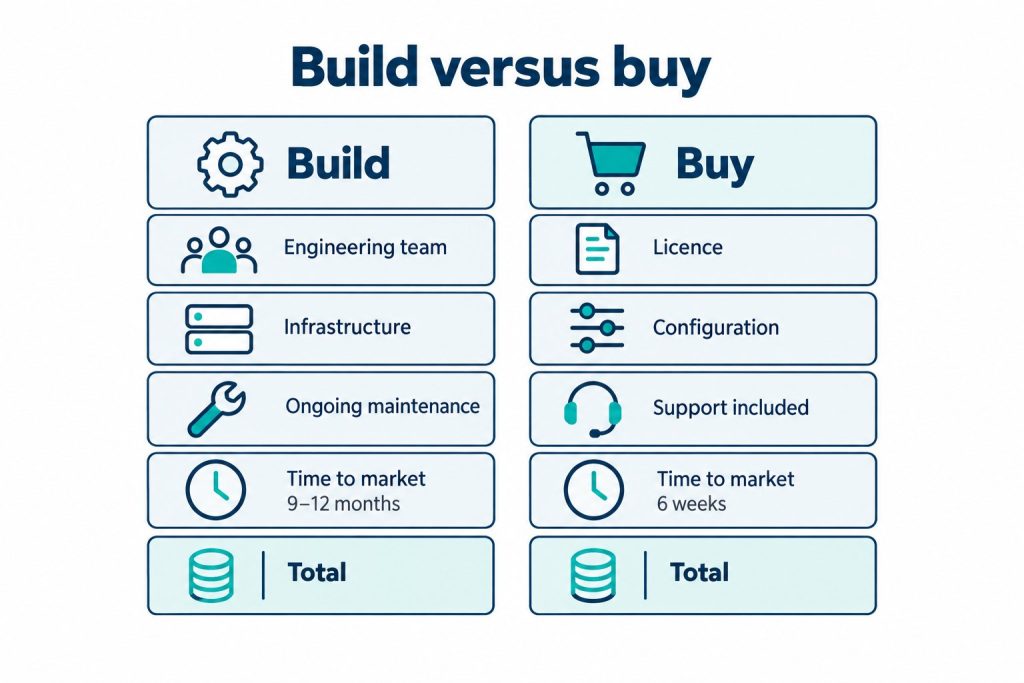
Building in-house means paying for engineering time, data infrastructure, model training, and ongoing maintenance, and each of those is a separate line item, not a bundled fee. Industry guidance on the build vs buy AI decision puts one-time implementation costs in the range of $50,000 to $150,000, with ongoing software costs running $20,000 to $100,000 per year depending on usage for organizations buying a commercial solution, while custom in-house builds tend to run considerably higher once salaries, infrastructure, and hidden costs like scope creep and technical debt are factored in [unframe.ai]. That range is wide because it depends heavily on how much of your data pipeline, feature store, and model retraining process already exists versus needs to be built from scratch.
There’s a newer wrinkle specific to 2026: AI-assisted development tools have compressed build timelines and costs by roughly 2 to 3 times compared to a few years ago [dinamicka.com]. That sounds like it tilts the math toward “build,” and for some teams it does. But a separate, less publicized trend cuts the other way. AI agents and merchandising models aren’t static software you build once and maintain – they require continuous retraining as catalog, seasonality, and customer behavior shift, which means the “build” decision isn’t a single project, it’s a recurring one [lorikeetcx.ai]. One analysis frames this bluntly: with AI agents, it’s not build vs buy, it’s buy vs build-build-build-build-build, because the model needs re-tuning every time the underlying data distribution moves [lorikeetcx.ai]. That’s a meaningfully different cost curve than traditional software, where you build once and patch occasionally.
What Does It Cost to Buy a Merchandising AI Platform?
Buying means paying a vendor for a product that’s already built, with pricing typically tied to your order volume or catalog size rather than a fixed engineering estimate. Leading third-party AI merchandising platforms generally use custom, quote-based enterprise pricing, so there’s no public number to anchor against [Verified External Facts]. Mid-market alternatives are more transparent, with pricing starting at roughly $99 to $449 per month and scaling with order volume [Verified External Facts]. The tradeoff is that “buy” pricing scales with your business size, which is predictable, but it also means you’re paying indefinitely for a capability you never own outright, and customization is usually bounded by what the vendor’s roadmap supports.
How Should Teams Actually Compare Build vs Buy AI Costs?
The comparison only works if you price both options over the same time horizon and include the costs that don’t show up in a vendor quote or an engineering estimate. A useful analogy: comparing build vs buy on sticker price alone is like comparing two apartments by rent alone and ignoring that one requires you to own and maintain the boiler, the roof, and the plumbing yourself. The “build” apartment might be cheaper per month, but only if you never account for the boiler breaking.
Concretely, run the comparison across these categories:
- Time to first revenue impact: a scoped pilot that goes live in weeks starts generating the 2 to 5 percent category lift sooner than a 6-month internal build, and that compounding gap is often larger than the cost difference itself.
- Ongoing retraining and maintenance: budget for continuous model updates, not a one-time build, since merchandising AI degrades as catalog and customer behavior shift.
- Compliance overhead: bias auditing, data residency controls, explainability requirements, and third-party audits add real cost regardless of build or buy, with frameworks like the EU AI Act adding roughly 17 percent overhead to high-risk AI projects [Verified External Facts].
- Integration cost: whether the engine plugs into your existing CRM, POS, and CMS, or requires you to rebuild those connections.
- Data control: whether your transaction and customer data trains a shared model used by other customers, or stays inside your own environment.
A useful framework from enterprise AI guidance is to treat this less as a binary and more as a hybrid decision: buy the commodity layer, build only where your data or workflow is genuinely differentiated [scale.com]. Another practical filter is to ask, feature by feature, whether it should be built, bought, or skipped entirely, since a large share of proposed AI merchandising features never justify their engineering cost once measured against actual revenue impact [drlongnecker.com].
Why Is “Buy” Getting More Complicated in 2026?
Buy used to mean a clean SaaS subscription with a fixed feature set, but that’s shifting. Recent industry survey data shows that a large share of teams have already replaced at least one SaaS tool with a custom build and expect to build more of their own tools going forward, while confidence in AI-generated code remains cautious, with most builders testing thoroughly before deploying anything rather than shipping AI output unmodified [retool.com]. That tells you something important: even teams that “buy” are increasingly customizing, extending, or wrapping vendor tools with their own logic, which blurs the cost line between the two categories. This is part of why the build vs buy AI question in 2026 is less about picking a side and more about picking the right partition, deciding which layers of your merchandising stack you own versus rent [tblocks.com] [montecarlo.ai].
Where Does a Partner-Build Model Fit?
A middle path exists between hiring an internal team and buying a rigid SaaS product: working with a partner who builds the merchandising engine with you, inside your own infrastructure, and hands over an operating system rather than a locked black box. Fooyo Commerce® bundles AI merchandising with product listings, storefront setup, and payments. Every deployment runs in the client’s own private cloud, so transaction and customer data never trains a shared public model, which matters directly for the data residency requirements referenced above [Verified External Facts]. Fooyo also integrates into existing CRM, POS, and CMS systems rather than requiring a rip-and-replace migration, which avoids one of the larger hidden costs in both build and buy scenarios: re-platforming your entire commerce stack just to add a merchandising layer.
Other Singapore-based providers occupy adjacent but different spaces, focusing on capabilities that don’t directly compete with a merchandising engine. Some specialize in agentic AI for document workflows, deployable air-gapped on-premise or in private cloud, with strength in regulated, vertical-specific tasks rather than general commerce merchandising. Others build AI-enabled field service management software on a subscription SaaS model, aimed at job scheduling and technician tracking, a different use case entirely from storefront merchandising. This underscores that the right comparison set for retail teams isn’t “AI vendors” broadly, but vendors and partners who’ve actually shipped commerce-specific AI.
| Approach | Cost pattern | Speed to production | Data control |
|---|---|---|---|
| Build in-house | Custom AI development costs vary widely by scope and complexity, and typically include ongoing costs for infrastructure, maintenance, and continuous retraining that exceed initial estimates [unframe.ai], plus continuous retraining cost [lorikeetcx.ai] | Typically months; recurring rebuild cycles | Full control, but requires internal infrastructure |
| Buy (mid-market SaaS) | From $99-$449/month scaling with volume [Verified External Facts] | Fast setup, bounded by vendor roadmap | Data typically resides on vendor’s shared infrastructure |
| Buy (enterprise SaaS) | Custom, quote-based pricing [Verified External Facts] | Varies by vendor implementation scope | Varies by vendor contract terms |
| Partner-build (e.g. Fooyo Commerce®) | Scoped pilot pricing, private-cloud deployment | Weeks to production | Runs in client’s own private cloud |
Frequently Asked Questions
Is it cheaper to build or buy AI merchandising in 2026?
It depends on time horizon. Buying is usually cheaper in year one; building can be cheaper over several years only if you account for the recurring retraining costs that AI models require, not just the initial build [unframe.ai] [lorikeetcx.ai].
How long does it take to see ROI from AI merchandising?
Mid-market retailers typically see a 2 to 5 percent category revenue lift within 6 to 12 months of implementation, alongside margin gains of 50 to 150 basis points [Verified External Facts].
Does compliance add significant cost to AI merchandising projects?
Yes. Bias auditing, data residency, and explainability requirements can add roughly 17 percent overhead to high-risk AI projects under frameworks like the EU AI Act [Verified External Facts], and this applies whether the system is built or bought.
Why do AI merchandising engines need continuous investment, unlike normal software?
Because the underlying model degrades as customer behavior and catalog data shift over time, requiring retraining cycles that traditional software doesn’t need [lorikeetcx.ai].
What’s the risk of buying a generic enterprise AI platform for retail merchandising?
Enterprise platforms with custom quote-based pricing may not disclose costs upfront, making budget planning harder compared to fixed-tier mid-market tools [Verified External Facts].
Can a partner-build model avoid the “build once, retrain forever” cost problem?
A partner that operates the system with you, rather than just delivering it, can absorb the ongoing retraining and maintenance burden as part of the engagement, rather than leaving it entirely on your internal team.
About Fooyo
Fooyo is a Singapore-headquartered company that builds data platforms and AI products deployed directly into clients’ private cloud environments, with development out of Chengdu and business partnerships based in Tokyo. Its product line includes Fooyo Commerce® for AI-powered storefronts and merchandising, an AI Knowledge Base for grounded, source-cited answers across enterprise data, Kakis for AI-generated marketing video, and Smart Tourism for destination engagement. Fooyo is trusted by government agencies, enterprises, and SMEs across Asia, and its model centers on building and operating production AI with clients rather than handing over a report or a prototype and walking away. Every deployment integrates with existing CRM, POS, and CMS systems, so teams evaluating build vs buy AI don’t have to choose between full control and fast delivery.
If you’re weighing the cost and timeline of an AI merchandising build against buying an off-the-shelf platform, it’s worth seeing what a partner-built, private-cloud option looks like in practice. Get in touch with Fooyo at https://fooyo.sg/ to scope a pilot.
References
- Build vs Buy: Retail AI and Personalization Engines (tblocks.com)
- Build vs. Buy AI: How to Choose the Right Approach | Unframe AI (unframe.ai)
- Enterprise Guide: Build vs. Buy AI Tools | Scale AI (scale.com)
- The Build Vs. Buy Guide For The Modern Data Stack (montecarlo.ai)
- With AI agents, it’s not buy vs build. It’s buy vs build, build, build, build, build | Lorikeet (lorikeetcx.ai)
- Build vs. Buy Software in 2026: What Actually Changed (dinamicka.com)
- The Build vs. Buy Shift: AI, Shadow IT, and the SaaS Replacement Era | Retool Blog (retool.com)
- When to Build, Buy, or Skip AI Entirely (drlongnecker.com)